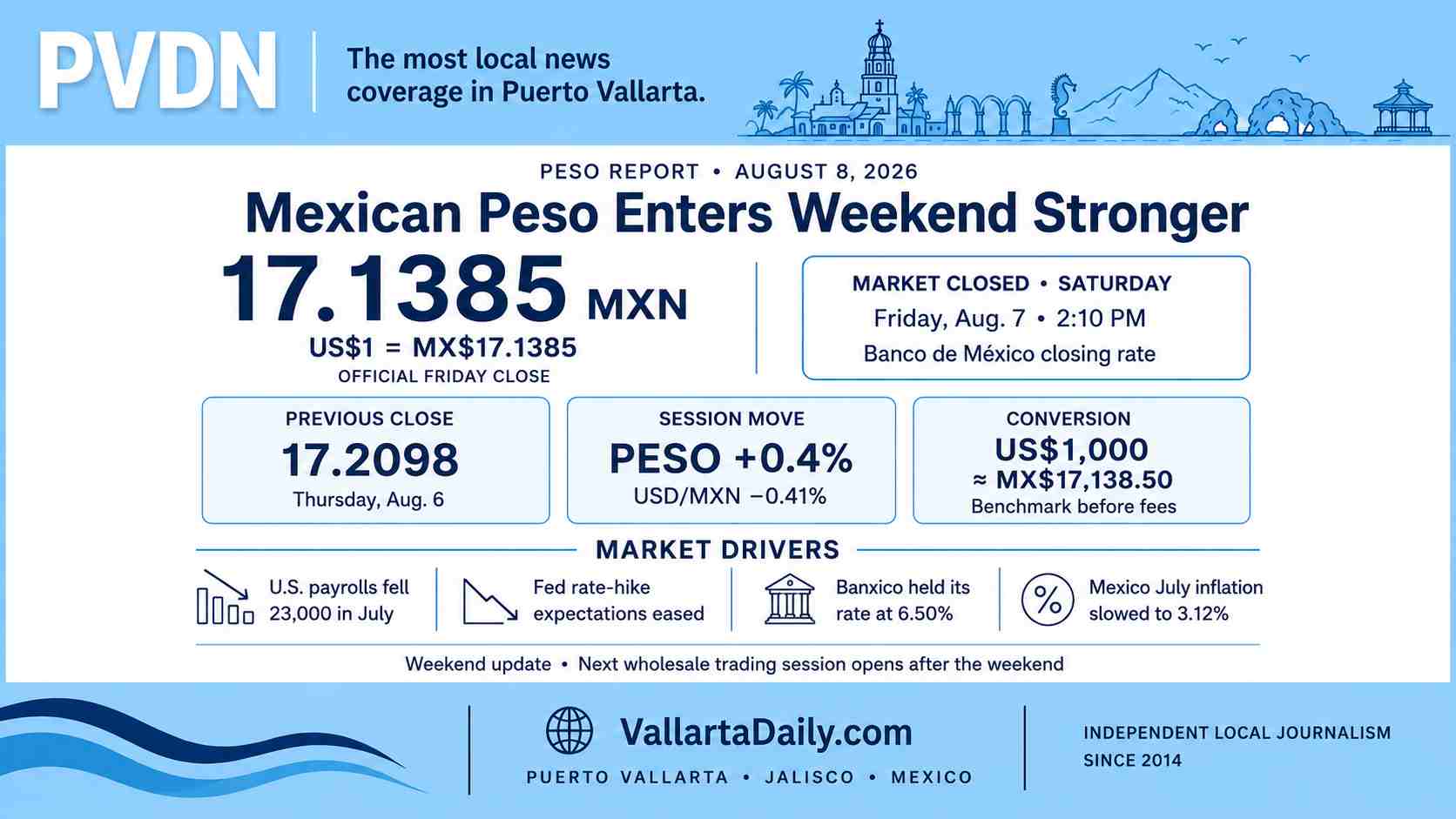
Puerto Vallarta, Jalisco, August 8, 2026 – The Mexican peso enters the weekend at about 17.14 pesos per U.S. dollar, following a Friday session in which the peso gained ground against the dollar.
As of 6:31 a.m. Saturday, normal wholesale foreign-exchange trading is closed. The latest official reference is Banco de México’s Friday closing rate of 17.1385 pesos per dollar, published at 2:10 p.m. Mexico City time on August 7.
That compares with 17.2098 on Thursday, a decline of about 0.41% in USD/MXN. Because the rate measures how many pesos are needed to buy one dollar, the move represents a roughly 0.4% gain for the peso. Banco de México’s separate FIX rate for Friday was 17.1387.
Peso finishes a stronger week
Friday saw a continuation of the broader move in the peso. Banco de México’s closing reference stood at 17.3207 on July 31, putting USD/MXN about 1.05% lower over the five trading sessions through August 7.
The peso’s Friday advance came amid a broader retreat in the U.S. dollar after employment data raised fresh questions about whether the Federal Reserve will raise interest rates at its September meeting.
The U.S. employment report released Friday showed nonfarm payrolls declining by 23,000 jobs in July. May and June employment figures were also revised down by a combined 103,000 jobs. The unemployment rate was 4.1%.
Following the report, market expectations for a September Fed rate increase fell to about 40%, from roughly 55% before the employment data. The dollar index was down about 0.3% at 99.61 during Friday trading, while U.S. Treasury yields also declined.
That broad dollar weakness provided a favorable backdrop for the peso. It does not, by itself, explain the entire USD/MXN move.
Banxico holds rates while Mexican inflation slows
Mexico also supplied important economic signals this week.
On Thursday, Banco de México unanimously kept its benchmark interest rate at 6.50%, extending the pause in rate changes that began in June.
The central bank said it expects headline and core inflation to continue declining, although more gradually than previously anticipated. It now expects headline inflation to reach its 3% target in the fourth quarter of 2027.
Friday brought evidence of further disinflation. INEGI reported that annual inflation slowed to 3.12% in July, from 3.37% in June. Core inflation was higher at 3.95%.
Those figures create competing considerations for the currency. Lower inflation can eventually give Banxico more room to reduce rates, while its decision to remain at 6.50% preserves a substantial interest-rate difference with the United States.
The Federal Reserve currently has its target range at 3.50% to 3.75%. Friday’s weaker U.S. employment report reduced expectations that the Fed will narrow that gap with a September increase.
Oil and global markets add another layer
International risk appetite was relatively firm Friday, with global stocks benefiting from reduced expectations for an imminent Fed rate increase.
Oil remained a source of uncertainty. Brent crude traded around $82 a barrel Friday as markets continued to follow developments involving Iran and the Strait of Hormuz. Energy prices can affect both inflation expectations and broader sentiment toward emerging markets, although oil did not provide a clear standalone explanation for Friday’s peso move.
What 17.14 means for Puerto Vallarta budgets
For Puerto Vallarta residents receiving income in U.S. dollars, the peso’s recent strength slightly reduces the number of pesos those dollars buy.
At the Banco de México closing reference, US$1,000 converts to about 17,138.50 pesos, compared with 17,209.80 pesos at Thursday’s reference rate, a difference of roughly 71 pesos.
The reverse applies to people earning or holding pesos who need to make dollar-denominated payments: fewer pesos are required to buy the same amount of dollars than at Thursday’s rate.
These are wholesale reference calculations. Banks, ATMs, credit cards, and Puerto Vallarta currency exchange counters use their own buy and sell rates and may add spreads or fees.
Monday opens with U.S. inflation in view
Because Saturday is not a normal FX trading day, there will be no new Banco de México closing rate today. The peso can reopen away from Friday’s level if financial or geopolitical developments over the weekend change market sentiment.
The next major scheduled U.S. data point is the July Consumer Price Index on Wednesday, August 12. With Friday’s employment report reducing expectations for a September Fed rate hike, the inflation reading will give markets another significant piece of evidence to reassess U.S. interest-rate expectations and the dollar.