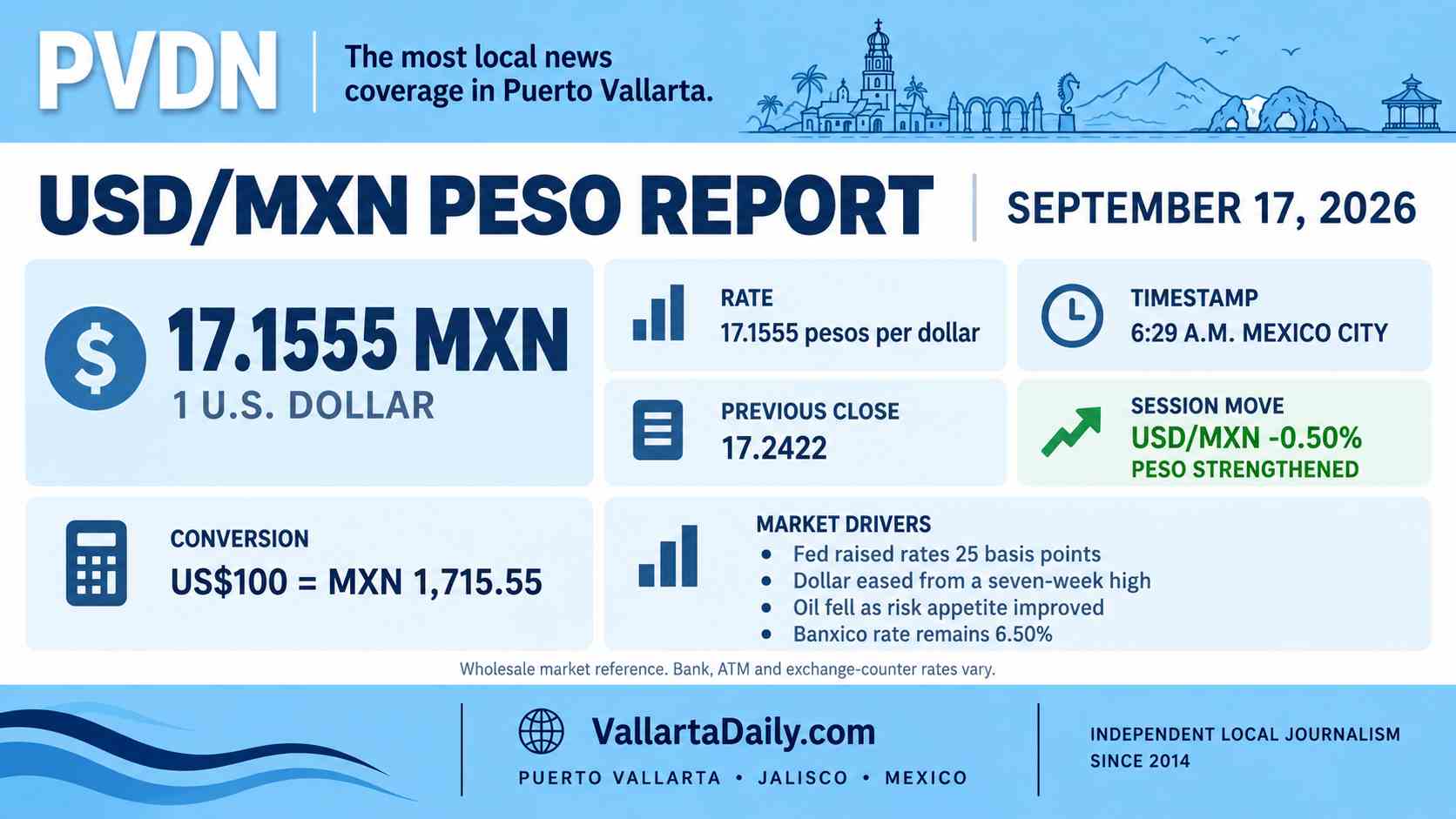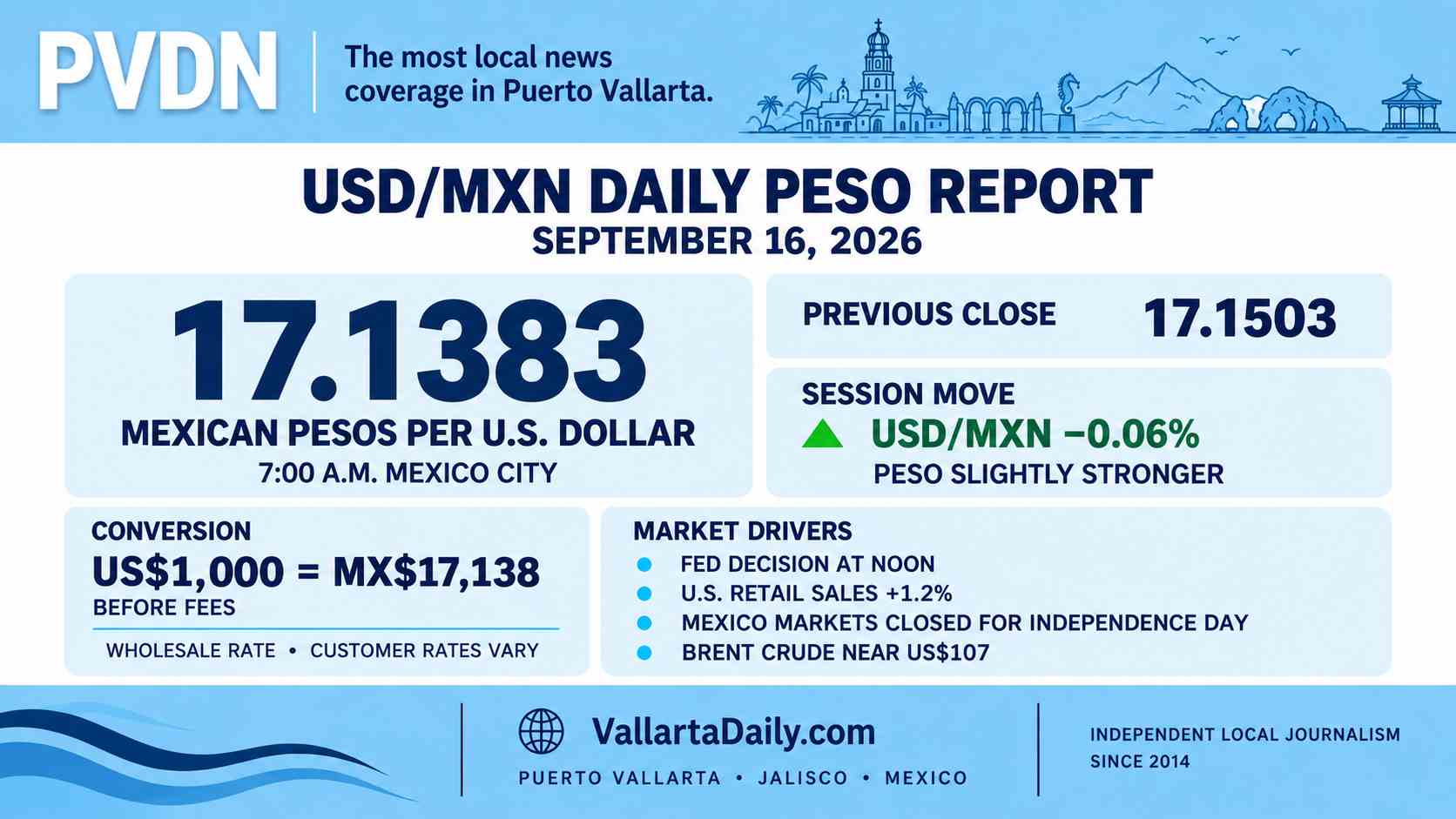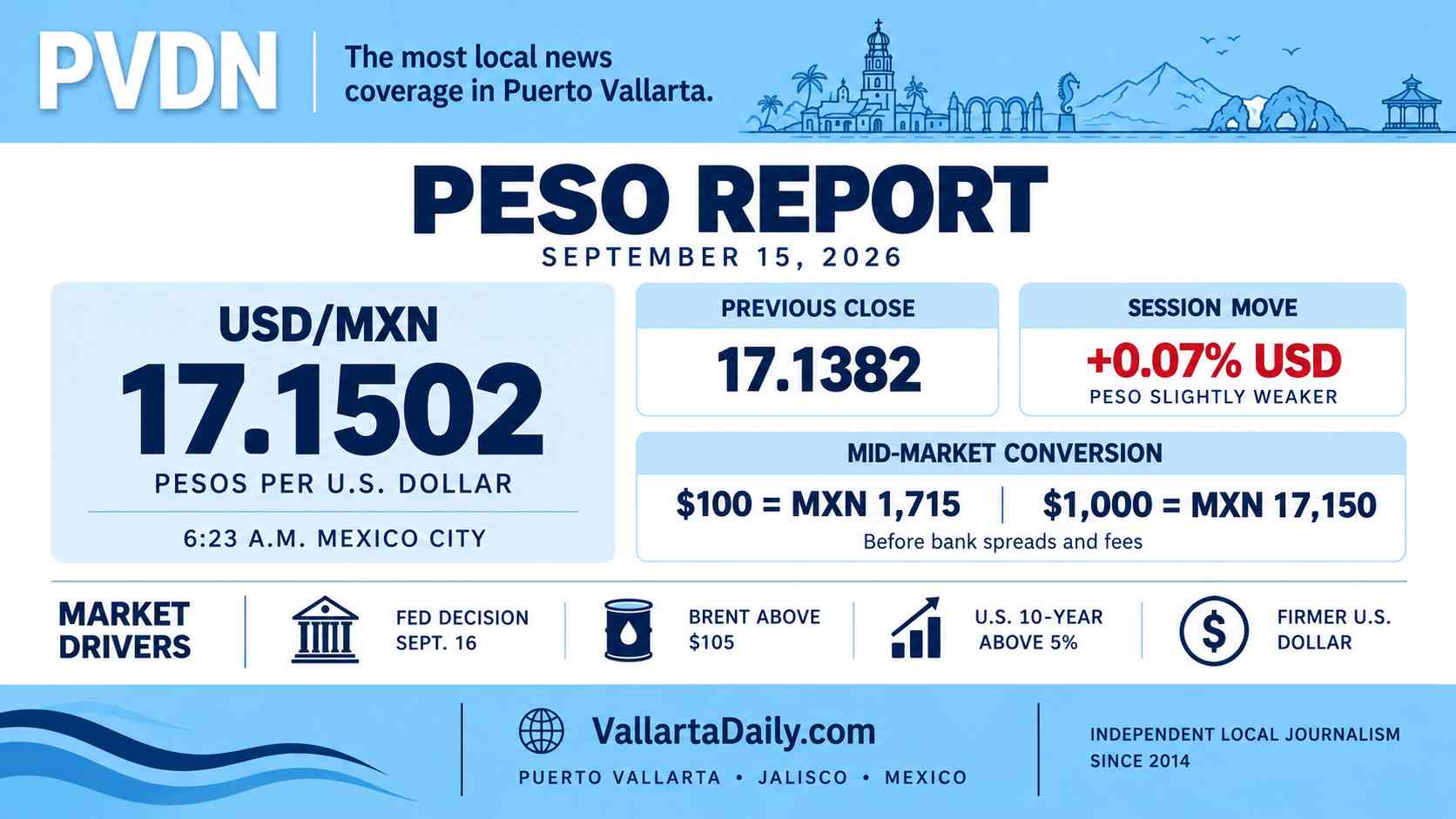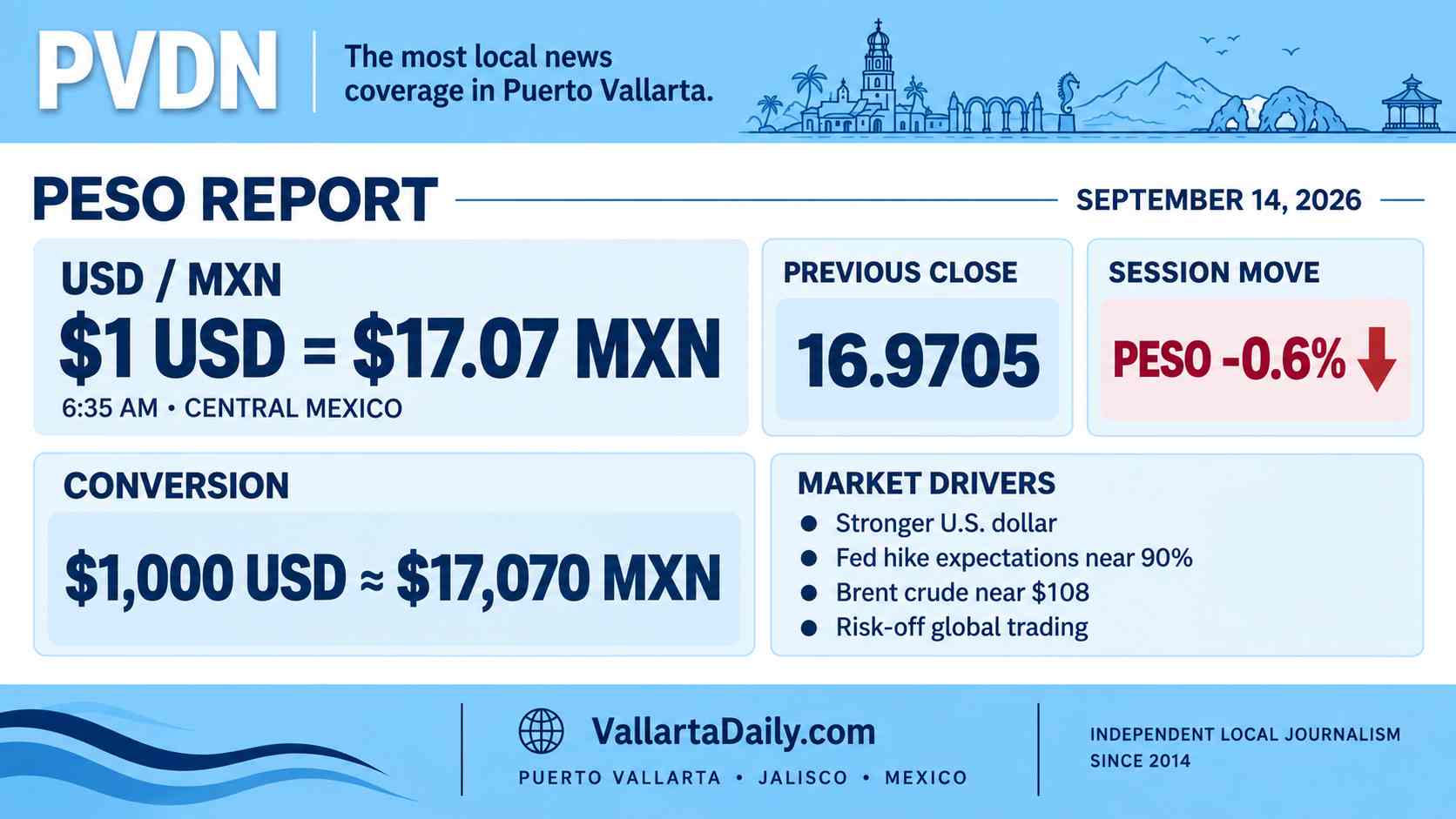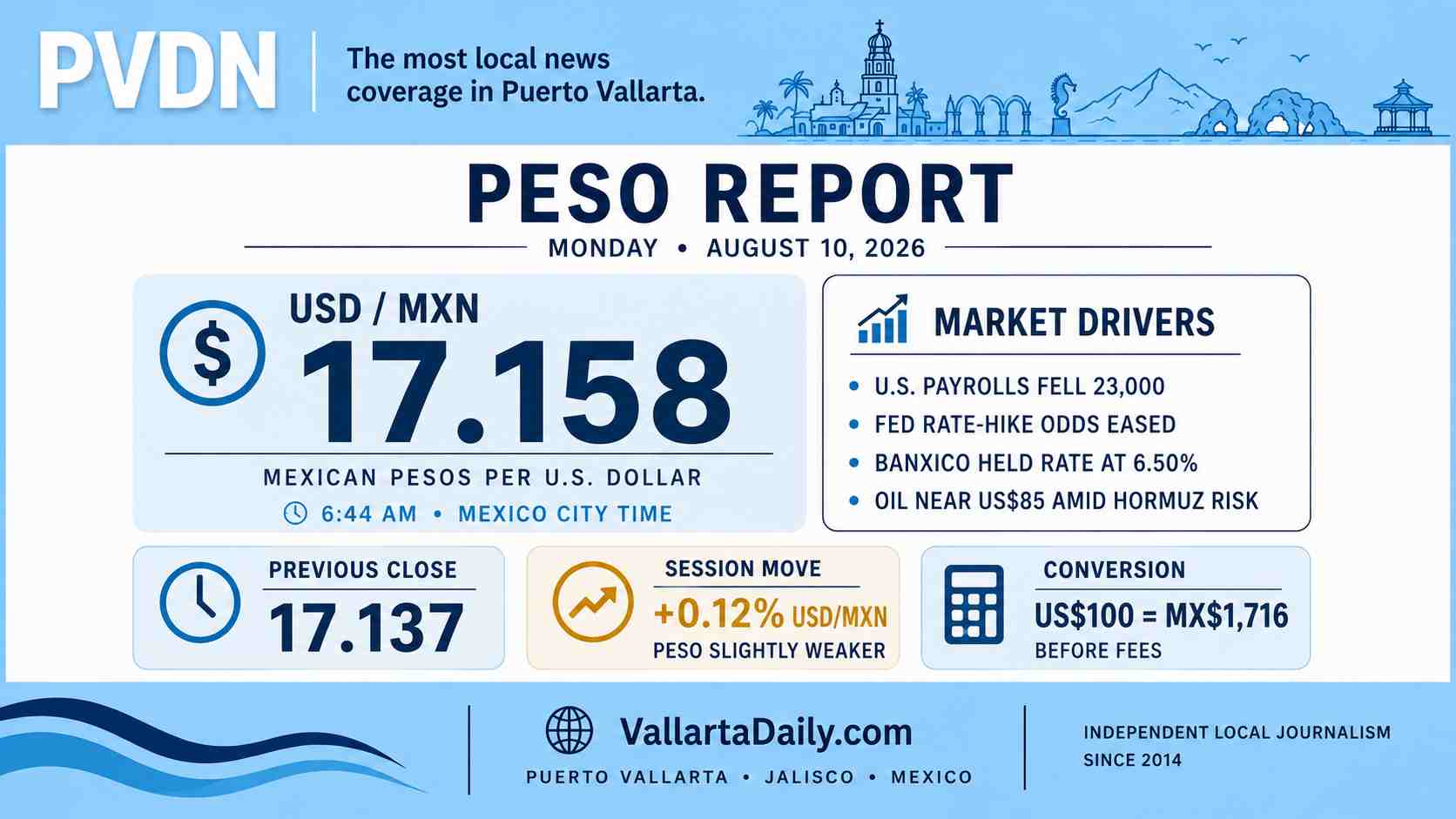
Puerto Vallarta, Jalisco, August 10, 2026 – The Mexican peso traded near 17.16 per U.S. dollar early Monday, giving back a small part of Friday’s gain. At 6:44 a.m. Mexico City time, a live USD/MXN quote stood at approximately 17.158 pesos, up about 0.12% from the previous session’s reference near 17.14.
A higher USD/MXN rate means the dollar is strengthening and the peso is weakening. Monday’s change was modest and followed a stronger Friday session for the Mexican currency.
The Bank of Mexico’s official FIX rate was 17.1387 on Friday, August 7, compared with 17.2195 on Thursday. That represented a peso gain of about 0.47%. Banxico will publish Monday’s FIX after noon.
These are wholesale-market references. Banks, exchange houses, cards and ATMs apply their own rates, spreads and fees.
U.S. jobs report shifts Fed expectations
The dollar entered Monday close to a two-month low after the United States reported an unexpected decline in employment.
U.S. nonfarm payrolls fell by 23,000 in July, while employment estimates for May and June were revised lower. The unemployment rate slipped to 4.1%, partly because fewer people participated in the labor force.
The report reduced expectations that the Federal Reserve will raise interest rates in September. Futures pricing early Monday placed the probability of an increase at about 48%, down from 67% one week earlier. That reflects market positioning, not a signal from the Fed.
The dollar index was near 99.70 after touching its lowest level since June 15 on Friday. A weaker dollar can support the peso, although Monday’s slight USD/MXN increase showed that the relationship was not moving in a straight line.
Banxico holds its rate as inflation slows
Mexico’s domestic backdrop remained relatively supportive of the peso after Banxico voted unanimously on Thursday to hold its benchmark interest rate at 6.50%.
The central bank said it expects to maintain the rate at its current level for now. Mexico’s comparatively high interest rate can support demand for peso-denominated assets, although that support depends on inflation, economic growth and global risk conditions.
Annual inflation slowed to 3.12% in July, down from 3.37% in June. Core inflation, which excludes some volatile prices, remained higher at 3.95%.
Banxico said inflation is declining more gradually than previously expected and delayed its projected return to the 3% target until the fourth quarter of 2027. The bank identified persistent core inflation, trade disruptions, geopolitical conflicts, and possible peso depreciation as risks to its forecast.
Oil and trade policy remain in the background
Oil prices moved higher Monday as markets followed developments related to efforts to reopen the Strait of Hormuz. Brent crude gained more than 1.5% to approximately $85 a barrel.
Mexico is an oil producer, but geopolitical tension can also weaken risk appetite and pressure emerging-market currencies. Those competing effects make oil an important backdrop without establishing it as the direct cause of Monday’s peso movement.
North American trade policy remains another source of uncertainty. Mexico’s economy minister said in July that the latest U.S. tariff schedule would not materially change Mexico’s effective treatment because goods that comply with the USMCA remain exempt. That is the Mexican government’s assessment; the practical effect depends on product eligibility and enforcement.
Planning around the morning rate
At the morning market rate, $100 was equivalent to approximately 1,716 pesos before fees. A $1,000 conversion would produce about 17,158 pesos, while a 1,000-peso expense would equal roughly $58.28.
Monday’s early change amounted to only about two additional pesos for every $100 converted compared with the previous session’s reference. Retail customers may see a much larger difference between providers than the movement recorded in the wholesale market.
People earning dollars but paying expenses in pesos receive more pesos when the USD/MXN exchange rate rises. Those earning pesos and paying dollar-denominated bills face the opposite effect.
The calendar turns to U.S. inflation
Mexico’s next scheduled industrial production report is due Tuesday, August 11. The June figures will provide another measure of whether the economic rebound reported during the second quarter continued.
Markets will then turn to U.S. consumer inflation on Wednesday. Producer prices follow Thursday, with retail sales scheduled for Friday. Those reports could change expectations for the Federal Reserve and lead to broader movement in USD/MXN as the week progresses.