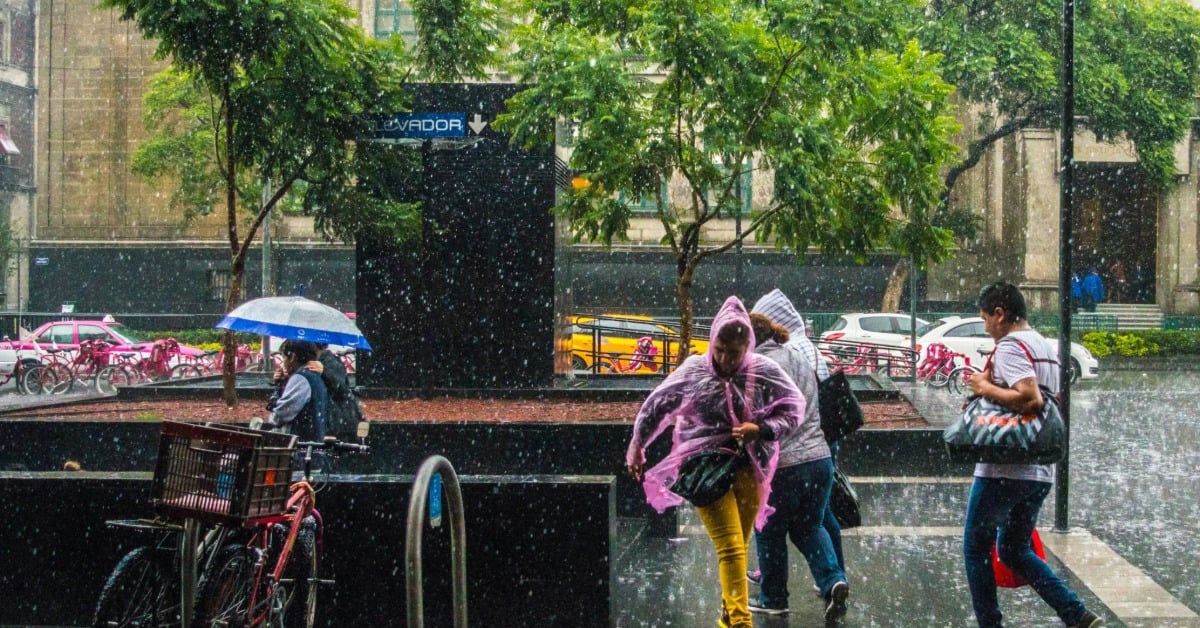
Mexico City — A burst of intense summer rainfall swept across Mexico City Tuesday afternoon, flooding streets, toppling trees, and snarling traffic in several parts of the capital. City authorities activated a Yellow Alert for heavy rain and high winds in at least six central boroughs as the storm rolled through, urging residents to take precautions and mobilizing emergency crews to address waterlogged roads.
The Secretariat of Integral Risk Management and Civil Protection issued the Yellow Alert around 6:30 p.m. on July 29 for the boroughs of Álvaro Obregón, Benito Juárez, Cuauhtémoc, Iztacalco, Magdalena Contreras, and Venustiano Carranza. These areas were expected to see “fuertes lluvias” (15–29 mm of rain), wind gusts up to 45–50 km/h, and possible hail between 6:30 p.m. and 9:00 p.m.. Sure enough, shortly after, rain began bucketing down in pockets of the city, accompanied by flashes of lightning and rumbles of thunder.
Within minutes, reports of “encharcamientos” (ponding/flooding) came in. One of the first trouble spots was Congreso de la Unión Avenue in Venustiano Carranza borough, where photos showed cars plowing through ankle-deep water as drains were overwhelmed. Civil Protection confirmed that at least one lane of the avenue had to be closed due to flooding near a busy intersection. Commuters in parts of downtown and central neighborhoods like Roma and Condesa found themselves wading through large puddles on sidewalks.
The Mexico City Metro even briefly halted service on parts of Line 2 and Line 9 as a precaution, due to water buildup near station entrances, though service resumed quickly once pumps cleared the water. Several trolleybus and bus routes were delayed or detoured because certain underpasses and low-lying stretches became impassable.
The storm was relatively fast-moving – dumping a lot of rain in a short time. By 8 p.m., rainfall stations recorded between 10 and 25 mm of accumulation in the alerted boroughs, confirming the Yellow Alert criteria. The high winds (up to 45 km/h) also led to at least 15 reports of fallen tree branches across the city, according to the Heroic Fire Department (HCB). One particularly large tree came down in the Narvarte area (Benito Juárez borough), damaging a parked car. Fortunately, no injuries were reported from these incidents.
In response, city authorities activated the Operativo Escorpión (also known as Operativo Tláloc or Tlaloque) – a standing emergency operation for heavy rains. Over 70 crew members from the SACMEX water system, Civil Protection, SSC (Citizen Security), and firefighters were deployed with 35 hydrovacuum trucks, pumps, and vehicles to strategic flood-prone sites. This operation is intended to rapidly address flooding: crews clear storm drains of trash and debris (a major cause of flooding is trash clogging drains), pump out water from inundated areas, and help stranded motorists.
By 9:30 p.m., the Yellow Alert was lifted as rainfall intensity decreased. However, some residual flooding persisted. Civil Protection reported that the Luis Delgado Canal in far south Tláhuac borough overflowed earlier (on Monday) and had affected 16 homes with water ingress, but by Tuesday night those waters had subsided and the city’s Tláloc operation had cleared the remaining floodwaters. In the city’s core, the worst that remained were some big puddles along medians and slow-moving traffic as the water slowly receded.
The complicated weather was not unexpected – meteorologists had forecast evening thunderstorms as is typical in the Valley of Mexico’s rainy season (which runs roughly from May to September). Still, the abrupt downpour caught some chilangos (city residents) off guard. Many ducked into cafes or store awnings to wait out the heaviest rain. On social media, memes quickly popped up of the famous “Lagoon” at Metro Oceanía, joking about a perennial flood spot.
City authorities delivered constant updates via Twitter and the new “SkyAlert” app, advising people which roads to avoid. They recommended drivers use alternate routes to bypass flooded stretches – for instance, Circuito Interior had heavy pooling near the airport, so drivers were guided to use Viaducto instead until pumps cleared Circuito.
By late evening, Mayor Martí Batres commented on the city’s response: “The rain was intense but relatively brief. Our drainage system handled it in most areas, and our emergency teams responded quickly where there were issues. We had about 16 encharcamientos atendidos (flood incidents addressed),” he noted in a brief statement. He also urged citizens to do their part by keeping storm drains free of garbage, pointing out that 50% of flooding problems are due to litter blocking drainage. The city’s public service crews had cleared tons of trash from drains just ahead of the rainy season, but littering remains a challenge.
One positive development was the improved functioning of the Operativo Tláloc. After Monday’s heavy rains, where parts of Tláhuac saw house flooding, crews refined their strategy, and Tuesday’s response in central boroughs was quicker. For example, an infamous flood spot near Metro Normal did not flood this time, presumably thanks to pre-storm clearing and a new pump installed there.
As the night progressed, traffic returned to normal on main avenues like Reforma and Insurgentes. Some minor cleanup continued – e.g., sweeping away leaves and debris that had washed onto roadways. The city’s 911 line handled dozens of weather-related calls, but no grave emergencies.
Looking ahead, the Meteorological Service warned that more afternoon rains are likely in coming days – a typical pattern of hot, sunny mornings giving way to convective storms in late day. The Yellow Alert system (which is coded by color: Green for none, Yellow for moderate, Orange/Red for severe) will be utilized as needed. Authorities advise residents to follow a few key tips during these alerts:
- Carry an umbrella or raincoat when an alert is in effect.
- Avoid driving or walking through flooded areas, as the water may be deeper than it looks or conceal open manholes.
- Do not attempt to cross flowing rainwater, especially in ravines or street torrents.
- Secure objects that wind could blow away, and stay away from trees, billboards, or cables that could fall in wind gusts.
- Keep gutters and drains around your home clear of leaves and garbage to help water flow.
Thanks to such precautions and a robust city response, no injuries or major damage were reported from Tuesday’s storm. For a sprawling metropolis known to flood, that counts as a success. As one meme circulating said, “We survived the 29J rain!” – a tongue-in-cheek nod to the habit of naming memorable city storms. This one likely won’t go down as legendary, but it served as a useful drill for the peak of rainy season.