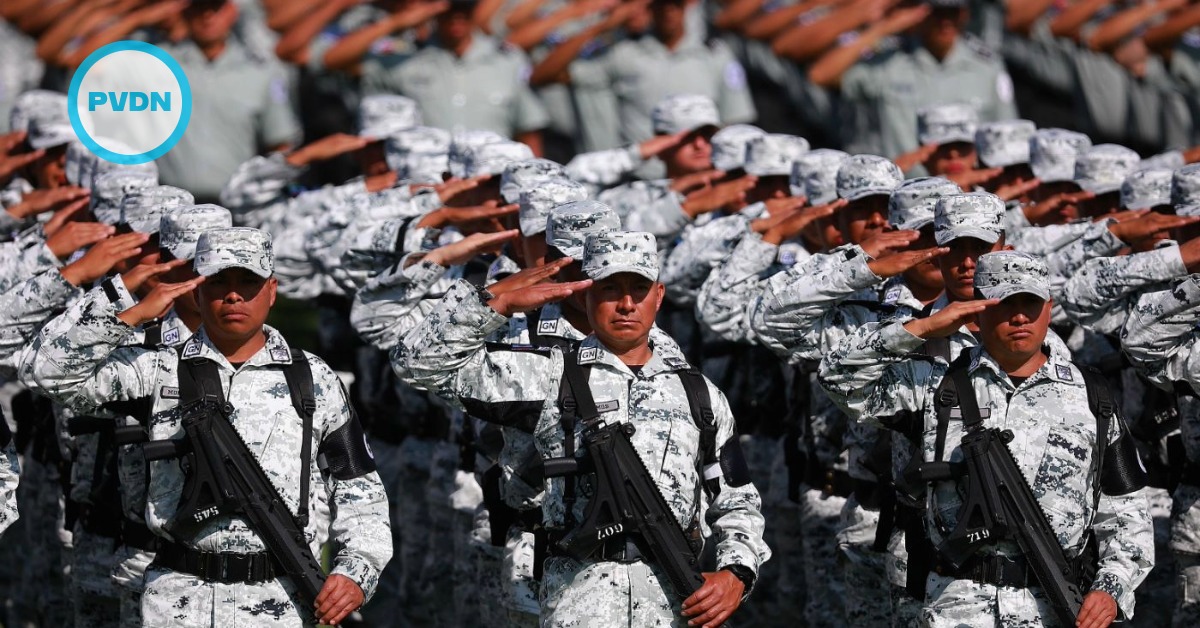
Mexico has drawn a firm line in the sand on security cooperation with the United States. President Claudia Sheinbaum is openly pushing back against suggestions of U.S. agents operating on Mexican soil or joint anti-cartel missions. Her pointed remarks come as news reports hint at American pressure for deeper involvement in Mexico’s fight against drug trafficking. The move raises questions about how far Mexico’s stance on sovereignty will shape its approach to combating cartels and what it means for the future of cross-border security efforts.
Mexico is making it clear that its fight against drug cartels will remain strictly under national command. President Claudia Sheinbaum stated unequivocally this week that no new permits will be issued for United States agents operating in Mexico, and that there are no joint security operations taking place on Mexican soil. She stressed that if U.S. agencies are involved at all, it is only through intelligence-sharing rather than boots-on-the-ground action. “There are no joint operations… if anything, information is shared by a U.S. agency,” Sheinbaum said at her morning press conference in Mexico City, underscoring that any foreign personnel in the country are limited to previously authorized roles. According to the president, the only U.S. agents in Mexico are those whose postings have been renewed or whose predecessors have been replaced – “no additional permits” have been granted beyond that.
This forthright stance from Mexico’s new leadership comes on the heels of reports that Washington has been pushing for a more direct role in Mexico’s anti-drug efforts. Recent U.S. media stories suggested that the administration of President Donald Trump has urged joint operations to dismantle fentanyl labs in Mexico – even proposing that American Special Forces or federal agents accompany Mexican troops on raids. Those reports, attributed to unnamed U.S. officials, also claimed that American military advisers have quietly embedded themselves in some Mexican command centers to help target drug cartels. Such claims have stirred controversy in Mexico, where any hint of foreign agents conducting armed actions is politically sensitive and, in fact, against Mexican law. Sheinbaum flatly rejected the idea of U.S. forces operating in her country, framing it as a matter of national sovereignty. When asked about these scenarios, she emphasized that Mexico will not accept U.S. personnel participating in operations on its territory, and that the role of U.S. agencies is limited to sharing information that Mexican authorities can act on.
The backdrop to this sovereign stance is a chapter of growing U.S. pressure and a history of guarded cooperation between the two neighbors. Since taking office late last year, Sheinbaum has faced intensifying calls from Washington to crack down harder on drug cartels – calls that have escalated since Trump returned to the White House in 2025. Trump has openly mused about taking matters into his own hands, at one point suggesting on television that the United States could launch strikes against cartel targets inside Mexico. In early January, a dramatic U.S. military operation abroad – the capture of Venezuela’s former president Nicolás Maduro by American forces – put Mexico on alert that Washington might be willing to act unilaterally in the region. Shortly after, U.S. officials reportedly renewed a request for permission to send U.S. agents or special forces into Mexico to combat fentanyl production.
Sheinbaum has responded by doubling down on Mexico’s red lines. She said she had a “good conversation” with Trump about security cooperation, but made it clear to him that no foreign military intervention or joint raids would be permitted. Mexico’s Foreign Ministry echoed that sentiment, declaring that the country would never allow any violation of its sovereignty in the name of fighting cartels.
Sovereignty Over Security Cooperation
Mexico’s insistence on handling its own security operations is not new; it builds on a long-standing policy aimed at protecting national sovereignty. In fact, Mexico’s Congress passed a law in late 2020 limiting the activities of foreign agents after a flare-up in tensions with the United States. That law, enacted under former president Andrés Manuel López Obrador (known as AMLO), requires all foreign security agents to obtain permission to operate in Mexico and strips them of diplomatic immunity for law enforcement actions. It was a direct response to past incidents, such as the U.S. arrest of a former Mexican defense minister without prior warning, which outraged the Mexican government. Since then, Mexico has tightly controlled the presence of U.S. agencies like the Drug Enforcement Administration (DEA) and the Federal Bureau of Investigation (FBI) on its soil. By the time Sheinbaum assumed the presidency, the principle was clear: no armed U.S. operatives would patrol or conduct arrests on Mexican territory. Cooperation would continue, but strictly on Mexican terms.
President Sheinbaum portrays her approach as continuity rather than a reversal of her predecessor’s security strategy. She belongs to the same political movement as AMLO and has repeatedly said there is no “rupture” with the previous government’s security policies. The slogan “hugs, not bullets” – AMLO’s emphasis on addressing root causes of crime over head-on armed conflict – officially remains in place. However, Sheinbaum has also taken steps that signal a somewhat more assertive posture against organized crime, albeit within a Mexican-led framework. During her first year in office, Mexican forces have arrested tens of thousands of suspects and even extradited dozens of cartel figures to the United States to face charges. Her administration also agreed to a new bilateral security cooperation program with Washington that emphasizes sharing intelligence and training, but notably does not entail any joint combat missions.
U.S. officials have privately lauded what they call a “bold change” in Mexico’s security efforts – pointing to increased operations against cartels compared to the earlier, more restrained approach. Yet Sheinbaum publicly downplays any notion of a major strategy shift. She insists that Mexico is simply strengthening certain areas (such as intelligence gathering and interagency coordination), while still refusing to let foreign forces take the lead.
Balancing Act in US-Mexico Security Ties
Sheinbaum’s latest declarations underscore a delicate balancing act in Mexico–U.S. relations. On one hand, the two countries need each other to tackle transnational drug trafficking that has devastated communities on both sides of the border. On the other hand, Mexican leaders know that the image of U.S. agents carrying out operations in Mexico would be a political flashpoint at home, reviving historic sensitivities about sovereignty and past interventions. By saying “no more permits” for U.S. agents and publicly dismissing the idea of joint operations, Sheinbaum is sending a clear message to her domestic audience that Mexico won’t be bossed around. It’s a stance likely to play well with a public that broadly supports defending national autonomy.
For American observers – including many expatriates living in Mexico – this position might raise concerns about how effectively the cartels can be fought without closer U.S. involvement. Yet, it does not mean cooperation has halted. In practice, U.S. and Mexican authorities continue to collaborate through information exchange, legal extraditions, and coordinated but independent operations. U.S.-provided intelligence has helped Mexican forces locate high-profile criminals, and Mexico has quietly welcomed American training for its security personnel. The line that Mexico won’t cross is having U.S. agents wield enforcement powers on Mexican territory. As President Sheinbaum navigates mounting U.S. demands and domestic expectations, her challenge will be to show that Mexico can deliver results against organized crime – on its own terms. The coming months will test how this sovereignty-first approach influences the dynamics of the drug war, and whether both nations can find common ground that respects Mexico’s limits while addressing a shared crisis.