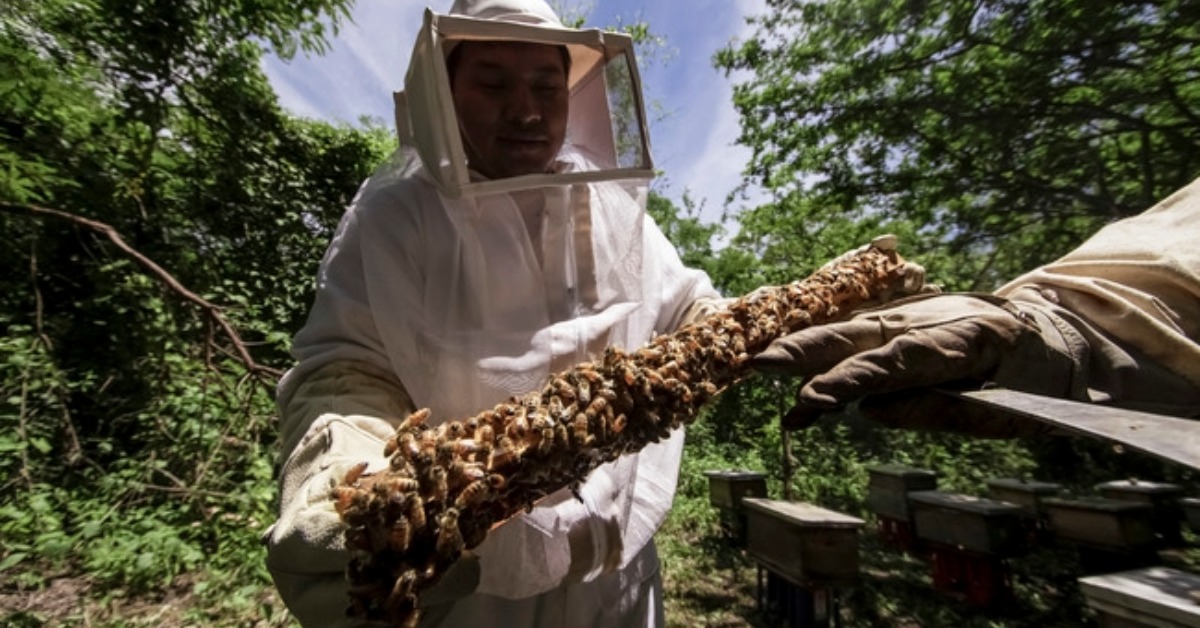
Mexico’s agricultural health authority has launched a national campaign to detect and contain varroasis, a disease that damages bee colonies and can cut into both pollination and honey production.
The campaign was announced by Senasica, the federal agency responsible for oversight of agricultural health and food safety. Its stated focus is practical. Officials want earlier diagnosis, better measurement of infestation levels, timely treatment, and more training for beekeepers. That makes this more than a public awareness effort. It is a field-level response aimed at reducing losses before they spread through more apiaries.
The timing matters because bees support far more than honey. They are part of the biological system that helps crops reproduce. When colony health declines, the damage can spread outward, affecting farm productivity, input costs, and, in some cases, the stability of small rural businesses that depend on apiculture.
Why varroasis is treated as a serious problem
Varroasis is caused by the Varroa mite, a parasite that attaches to adult bees and developing brood. It weakens bees directly and can also help spread viruses through the colony. That is one reason the disease is viewed as one of the most serious threats in modern beekeeping.
A colony under pressure from Varroa may show fewer healthy young bees, visible deformities, weaker orientation, and lower productivity. The damage is not always obvious at first. Infestations can build before the problem becomes visible to a beekeeper, which is why surveillance is so important. By the time symptoms are easy to spot, the colony may already be under heavy strain.
That helps explain the logic behind Senasica’s campaign. Officials are not only warning about the disease. They are stressing diagnosis, monitoring, and training, which are the steps most likely to catch an infestation before it becomes harder and more expensive to control.
This story is also about food and farming
For many readers, bees are closely associated with jars of honey sold in markets and supermarkets. That is part of the picture, but it is not the largest one. The bigger issue is pollination.
Pollinators support a large share of food production. In practical terms, that means bee health is tied to the crops people buy every week. In Mexico, bees help pollinate products such as beans, chiles, tomatoes, squash, plums, mangos, apples, guavas, and coffee. Some of those are staples in household shopping. Others are cash crops with economic weight in regional agriculture.
For foreign residents in Mexico, this is where the story becomes more relevant. A bee health campaign can sound distant until it is connected to crop yields, food availability, and the broader resilience of local agriculture. A weaker pollination system not only affects producers. Over time, it can shape prices, supply chains, and environmental conditions in the places where people live.
Why the honey industry is part of the equation
The federal announcement also ties bee protection to Mexico’s honey sector, which remains economically significant. Officials say coordinated work between Senasica and beekeepers helps sustain access to more than 57,000 tons of honey a year, with the product reaching consumers in Mexico and abroad.
That matters because apiculture is not evenly distributed across the country. In many areas, it is a meaningful rural activity tied to employment, household income, and export earnings. Disease pressure in bee colonies can therefore become both an environmental problem and a local economic problem.
Seen that way, the campaign has two layers. One is immediate and sanitary: detect infestation and reduce colony damage. The other is structural: protect a productive chain that depends on healthy bees, functioning apiaries, and beekeepers who know when and how to respond.
What this campaign may signal next
The announcement does not suggest a one-time intervention. It points instead to a continuing effort that depends on follow-through. The next important sign will be whether the campaign turns into a stronger local implementation, especially in honey-producing regions and areas where beekeepers need technical support.
That could mean more inspection activity, more outreach, more testing, and more emphasis on proper treatment timing. It could also mean a broader push to ensure producers recognize infestations earlier and respond before colonies weaken further.
There is also a policy angle behind the announcement. Mexico already has a formal framework for varroasis control, so this campaign is best read as reinforcement rather than reinvention. In other words, the problem is not new. What appears to be changing is the level of emphasis being placed on active detection and field response.
For readers, that is the main takeaway. This is not only a bee story. It is a reminder that agricultural health, food systems, and environmental stability are often connected in ways that are easy to miss until a parasite, pest, or disease forces the issue into view.