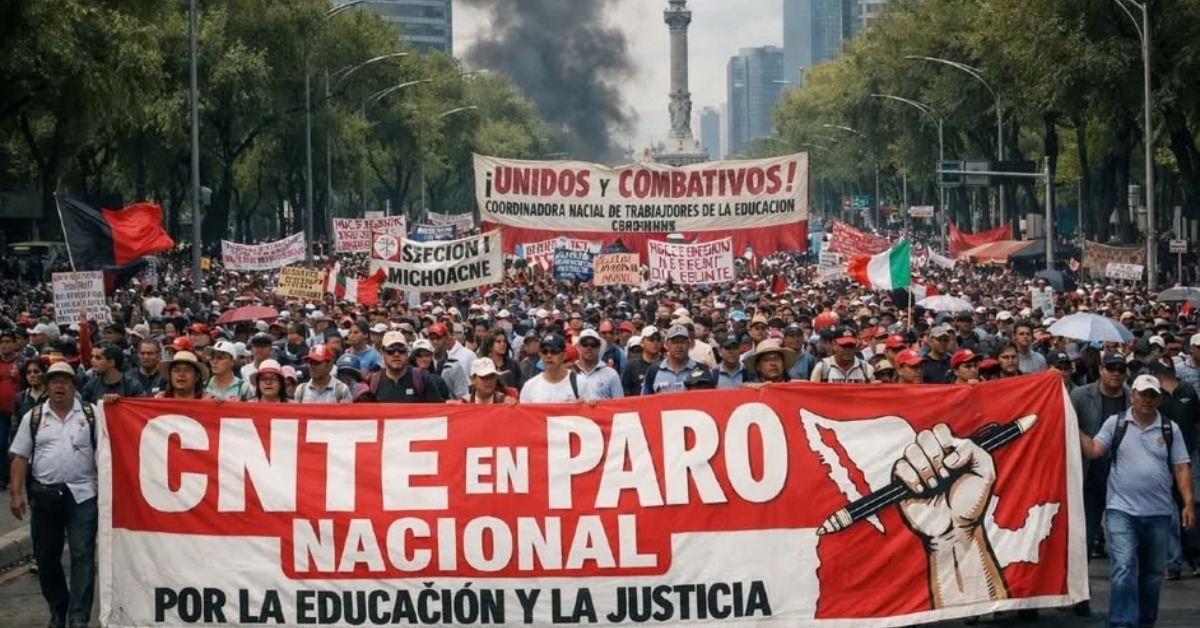
What begins as a teachers’ march can quickly become a wider test of how Mexico handles protest in its political center. The CNTE has returned to Mexico City with a 72-hour strike, a march to the Zócalo, and the threat of broader disruption if talks go nowhere. The traffic alerts are only the surface story. The deeper issue is whether the federal government can contain a long-running pension fight without letting another encampment reshape daily life in the capital.
The capital is the message
The CNTE chose Mexico City for a reason. The movement’s 72-hour strike began on Wednesday with a march from the Ángel de la Independencia toward the Zócalo and a camp expected to remain through Friday. That route passes through some of the capital’s most visible and busiest corridors. It also ends at the symbolic heart of federal power. The point is not only to be seen. It is to make the government feel the protest in the place where national politics is staged.
That matters because the CNTE has always understood the value of geography. A protest in one state can be dismissed as a regional conflict. A protest in the historic center of Mexico City becomes a national story within hours. This time, the union paired the capital action with a wider strike in multiple states. That turns a labor dispute into a test of how much disruption the federal government is willing to absorb before it changes course or raises its offer.
Why the city keeps paying attention
For residents, workers, and visitors, the first impact is practical. The expected trouble spots include Paseo de la Reforma, Avenida Juárez, Eje Central, and the streets around the Centro Histórico. Even a protest planned for only a few days can slow commuting, deliveries, business activity, and access to the downtown core. When the Zócalo becomes a protest camp, the effects spread beyond the route itself. The center of the city starts operating under a different rhythm.
That is why this story reaches beyond education policy. In Mexico City, major protests are never only about the group in the streets. They also become a measure of state capacity. Can officials keep the city moving? Can they protect the right to protest without allowing the capital to seize up? Can they avoid the kind of confrontation that could create a broader political crisis? Those questions sit behind every large mobilization near Palacio Nacional, and they are back again with this strike.
The dispute behind the disruption
The immediate demands are broad, but the central grievance is old. The union wants the repeal of the ISSSTE 2007 law, an end to the pension model tied to individual accounts, the elimination of USICAMM, a 100% increase in base pay, and the reinstatement of dismissed workers. Those demands combine labor rights, career rules, and retirement policies into a single conflict. That is one reason the dispute has lasted so long.
For readers outside Mexico, the pension issue is the anchor. The ISSSTE system covers state workers, including many teachers. Since the 2007 reform, many workers have been tied to an individual-account model rather than the older structure that many teachers still prefer. The government has made changes around the edges, including a lower retirement age for some workers under the transitional system. But the CNTE argues those steps do not fix the core problem. The movement wants a structural reversal, not another adjustment.
A hard test for Sheinbaum
That puts President Claudia Sheinbaum in a narrow space. On Wednesday, she said the protest should remain peaceful and made clear that dialogue continues through the Education Ministry, not through a direct meeting with her. She also said some demands cannot be met due to budget constraints. That is a familiar government position. It signals openness to negotiation, but not to a full rollback of the pension model or a blank check for all union demands.
The political risk is obvious. If the administration gives too little, the strike could grow. If it gives too much, it could invite fresh pressure from a movement that has often used disruption to force concessions. The government also has to think beyond teachers. Any major pension shift for one large group raises questions for other public workers and for the federal budget. So while the protests look like street-level conflict, the real argument goes deep into how the Mexican state finances retirement and maintains labor peace.
Why this version of the conflict matters
The CNTE’s return also matters because it challenges a government that presents itself as more aligned with workers than previous administrations. That makes the confrontation more complicated. This is not the easy politics of a union facing an openly hostile government. The administration has already pointed to salary increases, pension support, and retirement-age relief for some workers. The union says those gains were partial and left the main structure untouched.
That gap helps explain why the conflict feels unfinished. Each side can claim movement. Each side can also say the other failed to solve the real issue. For the government, the risk is that a protest framed as unreasonable by budget math still looks powerful in the streets. For the union, the risk is that public patience thins if the disruption outlasts sympathy for the cause. That balance will shape what happens next in the capital.
What to watch over the next 72 hours
The next question is not whether the march affects Mexico City. It already has. The real question is whether the planned three-day action stays within that limit. If the Zócalo encampment remains in place beyond Friday, the story changes from a pressure tactic to a longer confrontation. If the strike spreads more deeply in the states, the conflict becomes harder to contain as a capital story.
For now, this is the clearest way to read the moment. The CNTE is not only demanding changes for teachers. It is reminding the federal government that street pressure still matters in Mexico’s political center. And Sheinbaum is trying to show that dialogue can continue without surrendering fiscal control or direct authority. That is why this protest matters beyond the classrooms. It is a contest over leverage, visibility, and who sets the terms of the next negotiation.
With information from Aristegui Noticias, Secretaría de Seguridad Ciudadana de la Ciudad de México