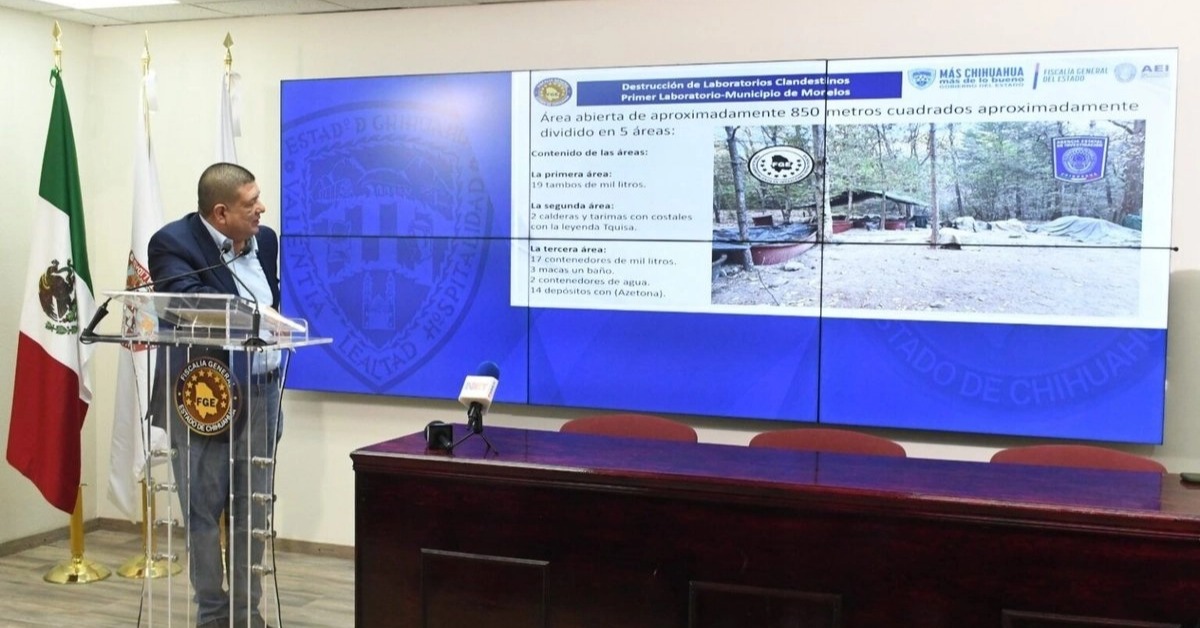
Two U.S. Embassy personnel and two officials from Chihuahua’s Agencia Estatal de Investigación died after their vehicle left the road and fell into a ravine following an operation in a remote part of the state. State authorities said the group had been returning from work tied to the location and destruction of clandestine drug laboratories in the mountain region between Guachochi and Morelos.
The two Mexican officials were identified as Pedro Román Oseguera Cervantes, director of the state investigation agency, and Manuel Genaro Méndez Montes, another agency member. The identities of the two U.S. personnel had not been made public as of Monday. Early accounts from Chihuahua officials said the vehicle skidded, plunged into a ravine, and then caught fire.
Based on the information released so far, the crash appears to have been an accident rather than an attack. Even so, the deaths immediately drew attention because of who was involved and what kind of operation they had just completed. Chihuahua is one of Mexico’s most strategically important border states, and operations tied to synthetic drug production carry obvious implications for both Mexican and U.S. security policy.
Why this became a federal issue
The story changed tone on Monday when President Claudia Sheinbaum said her federal security cabinet had not been informed about the operation involving U.S. personnel. That public statement turned a fatal crash into a broader question about how security cooperation with foreign officials is handled inside Mexico.
Sheinbaum said there is cooperation and coordination with the United States, but not joint operations on land or in the air. She also said her government was requesting information from both Chihuahua authorities and the U.S. government to determine whether there had been any violation of Mexico’s national security law or constitutional limits on foreign participation in security matters.
That distinction is central to understanding why this case matters. Mexico and the United States work together regularly on intelligence sharing, training, extraditions, drug trafficking investigations, and border enforcement. But Mexico’s federal government has long drawn a hard line on anything that could be interpreted as foreign agents conducting direct security operations on Mexican soil without proper authorization.
In plain terms, the dispute is not about whether the two countries cooperate. They do. The issue is whether this specific collaboration was structured and approved in accordance with Mexican law.
The sovereignty question behind the crash
For readers outside Mexico, the legal and political sensitivity may not be obvious at first glance. But inside Mexico, the role of U.S. personnel in security work is closely watched. That scrutiny has only grown in recent years as cartel violence, fentanyl trafficking, and pressure from Washington have pushed security ties into a more public and more politically charged phase.
Successive Mexican governments have accepted security coordination with the United States while insisting that operational control remains in Mexican hands. That position reflects both law and politics. Cooperation can be popular when it leads to arrests or drug seizures, but it becomes controversial when it appears to blur the line between assistance and direct foreign involvement.
This is why Sheinbaum’s response matters. Her comments suggest the federal government sees a possible gap between what the Chihuahua state government arranged and what Mexico City believes should have gone through federal channels. If that gap is confirmed, the crash could trigger more than an internal review. It could shape how future training missions, advisory roles, and joint anti-cartel efforts are approved.
What is known and what is still unclear
Several facts appear settled. Four people died. The group was returning from an operation related to drug-lab enforcement. Two of the victims were senior Chihuahua investigative personnel. Two others were linked to the U.S. Embassy and described in multiple reports as instructors or embassy personnel involved in training.
What remains unclear is the exact legal status of the U.S. personnel’s participation, who authorized the arrangement, and how the mission was described internally before the accident. It is also not yet clear whether the federal review will conclude that any law was broken or whether the dispute is mainly about protocol and notification.
There are also unanswered operational questions. Authorities have offered an initial explanation that the vehicle skidded and fell into a ravine, but a full accident reconstruction has not been made public. That leaves open basic questions about road conditions, convoy procedures, weather, visibility, and vehicle safety in a region known for difficult terrain.
Why this matters to foreign residents in Mexico
For foreigners living in Mexico, this story is not only about a crash in a remote mountainous area. It touches on the broader framework of Mexico-U.S. security cooperation, an issue that can influence border policy, anti-cartel strategy, diplomatic tension, and public debate over sovereignty.
That matters because security policy in Mexico often spills over into other areas that foreigners closely monitor, including travel advisories, trade negotiations, migration policy, border crossings, and the tone of bilateral relations. A case like this can move quickly from a local tragedy to a national political issue.
At the same time, the human dimension should not be lost. Four officials died after taking part in a dangerous operation in a remote zone where organized crime remains deeply entrenched. Whatever legal questions follow, the crash is also a reminder of the risks faced by those involved in anti-drug work in Mexico.
The next steps will likely come from two directions at once: investigators examining the crash itself, and federal authorities reviewing whether the collaboration behind the operation stayed within Mexico’s legal framework. Until those answers are clearer, this will remain both a security story and a sovereignty story.