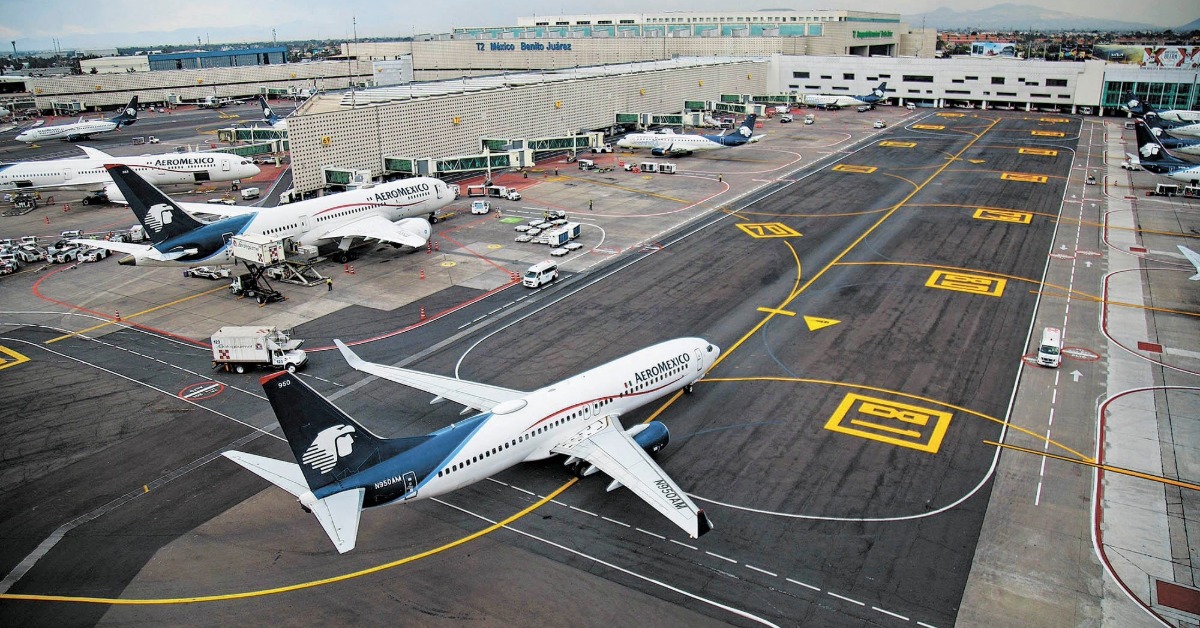
Mexico City’s main airport is seeking permission to handle more flights per hour, but the change is not just about two extra takeoffs or landings. The new limit comes after years of capacity cuts, pressure from airlines, technical studies, and a growing dispute with the United States over airport access. With summer travel and the 2026 World Cup adding pressure, the decision could affect schedules, competition, and the way airlines plan routes through Mexico’s busiest airport.
Mexico City Airport Gets More Flights Before World Cup
Mexico City’s main airport has been authorized to increase its hourly operations from 44 to 46 during the summer season, giving airlines slightly more room at one of the country’s most important travel hubs.
The change applies to the Aeropuerto Internacional de la Ciudad de México, also known as AICM or Benito Juárez International Airport. It covers takeoffs and landings combined. In airport terms, each arrival or departure counts as one operation.
That means the new limit does not allow 46 departing flights and 46 arriving flights every hour. It allows a combined maximum of 46 movements per hour.
The authorization is small on paper, but it arrives at a sensitive time. Mexico is heading into the 2026 summer travel season, the World Cup is approaching, and the country is still trying to ease tensions in aviation with the United States.
What the new authorization changes
The Federal Civil Aviation Agency, known as AFAC, authorized the airport to add two more operations per hour after reviewing capacity studies. The decision was published through the federal government and applies to the airport’s summer operation.
The increase is not an open-ended expansion. It is tied to technical conditions at the airport, including airspace capacity, terminal capacity, and airfield infrastructure work.
A key part of the plan involves rapid-exit taxiways. These are runway exits that help planes depart the runway more quickly after landing. When an aircraft clears the runway sooner, the airport can safely handle the next movement with less delay.
AICM has been working on three rapid-exit taxiways on runway 05R. The first has been completed. The second was expected to be finished in May. The third is planned for later in 2026.
Those details matter because the airport is not adding a new runway. It is trying to squeeze more efficiency from the infrastructure it already has.
The limit has moved several times
AICM’s hourly capacity has become one of the biggest aviation policy issues in Mexico.
For years, the airport operated under a higher cap. In 2022, authorities reduced the limit from 61 to 52 operations per hour. The government cited saturation inside the terminal buildings.
In 2023, the limit fell again, from 52 to 43 operations per hour. That time, the explanation focused on airspace conditions. The reduction was described as temporary while the conditions that caused it remained in place.
In 2025, the airport received permission to increase its operations from 43 to 44 per hour. The latest decision raises the limit again, this time to 46.
That history helps explain why two more operations per hour have drawn attention. Airlines have long argued that AICM needs more usable capacity, especially during peak hours. U.S. officials have also questioned Mexico’s reductions and their impact on foreign airlines.
Why AICM still carries so much weight
AICM remains Mexico’s most important passenger airport. It handled more than 44.6 million passengers in 2025, according to airport statistics.
The airport also sits at the center of Mexico’s domestic and international route network. Many travelers connect through Mexico City even when their final destination is elsewhere.
That includes foreign residents living in Mexico who fly between the country and the United States or Canada. It also includes tourists connecting to destinations such as Puerto Vallarta, Cancún, Mérida, Oaxaca, Guadalajara, and Los Cabos.
For travelers, airport capacity can shape more than flight availability. It can affect ticket prices, connection times, delays, and how much schedule flexibility airlines have.
A higher hourly cap does not guarantee cheaper tickets. It also does not guarantee new routes. But it gives airlines more room to request slots, especially during crowded parts of the day.
The U.S. dispute behind the airport decision
The increase comes as Mexico and the United States try to settle a broader dispute over aviation access.
The U.S. Department of Transportation has argued that Mexico violated the 2015 bilateral air transport agreement. U.S. officials cited two main concerns: reductions in passenger slots at AICM and the forced move of dedicated cargo operations from AICM to Felipe Ángeles International Airport, known as AIFA.
Those actions became a major point of conflict. U.S. officials said American carriers lost fair access to Mexico City’s main airport. Mexico has argued that the changes were part of a wider strategy to reduce congestion and develop the metropolitan airport system.
The United States responded with restrictions on Mexican airlines. Those included actions affecting 13 routes and limits tied to growth between Mexico and the United States.
This week, both governments said they had reached a preliminary understanding. The deal is meant to move Mexico toward compliance with the bilateral agreement. It also recognizes AIFA as part of the Mexico City airport system.
The U.S. position remains cautious. Washington has said that restrictions on Mexican carriers will remain in place until the promised reforms are implemented.
Slots are the real pressure point
The word slots is central to this story.
A slot is permission for an airline to land or take off at a specific airport during a specific time period. At crowded airports, slots are valuable because they determine when airlines can operate.
For passengers, slots shape the schedule they see when booking flights. A good slot can support a convenient morning departure, an easier connection, or a late-evening return. A less useful slot can make a route harder to sell.
That is why AICM’s hourly limit matters. When the cap is lower, fewer slots are available. When the cap rises, even slightly, airlines may gain more flexibility.
Still, the new 46-operation limit does not settle every slot dispute. Airlines must still request times, airport coordinators must manage demand, and authorities must verify that the airport can maintain safe operations.
World Cup pressure adds urgency
The timing also connects to the 2026 FIFA World Cup.
Mexico will co-host the tournament with the United States and Canada. Mexico City will host the opening match on June 11, 2026, and the country will hold matches in Mexico City, Guadalajara, and Monterrey.
That does not mean every World Cup visitor will pass through AICM. Many will fly directly to other cities. Some will use AIFA, Toluca, Guadalajara, or Monterrey. Others will enter through the United States or Canada.
Even so, Mexico City will remain a major gateway. The opening match alone will bring more international attention to the capital, while airlines will be managing summer demand, tourism traffic, and World Cup-related travel.
The extra hourly operations could help during that period. But the airport will still face limits. More flights do not solve ground transportation, customs, baggage, weather delays, or terminal crowding.
What passengers should expect
Travelers should not expect the change to transform AICM overnight.
Airlines need time to adjust schedules. Some changes may already be built into summer planning. Others may depend on whether the new slots become available, whether U.S. restrictions are lifted, and whether demand supports more flights.
Passengers could eventually see more flight options on some routes. The impact may be clearer on high-demand domestic and U.S.-Mexico routes, where airlines often want better times.
Delays may still happen. AICM is a busy, older airport with limited space. Storms, air traffic congestion, maintenance work, and late aircraft can still affect operations.
For travelers connecting through Mexico City, the best advice remains practical. Leave enough time between flights. Watch schedule changes after booking. Avoid tight connections when traveling during peak periods.
A small increase with larger meaning
The move from 44 to 46 operations per hour is not a dramatic expansion. It is a measured increase at an airport that has been under pressure for years.
But it signals a shift. Mexico is giving AICM more breathing room after several rounds of reductions. It is also trying to show U.S. officials, airlines, and passengers that it can manage capacity more transparently.
The decision does not end the debate over AICM, AIFA, or Mexico City’s long-term airport needs. Those questions remain open.
For now, the immediate result is clear. Mexico City’s main airport has permission to conduct two additional takeoffs or landings per hour once the required conditions are met.
That may not sound like much. At a crowded airport, two extra movements per hour can still matter.