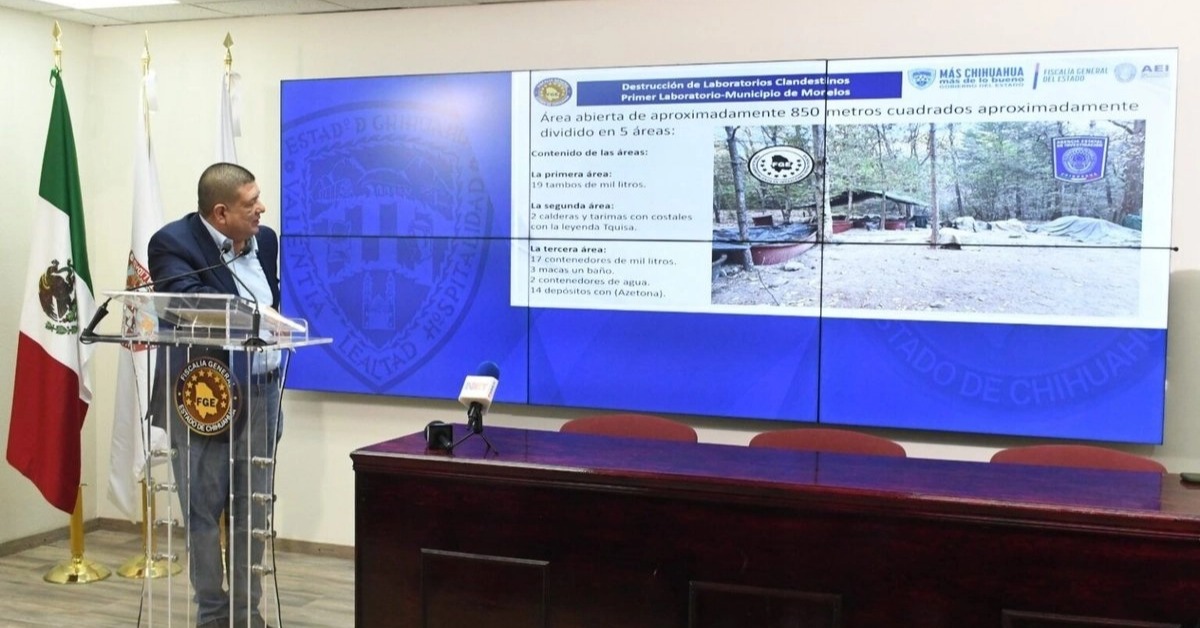
President Claudia Sheinbaum said both the government of Chihuahua and the United States must explain the role of two U.S. officials who died after an anti-drug mission in the state. The case grew quickly because the dead were traveling with senior Chihuahua investigators after an operation tied to clandestine drug laboratories in the municipality of Morelos, in the Sierra Tarahumara.
The crash happened on April 19, when the vehicle carrying two U.S. embassy personnel and two Mexican state investigators went off a mountain road and fell into a ravine. All four died. Chihuahua authorities identified the Mexican victims as Pedro Román Oseguera Cervantes, head of the state investigation agency, and agent Manuel Genaro Méndez Montes.
What turned the case into a national story was not only the loss of life. The question was whether foreign personnel were working alongside state authorities without federal approval or notice. Sheinbaum said her security cabinet was unaware of the U.S. personnel’s field presence and asked for full information to determine whether Mexican law was violated.
Why the president is demanding answers
At the center of the dispute is the gap between local explanations and the federal account. Chihuahua officials first linked the dead U.S. personnel to the broader anti-drug effort. Later, state officials said the Americans had not taken part in the actual raid and were instead in the area for drone training, later joining the convoy.
That distinction matters. If U.S. personnel were only providing training, the legal and political implications would differ from those of direct operational involvement. But Sheinbaum said the information available to the federal government still pointed to some kind of joint work, which is why she ordered a review.
The case has also drawn attention because U.S. media later reported that the two dead Americans were CIA officers. Mexican authorities said they were still verifying which U.S. agency they belonged to. That uncertainty has added another layer of sensitivity to a case already touching on national sovereignty, security cooperation, and federal control over foreign agents.
Why foreign agents are such a sensitive issue in Mexico
For international readers, the legal issue can sound technical. In Mexico, it is not. The country has long treated the presence of foreign security and intelligence personnel as a matter tied directly to sovereignty.
Under Mexico’s National Security Law, foreign agents are supposed to operate under strict limits. They may act as liaisons and exchange information within the scope of their accreditation, but they are not authorized to exercise powers reserved to Mexican authorities. The law also requires reporting to Mexican authorities and gives the federal government supervisory control over their activities.
That is why Sheinbaum’s argument is so important. Her position is that the relationship is federal, not state-level, regarding foreign security personnel. In plain terms, a Mexican state government cannot simply establish its own security arrangement with foreign agents if that work touches on matters reserved to the federation.
What remains unclear
Several basic questions are still unanswered. It is still not fully clear what agency the U.S. personnel belonged to in official terms, what exact role they played before the crash, and what federal authorities were told in advance.
It is also unclear whether this was a case of poor communication, a narrow training mission that became politically explosive, or a genuine breach of protocol. Chihuahua officials have insisted the Americans did not participate in the destruction of the laboratories. Sheinbaum has said the changing versions are exactly why the matter requires investigation.
The U.S. side has also been cautious. Publicly, the embassy described the dead personnel as officials supporting Chihuahua state authorities in efforts against cartel operations. That wording confirmed a support role, but it did not settle the deeper question of whether the support stayed within the legal limits Mexico says apply.
Why this story matters beyond Chihuahua
This story lands at a tense moment in Mexico-U.S. security cooperation. Both countries continue to work together against fentanyl trafficking, synthetic drug production, and cartel finance. But Mexico’s government has been trying to draw a firm line between cooperation and foreign operational presence on Mexican soil.
That line matters politically and legally. For many Mexicans, the core concern is not whether the United States shares intelligence or training. It is whether foreign personnel are engaging in activities that appear to be enforcement, field operations, or direct security coordination outside clear federal control.
For expats and other international readers, this case is a reminder that security cooperation in Mexico is often shaped by two competing realities. There is strong pressure for closer cross-border action against organized crime. There is also a deep political insistence that any such action must remain under Mexican authority. The crash in Chihuahua has forced that tension into the open.