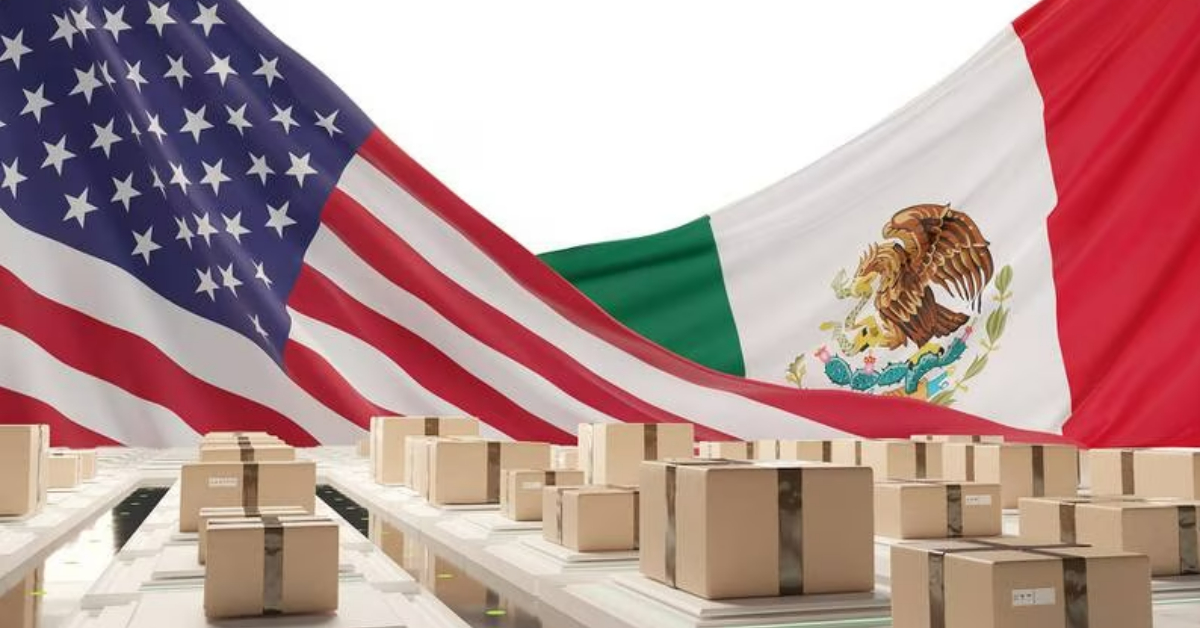
Mexican exporters are entering the U.S. market with one of the lowest average tariff rates among major trade partners. That gives Mexico a clear advantage as companies seek stable supply chains near the United States. But the benefit is not automatic. T-MEC compliance, rules of origin, and sector-specific tariffs are now shaping which products keep preferential access and which face higher costs.
Mexican goods shipped to the United States are paying an average tariff rate of 3.7%, one of the lowest among major U.S. trading partners, according to recent tariff analysis.
The figure matters because it shows how much protection Mexico still receives under the T-MEC, known in the United States as the USMCA. At a time when U.S. trade policy has become more aggressive, Mexico’s exporters are still entering the American market with a relatively low tariff burden.
That does not mean Mexican exports are free from pressure. Some sectors, especially autos, steel, aluminum, and copper, continue to face higher tariffs. But on average, Mexico remains in a stronger position than many other U.S. trade partners.
For Mexico, the message is simple. Compliance with the trade agreement is no longer paperwork in the background. It is now one of the main tools protecting exporters from higher costs.
Why the 3.7% rate matters
An average tariff rate of 3.7% means U.S. importers paid duties equal to that share of the value of Mexican goods entering the country.
That is low compared with the broader U.S. tariff environment. U.S. tariff rates have risen sharply since 2025, as Washington used import duties to pressure foreign producers and protect selected industries.
Mexico’s lower rate is important because the United States is its largest export market. U.S. goods imports from Mexico totaled about $534.9 billion in 2025, making Mexico a key supplier for American consumers and companies.
Many of those imports are tied to shared North American supply chains. A product may cross borders more than once before reaching a final buyer. That is common in autos, electronics, machinery, medical devices, and food production.
When tariffs rise, each border crossing becomes more expensive. That is why a lower average rate gives Mexico a competitive edge.
T-MEC compliance is the dividing line
The lower tariff rate is closely tied to T-MEC rules of origin.
Under the agreement, many goods can enter the United States with preferential tariff treatment if they qualify as North American products. That usually means they must meet specific content, production, and documentation rules.
In practical terms, a Mexican product does not automatically receive lower tariffs just because it was shipped from Mexico. The importer must be able to show that the product meets the agreement’s rules.
That distinction has become more important as U.S. tariffs have expanded. Goods that comply with T-MEC can often avoid broader tariff measures. Goods that do not comply may face higher duties.
This is why companies exporting from Mexico are paying closer attention to supply chains. Where parts come from now matters. So does documentation.
For smaller exporters, this can be a challenge. Larger manufacturers often have legal and customs teams. Smaller firms may need outside help to prove eligibility and avoid mistakes.
Mexico’s advantage is real but not complete
Mexico’s tariff position is favorable, but it is not a full shield.
Autos remain one of the most exposed sectors. The auto industry is central to Mexico’s export economy, but it is also heavily targeted by U.S. tariff policy.
Vehicles and auto parts are especially complicated because they often include inputs from several countries. A car assembled in Mexico may include parts from the United States, Canada, Asia, and Europe.
That makes compliance more technical. It also increases tariff risk when content rules are not met.
Metals are another pressure point. Steel, aluminum, and copper have faced higher U.S. duties under separate trade measures. These tariffs can affect manufacturers far beyond the metal industry itself.
For example, tariffs on steel can raise costs for autos, appliances, construction materials, and machinery. That can affect Mexican factories and U.S. buyers simultaneously.
So while Mexico’s average rate is low, some industries still face serious costs.
Why this matters to readers in Mexico
For expats living in Mexico, tariffs may sound like a distant business issue. But trade costs can affect daily life in indirect ways.
Mexico’s economy is deeply tied to exports. Manufacturing jobs, industrial parks, transport companies, port activity, and border logistics all depend on access to the U.S. market.
If exporters maintain low-tariff access, Mexico is more likely to attract investment. That can support employment and business activity in several regions.
If tariffs rise, companies may delay investment, reduce output, or raise prices. Those effects can move through the economy.
Tariffs can also influence the exchange rate. Trade uncertainty often affects investor confidence, which can move the peso. A weaker or stronger peso can affect imported goods, travel costs, and household budgets.
For foreign residents, the connection is not always immediate. But trade policy can still shape prices, jobs, and economic stability in Mexico.
The 2026 T-MEC review raises the stakes
The timing is important because North America is going through a formal review of the T-MEC.
Mexico wants to preserve the agreement and reduce tariffs that still affect key exports. The United States wants stronger enforcement and may seek tighter rules in some sectors.
That means the current tariff advantage could become a central issue in negotiations.
For Mexico, the goal is to keep preferential access to the U.S. market. For the United States, the goal is to make sure goods receiving trade benefits meet the agreement’s standards.
This creates a difficult balance. Mexico benefits from being part of a regional trade bloc. But it must also prove that its exports are not simply acting as a back door for goods from outside North America.
That issue is especially sensitive in sectors such as autos, electronics, steel, and advanced technology.
Nearshoring depends on predictable access
Mexico has spent several years promoting nearshoring, the movement of production closer to the U.S. market.
The idea is straightforward. Companies want shorter supply chains, lower shipping risks, and easier access to North American customers. Mexico offers proximity, manufacturing experience, and the T-MEC framework.
Low tariffs are a major part of that offer.
If companies believe Mexico can maintain stable access to the U.S. market, they are more likely to invest. If they believe tariff rules may change quickly, they may wait.
That is why the 3.7% tariff rate is more than a trade statistic. It is a sign of Mexico’s current position in the North American economy.
The advantage exists. But it depends on rules, documentation, and political negotiations.
What happens next
The next phase will depend on how Mexico, the United States, and Canada handle the T-MEC review.
Mexico is likely to defend the agreement as a foundation for regional competitiveness. U.S. officials are likely to continue to apply pressure to sensitive industries and rules of origin.
Exporters will have to adapt either way.
For many Mexican companies, the safest path is stronger compliance. That means clearer supply-chain records, better customs documentation, and closer tracking of where inputs are produced.
The countries that manage these rules well will have an advantage. Mexico already has one because of its trade agreement and location.
But that advantage is not guaranteed. The lower tariff rate shows what Mexico can protect under T-MEC. The next test is whether it can keep that position as trade pressure continues.