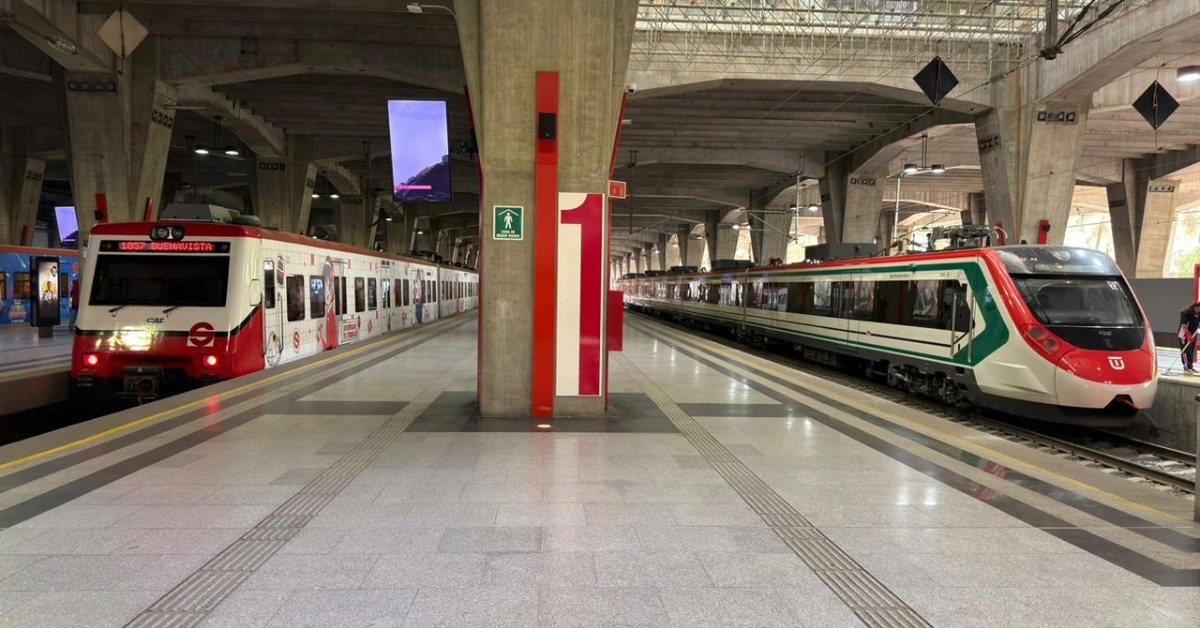
The long-awaited train to Felipe Ángeles International Airport is already changing how some travelers reach AIFA. Early demand has been strong, with riders using the new Buenavista route for airport trips, daily commutes, and even test rides. The lower fare is the clear draw, but the service also answers a bigger question that has followed AIFA since its opening: could travelers reach the airport without a long, costly road trip?
New AIFA train sees strong early demand
The new rail connection between Buenavista and AIFA is drawing heavy use in its first weeks, giving travelers a lower-cost option for reaching the airport from central Mexico City.
The service opened on April 26 and quickly became one of the most-watched transport changes in the Valley of Mexico. In its first week, the Tren Felipe Ángeles carried more than 206,000 passengers, according to transport authorities.
That early demand matters because AIFA has faced one central problem since opening in 2022: access. The airport is located in Zumpango, State of Mexico, far from many central neighborhoods in Mexico City. For many passengers, the trip often meant paying for a taxi, app-based car, or airport bus.
The new train changes that calculation. The full trip from Buenavista to the airport currently costs 45 pesos during the launch period. That price is well below many road-based options, especially for solo travelers.
A cheaper airport route from central Mexico City
The train connects AIFA with Buenavista, one of Mexico City’s best-linked transit points. From there, passengers can connect with Metro, Metrobús, Ecobici, trolleybus service, and other public transport.
The full route covers about 41 kilometers. It uses the existing Tren Suburbano corridor from Buenavista to Lechería, then continues on the new branch toward AIFA.
Authorities have said the trip is expected to take about 43 minutes once full operating conditions are reached. In the early stage, some trips have been closer to 50 minutes or about an hour, depending on service conditions and station flow.
For travelers, the key benefit is predictability. A train does not remove every airport headache, but it reduces exposure to traffic on the way to a terminal that many people still consider distant.
What passengers should know before using it
The new branch includes stations at Cueyamil, La Loma, Teyahualco, Prados Sur, Cajiga, Xaltocán, and the AIFA terminal station, known as Clara Krause.
The airport station is built into the terminal area, allowing passengers to continue into the airport without needing another road transfer. That point is important for travelers with luggage, especially those comparing AIFA with the older Mexico City International Airport.
Each train has space for about 719 passengers. During periods of heavier demand, authorities say trains can be coupled to carry about 1,400 passengers in a single trip.
There have also been early growing pains. Passengers have reported long lines and temporary problems with ticket machines. Those issues are common during the launch of major transport projects, but they will matter if demand stays high.
AIFA gets the connection it was missing
AIFA was built to relieve pressure on Mexico City’s older airport system. Still, many travelers were slow to adopt it because transport options were limited, expensive, or time-consuming.
The new train gives the airport something it lacked at launch: a direct rail link to the capital’s transit network.
For expats, residents, and visitors in Mexico City, the change makes AIFA easier to consider when comparing fares. A cheaper flight from AIFA may now be more practical if the ground trip is simple and affordable.
That does not mean AIFA will replace AICM for most travelers. Flight options, schedules, airline preferences, and neighborhood location still matter. But the train removes one of the main barriers that kept some passengers from using the newer airport.
If service remains reliable after the launch rush, the Buenavista-AIFA route could become a regular part of airport planning in Mexico City.