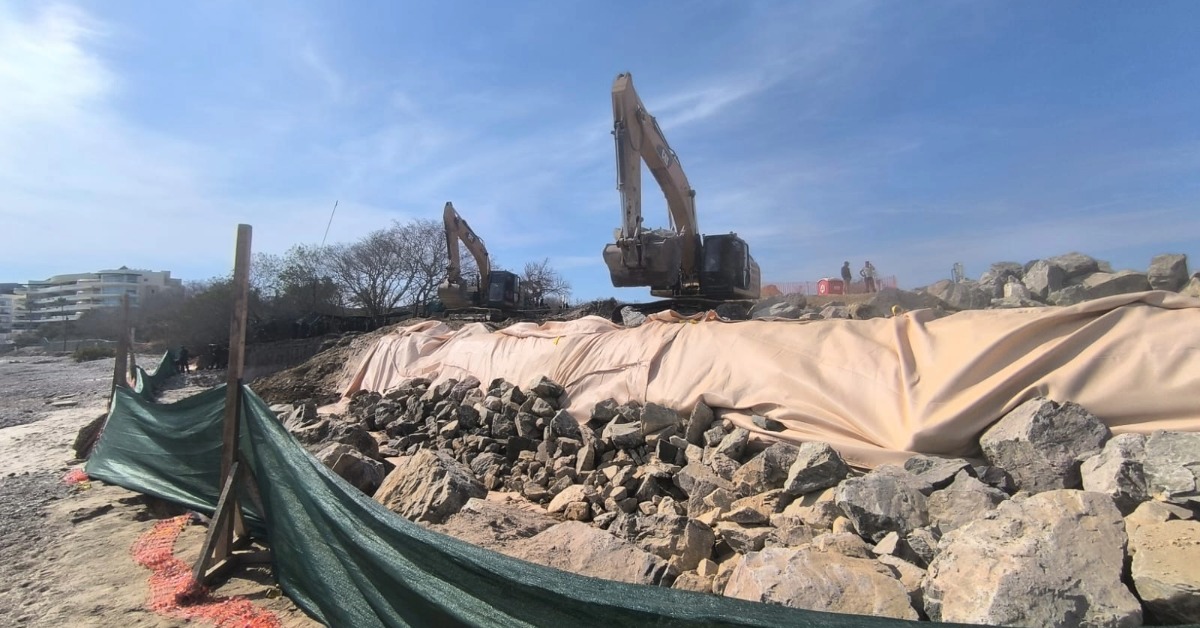
A local leader at Playa Las Cocinas says he fears for his life as the dispute over a luxury development in Punta de Mita grows more serious. The fight now reaches beyond one beach. It involves public access, alleged environmental damage, police action, federal oversight, and the future of coastal development in Riviera Nayarit. For residents and visitors, the case has become a test of whether Mexico’s public beach laws can be enforced when major private investment is involved.
A beach dispute turns personal in Punta de Mita
A community leader opposing works at Playa Las Cocinas in Punta de Mita says he fears for his life as the coastal-development dispute in Bahía de Banderas continues to escalate.
Efraín López, identified as a leader in the movement against the beach works, said in a video that he fears for his safety. He also said he had not intended to harm himself, a statement often made by activists in Mexico when they believe they may be at risk.
His remarks added a new level of concern to a conflict that had already drawn local protests, police action, federal attention, and growing public scrutiny.
The dispute centers on works linked to Cantiles de Mita, a company associated with Grupo DINE, near a luxury development area in Punta de Mita. Residents and environmental defenders say the works have damaged the beach area, affected a turtle nesting zone, and raised concerns about access to public coastal land.
The company side has argued that some works are related to coastal protection and erosion control. Residents say that the explanation does not answer their concerns about the scale of the intervention, the legal status of the works, or whether the beach will remain usable for the public.
What the community says is at stake
For residents of Punta de Mita and nearby Emiliano Zapata, the issue is not only a dispute over one construction site. It is about whether public beach access can survive in one of the most valuable real estate corridors in Riviera Nayarit.
Community members have rejected a proposal to move part of the stone structure back by five meters. They are asking for a 20-meter recovery of the beach area, which they say is needed to protect the federal coastal zone and the nesting area used by sea turtles.
Residents also say the beach has been altered by the removal of sand, stones, and coastal vegetation. They have described Las Cocinas as one of the last accessible natural beach areas left for local communities in that part of Punta de Mita.
That point matters in a place where luxury resorts, private residences, and gated developments have reshaped much of the coastline. For many local families, beaches are not tourist products. They are public spaces used for walking, fishing, swimming, surfing, and community life.
For foreign residents in the Puerto Vallarta and Riviera Nayarit area, the case is also worth understanding because it reflects a wider tension along Mexico’s coast. Investment can bring jobs and services, but it can also test water supply, public access, local roads, and trust in environmental oversight.
The legal question behind the beach
Mexico does not treat beaches as private property in the way many foreigners may understand that term. The Zona Federal Marítimo Terrestre, often called ZOFEMAT, is generally a 20-meter strip of firm land next to the beach.
That zone is federal property. It is meant to remain under public control, although private parties can receive concessions or permits for specific uses.
The legal question in Punta de Mita is whether the works near Playa Las Cocinas respect those limits. Residents say the works affect federal coastal land and restrict the natural use of the shoreline. They also say the area is ecologically sensitive because of turtle nesting.
Federal officials have said public access to Las Cocinas must be guaranteed. Semarnat and Profepa have also been brought into the review process, along with state and municipal officials.
That does not mean the dispute is resolved. It means the case has moved from a local protest into a formal public-access and environmental-review matter.
Police action raised the pressure
The conflict intensified after residents blocked access near the Higuera Blanca junction, a strategic route into Punta de Mita and nearby tourism developments.
Police detained three activists during the dispute. They were later released, but the legal proceedings against them have not been fully resolved in the public record. Reports from the conflict say they still face accusations related to alleged injuries to authorities and alleged invasion of private property.
The detentions deepened mistrust among residents. López is not the only person connected to the protest who has raised safety concerns. Activist Pepe Ávila also said he feared for his life after receiving anonymous messages and seeing vehicles he considered suspicious.
The governor of Nayarit later said state police would be withdrawn from the area and that dialogue tables would be held with the company, residents, and authorities. Those talks are expected to review the project, the beach access issue, and the environmental concerns.
For the community, however, dialogue alone may not be enough. Residents are asking for visible action, including restoration of the beach area and clarity over permits.
The development behind the dispute
The Punta de Mita area has long been marketed as a high-end tourism and residential destination. The wider development area includes luxury hotels, private residences, and branded resort projects.
DINE and partners have promoted Montage Punta Mita and Pendry Punta Mita as major resort and residential projects in the area. Public announcements have described the investment as large and job-producing, with hotels and branded residences planned for the Punta Mita peninsula.
That is the economic side of the story. The social side is more complicated.
Residents do not appear to be arguing only against tourism or jobs. Their complaint is that development must respect the beach, federal land, environmental rules, and local access. They also want the public to see the documents that support the work being done near the shoreline.
That difference is important. In many coastal communities, the debate is no longer simply development versus no development. It is about how projects are approved, who benefits, who absorbs the costs, and whether public spaces remain public in practice.
Permit questions remain central
The permit issue is one of the most important parts of the case.
Documents and public statements related to the dispute indicate that the company has held a concession for coastal protection. Residents and critics argue that such a concession does not automatically authorize construction, permanent infrastructure, or commercial use on the beach.
The company has argued that the shoreline has suffered erosion over many years and that protective works are needed to stabilize the coast. It has also pointed to mitigation and environmental measures.
Residents counter that the work has altered the beach and that federal environmental review must precede major physical intervention. They say the project cannot move ahead on the basis of informal understandings or after-the-fact explanations.
This is where federal agencies now face the clearest test. They must explain what permits exist, what they authorize, where the federal zone begins and ends, and whether any work has gone beyond what the law allows.
Without that public clarity, the conflict is likely to continue.
What happens next
The immediate concern is safety. When community leaders say they fear for their lives, authorities have a responsibility to take that seriously and protect the right to peaceful protest.
The next concern is transparency. Residents, business owners, visitors, and investors need to know whether the work at Playa Las Cocinas is legal, properly permitted, and environmentally reviewed.
There is also a practical question. Even when a beach is legally public, access can be reduced by walls, gates, private security, altered terrain, or development layouts. A beach right that cannot be used is not much of a right.
For now, Playa Las Cocinas remains a local beach with national attention. The outcome could shape how future coastal disputes are handled in Riviera Nayarit, especially as high-end development continues to expand along the bay.
For people living in the Puerto Vallarta region, the case is a reminder that coastal growth is not only about tourism numbers and property values. It is also about law enforcement, public space, environmental trust, and the relationship between local communities and outside investment.