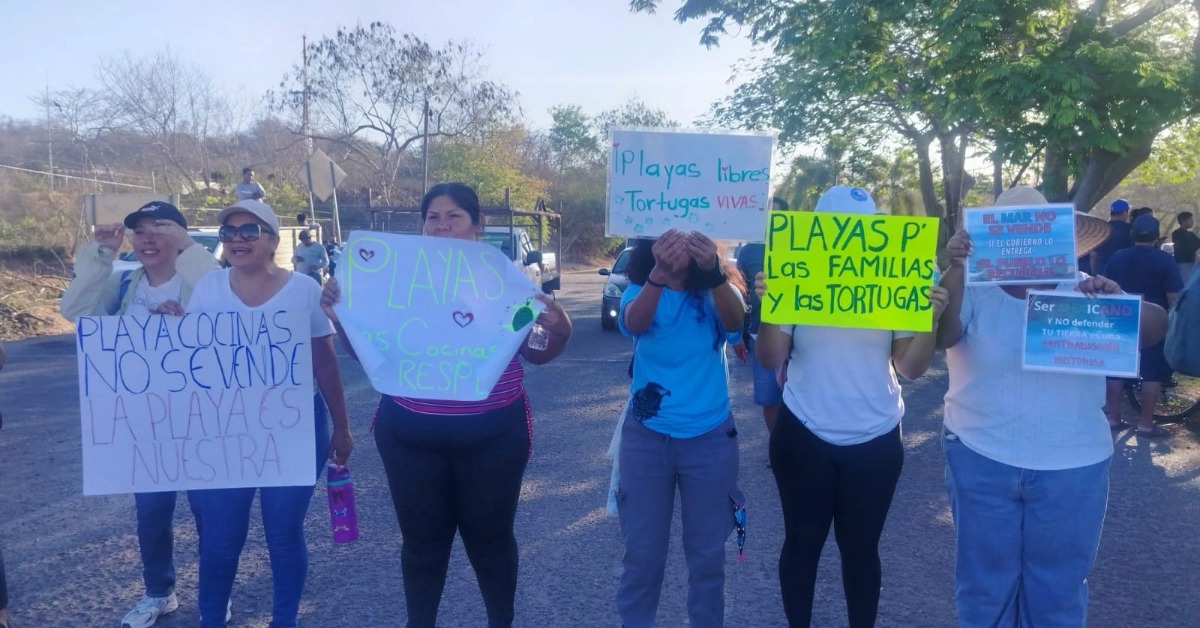
Traffic into Punta de Mita was disrupted Monday morning after residents blocked the junction at Higuera Blanca. The protest focused on Playa Las Cocinas, a small beach now at the center of a growing dispute over access, coastal construction, and local services.
Residents say the blockade was intended to force a response from authorities. Their complaints include alleged beach privatization, possible environmental damage, and continuing water shortages in nearby communities.
The protest affected one of Riviera Nayarit’s main tourist corridors. That route is used by residents, hotel workers, service providers, visitors, and businesses moving between communities along the northern side of Bahía de Banderas.
For travelers, it was a traffic problem. For residents, it was a public message. They argue that the coast is changing faster than local infrastructure, public oversight, and community trust can absorb.
What residents say is happening at Playa Las Cocinas
The central complaint involves works near Playa Las Cocinas, where residents allege a private development is altering the coastal area. They say stone structures, fill, and construction activity could affect the natural movement of sand and reduce public passage along the beach.
Residents are also asking authorities to show the project’s environmental permits, boundaries, and authorizations. Their concern is not only whether the development has the necessary paperwork, but also whether the works respect the federal maritime zone and public access.
The claims have not been settled publicly. The project side has defended the investment as a source of jobs and economic activity. Residents counter that jobs do not answer questions about the coast, water supply, or the public’s right to reach the beach.
That tension explains why the conflict has moved beyond a construction dispute. For many locals, Playa Las Cocinas has become a test of whether coastal development can proceed without erasing the places that communities still use.
Why beach access matters in Mexico
For many foreign residents, Punta de Mita is known for luxury resorts, gated developments, and high-end tourism. For local communities, the beaches are also everyday public spaces. They are used for family gatherings, fishing, walking, swimming, and cultural life.
Mexican law treats beaches and the adjacent federal maritime zone as national public-use property. In simple terms, there are no private beaches in Mexico in the way many foreigners may understand the phrase.
The problem is often not the legal principle. The problem is practical access. A beach may remain public on paper, while walls, gates, private guards, terrain changes, or development layouts make it hard for the public to enter or move along the shoreline.
That is why disputes like Playa Las Cocinas are sensitive. They are not only about one project. They touch a broader question in Mexico’s beach towns: whether public coastal rights are being protected in real life, not only in law.
Water shortages added fuel to the protest
The blockade was also tied to complaints about water shortages. Residents say local homes have faced unreliable water service while large tourist and real estate projects continue to operate in the same corridor.
That does not prove one development caused the shortages. But it helps explain why frustration has grown. In coastal communities, water pressure, road capacity, and public access are no longer background issues. They now shape how residents respond to new construction.
For people living in the area, the contrast can feel sharp. Luxury projects market privacy, pools, and comfort. Nearby communities may still deal with intermittent water, limited services, and busy roads.
That gap has become part of the political pressure around Punta de Mita. The protest was not only about reaching a beach. It was also about whether local communities are carrying the costs of a development model built for outside buyers and visitors.
Why the Higuera Blanca junction was targeted
The blockade location mattered. The Higuera Blanca–Punta de Mita junction is a strategic access point in Bahía de Banderas. Closing it created immediate pressure because it affected local travel, tourism movement, and work commutes.
Residents appear to have used the road closure as leverage after earlier discussions failed to resolve their concerns. The message was direct: if authorities would not stop and explain the project, residents would make the conflict impossible to ignore.
That approach carries risks. Roadblocks can affect workers, emergency access, visitors, and small businesses that depend on daily movement. They can also harden the government’s response.
Still, the protest shows how far the dispute has escalated. Once residents move from meetings to road closures, the issue becomes a governance problem. Authorities then face pressure to protect public order while also addressing the underlying complaint.
What authorities need to clarify
The next step should be a clear public process. Authorities need to explain what permits exist, what works are authorized, and whether any construction touches the Zona Federal Marítimo Terrestre.
They also need to clarify whether public access to Playa Las Cocinas will remain physically open and usable. A legal right has little meaning if the route is unsafe, blocked, or reduced to a symbolic passage.
If environmental rules were violated, a suspension or enforcement action would need to be more than temporary. If the project is operating under valid permits, authorities still need to demonstrate how beach access and coastal protection are being ensured.
The water issue also needs a separate answer. Residents are linking the protest to local shortages, and that concern will not disappear even if the beach-access dispute is mediated.
Why foreign residents should pay attention
For expats and seasonal residents, this may look like a local protest on a road outside Puerto Vallarta. It is more than that.
The Punta de Mita dispute sits at the intersection of tourism growth, real estate development, beach access, public infrastructure, and environmental enforcement. These issues affect home buyers, renters, business owners, and anyone who uses the coast.
It also shows how community tolerance is changing. Investment alone is no longer enough to calm concerns. Residents increasingly want proof that projects respect the law, preserve public space, and do not worsen local service problems.
Foreigners living in Mexico do not need to take over these local debates. But they should understand them. The same development pressures that create luxury housing and tourism amenities can also strain water, roads, beaches, and neighborhood life.
A warning sign for Riviera Nayarit
Riviera Nayarit has spent years positioning itself as a premium tourism corridor. Punta de Mita is one of its strongest brands. That success has brought investment, jobs, and international attention.
It has also created a harder question: how much coastal change can local communities absorb before they feel pushed out of their own shoreline?
The Punta de Mita blockade is a warning sign. It shows that beach access, water supply, and environmental trust are now central to the future of coastal development.
If authorities respond only to the traffic disruption, they may miss the larger issue. The roadblock was the visible event. The deeper conflict is about who gets protected when tourism growth reaches the edge of the beach.