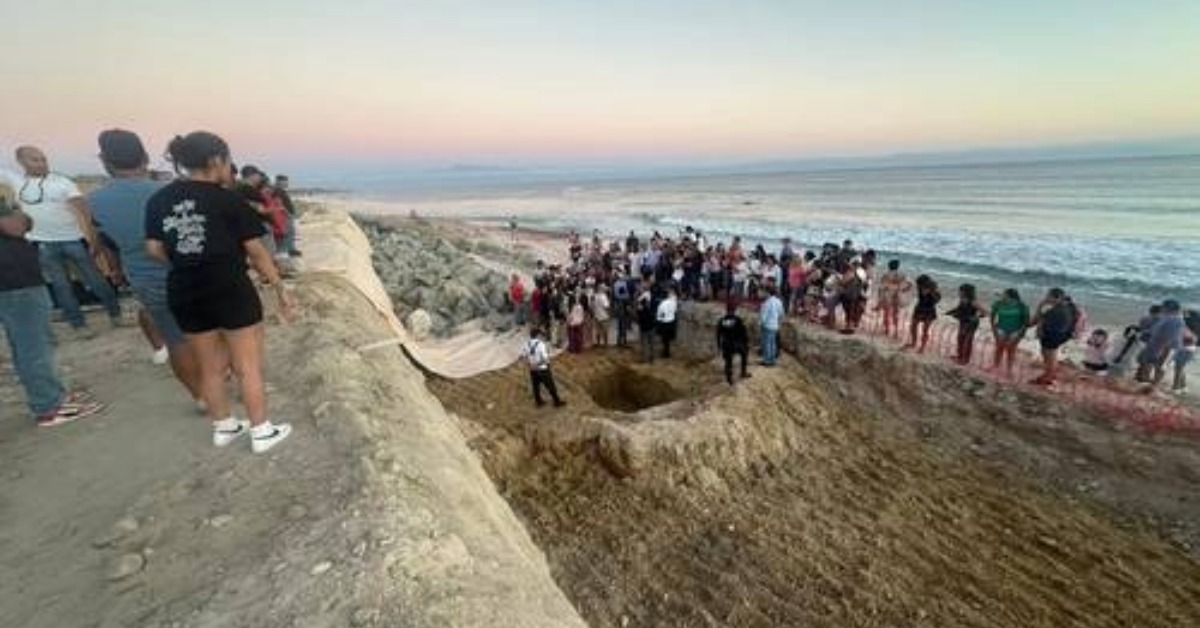
A dispute over Playa Las Cocinas in Nayarit has moved from a local beach complaint into a wider test of coastal access, luxury development, environmental enforcement, and public trust. Residents say a five-meter setback offer from the developer does not protect the federal beach zone or turtle nesting habitat. The case now raises a broader question across Mexico’s resort towns: when high-end projects reach the shoreline, who ensures the beach remains public?
Nayarit Beach Fight Grows Over Playa Las Cocinas
Residents of Punta de Mita and Emiliano Zapata have rejected a proposal by Cantiles de Mita, part of Grupo DINE, to move a stone wall only five meters back from Playa Las Cocinas in Nayarit.
The communities are seeking the recovery of 20 meters of beach, arguing that the area falls within the public coastal zone and has been damaged by works associated with a luxury development project.
The dispute is unfolding in Bahía de Banderas, one of Mexico’s most active tourism and real estate corridors. The area includes Punta Mita, a high-end enclave known for resorts, private residences, golf courses, and foreign investment. But nearby communities still use the same coastline for fishing, family visits, local work, and everyday access to the sea.
The conflict has grown beyond one wall or one construction site. It now involves questions about beach access, federal maritime land, environmental permits, turtle nesting habitat, and the role of authorities when private development reaches public coastal space.
Residents and environmental defenders say the developer’s offer does not answer their main demand. They are not asking only for a wider passage. They want the affected area restored and the federal beach zone respected.
A five-meter offer meets a demand for 20 meters
The latest turn came during a community assembly in Emiliano Zapata. Residents reviewed the proposal to move the stone wall five meters away from the disputed area. The response was rejection.
For the communities, five meters would leave the core problem unresolved. They argue that Mexico’s federal maritime zone must be protected and that the beach should not be reduced to a narrow passage beside private development.
Their demand is for a 20-meter recovery area. That figure is important because Mexican law defines the Zona Federal Marítimo Terrestre, often called ZOFEMAT, as a 20-meter strip of firm, walkable land next to the beach where beaches exist.
In simple terms, beaches in Mexico are not private in the way many foreigners may understand private beachfront property. A hotel, resort, condominium, or home may own land near the coast. But the beach itself and the adjacent federal maritime zone are public-use national property.
That legal principle is central to the Las Cocinas conflict. Residents say the stone wall and related work have pushed into an area that should remain open, natural, and usable by the public.
The company side has framed the proposal as a way to reduce the conflict and continue the project. Residents say that the approach treats the issue as a negotiation over distance, not as a legal and environmental obligation.
What residents say was damaged
Local residents and environmental defenders say machinery and construction activity have altered the beach area. Their complaints include the movement of stones, sand, and vegetation. They also allege damage involving mangrove vegetation and areas near sensitive coastal habitat.
The communities say Playa Las Cocinas is not only a scenic beach. They describe it as one of the last accessible coastal spaces still used by local families in that part of Punta de Mita.
They also say the area is used by sea turtles for nesting. That adds another layer to the dispute. Turtle nesting beaches in Mexico are subject to environmental rules meant to reduce disturbance, protect eggs and hatchlings, and preserve the natural conditions needed for nesting.
The residents’ concern is easy to understand. A beach can be legally public but still become difficult to use. A wall, a rock barrier, a gate, a private guard, or a narrow access route can change how the public experiences a shoreline.
That is why many beach-access disputes in Mexico are not only about ownership. They are about whether public rights exist in real life, not only in legal documents.
At Las Cocinas, residents say the development has already changed the physical landscape of the beach. They are now asking authorities to ensure the area is restored, not merely adjusted.
The legal meaning of the 20-meter strip
The 20-meter demand has become the heart of the dispute because it connects the local protest to national law.
Mexico’s General Law of National Assets treats maritime beaches and the federal maritime terrestrial zone as public-use national property. The same legal framework says access to beaches and the adjacent federal maritime zone cannot be blocked, restricted, obstructed, or conditioned except in specific legal cases.
The law also says that when there are no public roads or public access points, owners of land next to the federal maritime zone must allow access through routes agreed with federal environmental authorities.
That does not mean anyone can enter private property at random. But it does mean coastal landowners cannot use private property as a tool to make public beaches unreachable.
For international readers, this distinction matters. In some countries, private beachfront ownership can limit public access. In Mexico, the legal structure is different. The beach and federal maritime zone are national public-use areas.
The conflict often comes from the gap between law and practice. A beach may remain public on paper while development patterns make access difficult. In resort areas, this can happen through walls, gated communities, construction layouts, security checkpoints, or erosion-control works that narrow the usable shoreline.
At Las Cocinas, residents argue that a five-meter setback would still leave the public area too limited. Their 20-meter demand is based on the idea that the full federal zone should be protected.
The environmental review question
Another major issue is whether the work has the necessary environmental authorization.
Coastal construction can trigger federal review because beaches, dunes, mangroves, estuaries, and other coastal systems are treated as sensitive ecosystems under Mexican environmental law. Real estate projects that affect coastal ecosystems can require a federal environmental impact evaluation.
That process usually centers on a Manifestación de Impacto Ambiental, known as an MIA. An MIA is the technical study used to evaluate how a project could affect land, water, wildlife, vegetation, and surrounding ecosystems. It also sets out prevention, mitigation, and restoration measures.
Residents and environmental defenders have questioned whether the work at Playa Las Cocinas is authorized for the activities being carried out in the federal coastal zone.
A prior federal enforcement action also adds a longer background to the dispute. In August 2025, federal environmental authorities announced the closure of works in the federal maritime zone at Punta Mita after environmental authorization was not presented during an inspection.
That earlier action is relevant because residents see the current conflict as part of a pattern, not as a single misunderstanding. They want clear public answers about what permits exist, what work is allowed, and whether the project has changed from what was previously authorized.
For the company, this is a high-value tourism and real estate project. For the communities, the permit question is about whether the rules apply equally when powerful developers build near public coastal land.
Luxury development meets local pressure
Grupo DINE has been linked to major development in Punta Mita for decades. The broader Punta Mita area is one of Mexico’s best-known luxury tourism brands, with resorts, branded residences, golf courses, and private communities.
The current dispute is tied to the continued expansion of high-end hospitality and real estate in the area. DINE previously announced the construction of Montage and Pendry hotels in Punta Mita, with an investment of above 10 billion pesos. The projects were described as including hotel rooms and branded residences, with openings planned for 2027.
Supporters of these projects often point to jobs, investment, and tourism growth. Those arguments carry weight in a region where many families depend on hospitality, construction, transportation, and services.
But jobs do not settle every question. Residents are asking whether economic development can proceed without reducing public beach space, damaging coastal habitat, or weakening community access.
That tension is not unique to Punta de Mita. It appears in many parts of Mexico’s coastline, from Nayarit and Jalisco to Quintana Roo, Baja California Sur, Oaxaca, and Guerrero.
As tourism land becomes more expensive, the public shoreline becomes more contested. The beach is both a natural resource and a social space. It is also part of the value developers sell to buyers and guests.
This creates a difficult balance. Private projects can bring investment, but the coastline remains part of the public domain. When that balance is not clear, conflicts can escalate quickly.
Why turtle nesting adds pressure
Residents have described Las Cocinas as an area used by turtles for nesting. That claim is important because Mexico has specific standards for protecting sea turtles in their nesting habitat.
The relevant rule, NOM-162-SEMARNAT-2012, sets specifications for the protection, recovery, and management of sea turtle populations in nesting areas. Among other measures, it calls for avoiding the removal of native vegetation in nesting habitats and maintaining the natural dynamics of sand accumulation.
It also addresses lighting, beach objects, vehicle traffic, and other disturbances that can affect nesting turtles and hatchlings.
This does not automatically decide the legal outcome at Las Cocinas. Authorities would still need to determine the facts on the ground. That includes whether the area is an active nesting habitat, what species are present, what work was done, and whether any rules were violated.
But it does show why residents are focused on more than access. If the beach also functions as habitat, then a narrow setback may not be enough to protect the environmental conditions needed for nesting.
Turtle nesting beaches are not just sand. They depend on beach width, vegetation, darkness, low disturbance, and the natural movement of sediment. Heavy machinery, rock placement, vegetation removal, and lighting can all affect that balance.
For communities, the turtle issue strengthens their argument that the beach must be treated as a living coastal system, not only as land beside a development.
A public beach can still become inaccessible
One reason these disputes are so emotional is that the public often loses beach access gradually.
It may begin with construction fencing. Then comes a wall, a private gate, a security checkpoint, a rerouted path, or a change in terrain. Each step may be explained as temporary, necessary, or technical. Over time, the public experience changes.
People who once walked, fished, swam, or gathered at a beach may find that access now feels discouraged. They may still have a legal right, but the practical route becomes unclear or uncomfortable.
That is why the Las Cocinas dispute has drawn attention from people beyond Punta de Mita. Many residents in Mexico’s resort towns recognize the pattern. They have seen public beaches become harder to reach as private projects expand along the coast.
For expats and foreign residents, this can be an important lesson about coastal life in Mexico. The beach may look like part of a resort or gated community, but Mexican law treats beaches as public spaces. When access is blocked or narrowed, it is not only a local inconvenience. It can raise legal questions.
The Las Cocinas case is also a reminder that buying or renting near the coast comes with local context. The most attractive beaches are often the same places where communities have long histories of use.
The role of authorities
The conflict now depends heavily on how authorities respond.
Federal agencies have authority over environmental review and the federal maritime zone. State and municipal authorities also play roles through public security, local land-use matters, civil protection, and political mediation.
The communities want more than private talks. They are seeking visible enforcement and restoration. They want officials to confirm the boundaries, review the permits, inspect the alleged damage, and guarantee access.
The federal government has said that public beach access must be guaranteed by law. That statement matters, but the practical test is what happens at the site.
If the project has valid authorizations, authorities will need to explain what they cover. If work occurred outside those authorizations, officials will need to specify the corrective action required. If environmental damage occurred, restoration could become part of the resolution.
The police presence around the dispute has also added tension. Residents have complained about the use of force and the detention of protesters during earlier demonstrations. Those events changed the tone of the conflict.
Once a beach-access dispute becomes a public-order issue, trust becomes harder to rebuild. Communities may feel that authorities are prioritizing construction over legal questions.
A clear public process would help reduce that distrust. Without it, each new movement of machinery or each new government statement may be viewed with suspicion.
What the developer’s proposal does not settle
Moving a wall five meters may reduce the visible conflict, but it does not settle the larger issues.
It does not answer whether the full 20-meter federal maritime zone has been respected. It does not determine whether prior work damaged public land or habitat. It does not clarify whether the necessary environmental permits are in place. It also does not decide whether restoration is required.
For the communities, accepting five meters could be seen as accepting a permanent reduction of public beach space. That is why the response was firm.
The company may argue that the proposal is a compromise. But residents are framing the issue as a matter of law, not a private negotiation. In that view, the public beach zone cannot be reduced through a deal between a developer and the authorities.
This is the central divide. Developers often seek technical solutions to keep projects moving forward. Communities often seek recognition that some spaces should not be negotiated away.
At Las Cocinas, that difference has hardened positions. Residents say they are defending the last accessible piece of coast in the area. The developer is trying to keep a major investment moving.
A wider test for Riviera Nayarit
Riviera Nayarit has spent years building a reputation as a premium tourism corridor. Punta de Mita is one of its strongest names. That success has brought new hotels, real estate sales, road traffic, construction jobs, and international attention.
It has also brought public pressure over infrastructure, water, access, and environmental protection. Local communities often see luxury projects rise faster than public services improve.
The Las Cocinas dispute reflects that broader concern. It is not only about a beach wall. It is about whether local people still have meaningful access to the coast as land values rise.
For foreign residents, investors, and visitors, the issue may seem distant at first. But it affects the character of coastal Mexico. Public beach access is part of what makes Mexico’s shoreline different. If access becomes difficult in practice, the experience changes for everyone.
For Mexican communities, the issue is even more direct. Beaches are part of local life, not only tourism inventory. They are places for fishing, food, family gatherings, surfing, walking, and cultural memory.
When those spaces shrink, people feel the loss quickly.
What comes next
The next stage will depend on enforcement, negotiation, and public transparency.
Authorities will need to clarify the legal status of the work, the boundaries of the federal maritime zone, and whether any environmental damage must be repaired. They will also need to show whether public access will be physically open, safe, and usable.
The developer’s five-meter proposal has not ended the conflict. The communities have made clear that they want the 20-meter zone recovered. They also want restoration of the affected area.
That means the dispute is likely to continue unless authorities produce a decision that addresses the legal, environmental, and public-access questions together.
A narrow solution may not hold. Moving a wall could ease one immediate concern, but it would not resolve mistrust if residents believe the beach has already been damaged or reduced.
For now, Playa Las Cocinas has become a symbol of a larger coastal debate in Mexico. The question is no longer only whether one project can proceed. It is whether high-end development can coexist with public beach rights, environmental protection, and the communities that used the shoreline long before the latest investment arrived.