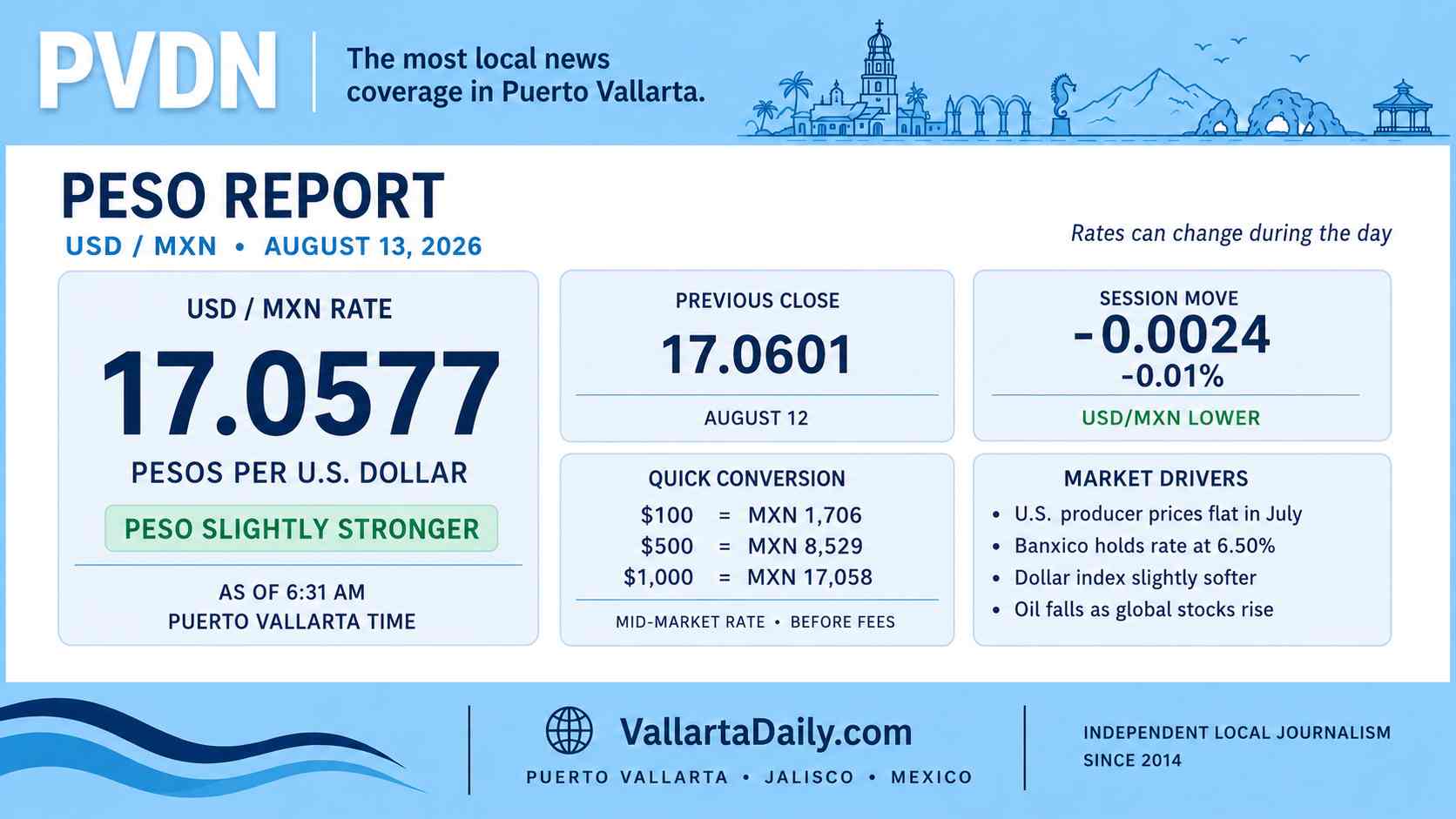
Puerto Vallarta, Jalisco, August 13, 2026 – The Mexican peso held close to 17.06 per dollar early Thursday. Live foreign-exchange data placed USD/MXN at 17.0577 at 6:31 a.m. Puerto Vallarta time.
The rate was 0.0024 peso, or about 0.01%, below Wednesday’s close of 17.0601. A lower USD/MXN quote means the peso is stronger, although Thursday’s initial movement was too small to represent a material change.
The currency pair had traded between 17.0468 and 17.0806 during the session, according to intraday market data. Exchange rates can move throughout the day, and bank, card, ATM and exchange-house quotes will differ from the wholesale midpoint.
U.S. inflation data keeps the dollar contained
The peso’s quiet opening came as markets processed two U.S. inflation reports and reassessed the likelihood of another Federal Reserve rate increase.
The U.S. Producer Price Index, released at 6:30 a.m. Puerto Vallarta time, was unchanged in July. Producer prices were 4.7% higher than a year earlier, down from 5.5% in June. Services prices rose 0.2% during the month, while goods prices fell 0.7%.
USD/MXN remained near 17.06 in the first minute after the report. The limited reaction showed no immediate break from the narrow range in place before the data.
Wednesday’s Consumer Price Index report showed U.S. prices rising 0.1% in July and 3.4% over 12 months. Annual inflation eased from 3.5% in June. Core inflation, which excludes food and energy, was 2.5%.
The readings reduced some pressure for an immediate Fed rate increase, although U.S. inflation remains above the central bank’s 2% goal. In early Thursday trading, the dollar index was down about 0.08% at 99.90, while traders assigned a 65% probability that the Fed would leave rates unchanged in September, according to global market pricing.
The Federal Reserve maintained its target rate at 3.50% to 3.75% in July. Three voting members favored a quarter-point increase, leaving the policy outlook dependent on incoming inflation and employment data.
Banxico preserves Mexico’s interest-rate advantage
Mexico continues to offer a substantially higher benchmark interest rate than the United States, a difference that has helped support demand for the peso.
The Bank of Mexico held its policy rate at 6.50% on August 6. The unanimous decision extended a pause that began in June. Banxico said maintaining that rate in the near term would be appropriate, while warning that trade policy, geopolitical conflict and persistent core inflation remain risks.
Mexico’s headline inflation rate fell to 3.12% in July, according to INEGI’s national consumer-price report. That placed the headline rate close to Banxico’s 3% target, but core inflation remained higher at 3.95%.
The gap between Mexican and U.S. interest rates can make peso-denominated assets more attractive. It does not prevent the currency from weakening when trade tensions, political risk or a broad flight to the dollar dominates global markets.
Oil and trade talks add a mixed backdrop
Global risk appetite was moderately positive Thursday, with European and U.S. stock futures rising. Oil moved in the opposite direction after weaker demand projections and a large increase in U.S. crude inventories.
Brent crude fell 1.7% to $87.44 per barrel, while U.S. crude dropped 1.9% to $81.66. Continued tension involving Iran and the Strait of Hormuz kept the risk of renewed energy-price volatility in the market.
Lower oil prices can reduce global inflation concerns and support risk-sensitive currencies. The effect on Mexico is more complicated because the country is also an oil producer. Thursday’s small peso move did not point to a clear oil-driven direction.
Trade policy remains another background risk. A report citing people familiar with bilateral discussions said Mexico is pressing the United States to reduce automotive tariffs and expand the share of Mexican and Canadian vehicle content that enters duty-free.
No completed agreement has been announced. The proposal should be treated as a negotiating position, although changes affecting Mexico’s automotive exports could eventually influence economic forecasts and the peso.
Puerto Vallarta dollar budgets receive fewer pesos
At the 17.0577 wholesale midpoint, $100 converted to approximately 1,706 pesos. A $500 conversion equaled about 8,529 pesos, while $1,000 equaled about 17,058 pesos before fees or exchange-rate spreads.
On August 6, the market closed at 17.2109. A $1,000 conversion at that rate produced roughly 17,211 pesos, about 153 pesos more than Thursday morning’s midpoint.
The peso’s recent strength therefore reduces local purchasing power for households paid in dollars or drawing from dollar savings. People earning in pesos face a slightly lower peso cost when converting money for expenses denominated in dollars.
The official exchange-rate indicator published for August 13 was 17.0627 pesos per dollar. That government reference is separate from the retail rates offered by banks, cards, ATMs and exchange houses, where fees and spreads determine the amount a customer actually receives.