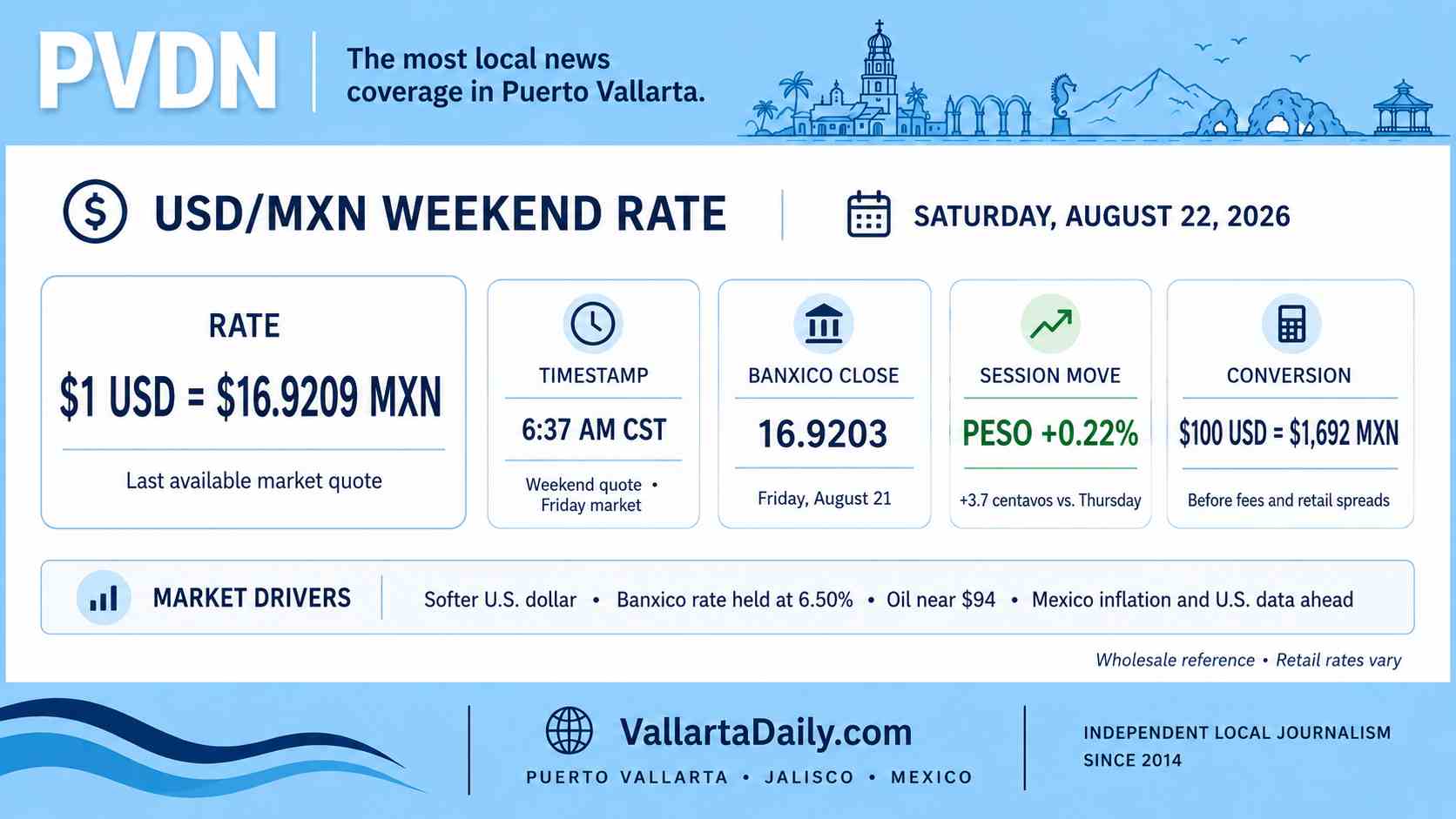
Puerto Vallarta, Jalisco, August 22, 2026 – The Mexican peso entered the weekend near 16.92 per U.S. dollar after strengthening during Friday’s session. A market quote checked at 6:37 a.m. Mexico City time on Saturday showed USD/MXN at 16.9209. That figure reflects the last available market price from Friday because regular wholesale trading is closed for the weekend.
The Bank of Mexico recorded Friday’s closing rate at 16.9203 pesos per dollar, compared with 16.9573 on Thursday. That represents a gain of about 3.7 centavos, or 0.22%, for the peso. The central bank’s separate FIX rate was 16.9018.
Friday marked the peso’s fifth consecutive weekly gain. It advanced about 0.6% during the week and remained below 17 per dollar, near levels last seen in May 2024. Weekend quotes can remain static until trading resumes, and the opening level on Monday may differ.
Dollar weakness supported the peso
Much of Friday’s movement came as the dollar lost ground against major currencies. The dollar index ended the week near 98.74, down almost 0.9%, after touching its lowest level in three months.
Investors were weighing concerns about U.S. debt and fiscal policy alongside a Treasury bond-repurchase program announced during the week. Those pressures weakened the dollar, although rising Treasury yields and stronger U.S. business activity data limited the decline.
The peso tends to benefit when the dollar weakens broadly, but Friday’s move cannot be tied to one factor alone. Currency trading also reflected changing expectations for interest rates, lower summer trading volumes and positioning after several weeks of peso gains.
Oil added another layer of uncertainty. Brent crude traded near $94 per barrel on Friday and gained more than 5% during the week as tensions involving the United States and Iran raised concern about shipments through the Strait of Hormuz. Higher oil prices can help Mexico’s export revenue, but they can also increase inflation pressure and reduce demand for risk-sensitive currencies.
Banxico’s rate pause remains in focus
Mexico’s interest-rate setting continues to offer support to the peso. The Bank of Mexico held its benchmark rate at 6.50% on August 6 and indicated that keeping the rate at its current level would be appropriate.
By comparison, the Federal Reserve’s target range is 3.50% to 3.75%. That gap can make peso-denominated assets attractive to traders seeking higher yields, a strategy known as the carry trade. Its support can fade quickly if expectations for either central bank change or global risk appetite deteriorates.
Banxico’s latest minutes showed that policymakers remain concerned about services inflation, including prices for restaurants, hotels and air travel. Headline inflation slowed to 3.10% in the first half of July, while core inflation was 3.95%.
Mexico’s economy also rebounded by an estimated 1.5% during the second quarter after contracting in the first three months of 2026. Stronger manufacturing exports helped the recovery, although Banxico continues to see downside risks to economic growth.
The exchange rate in household budgets
At 16.9209 pesos per dollar, US$100 converts to approximately 1,692 pesos before bank charges, transfer fees or exchange-house spreads. A 10,000-peso expense equals about US$591 at the same wholesale rate.
The stronger peso means people earning or holding dollars receive fewer pesos than they did at the end of July. Banxico’s closing rate was 17.3207 on July 31. A US$1,000 conversion would therefore produce about 400 fewer pesos at the latest rate, before fees.
People paid in pesos gain purchasing power when buying dollars or paying dollar-denominated expenses. Actual consumer rates will differ from the wholesale figure, especially for cash exchanges, credit cards, ATMs and weekend transactions. The buy and sell rates displayed by banks may be separated by one peso or more.
Monday’s reopening will bring fresh data
Mexico’s first-half August inflation report is scheduled for Monday, followed by additional economic activity and second-quarter GDP data during the week. The figures could affect expectations for how long Banxico keeps its rate at 6.50%.
U.S. inflation, GDP and durable-goods reports will also shape the dollar. Markets will then turn to the Jackson Hole Economic Policy Symposium, running August 27 through 29, for indications about the Federal Reserve’s approach to inflation and future interest-rate changes.
Until regular trading resumes, 16.92 remains the most useful wholesale reference. Retail exchange rates in Puerto Vallarta may vary throughout the weekend.