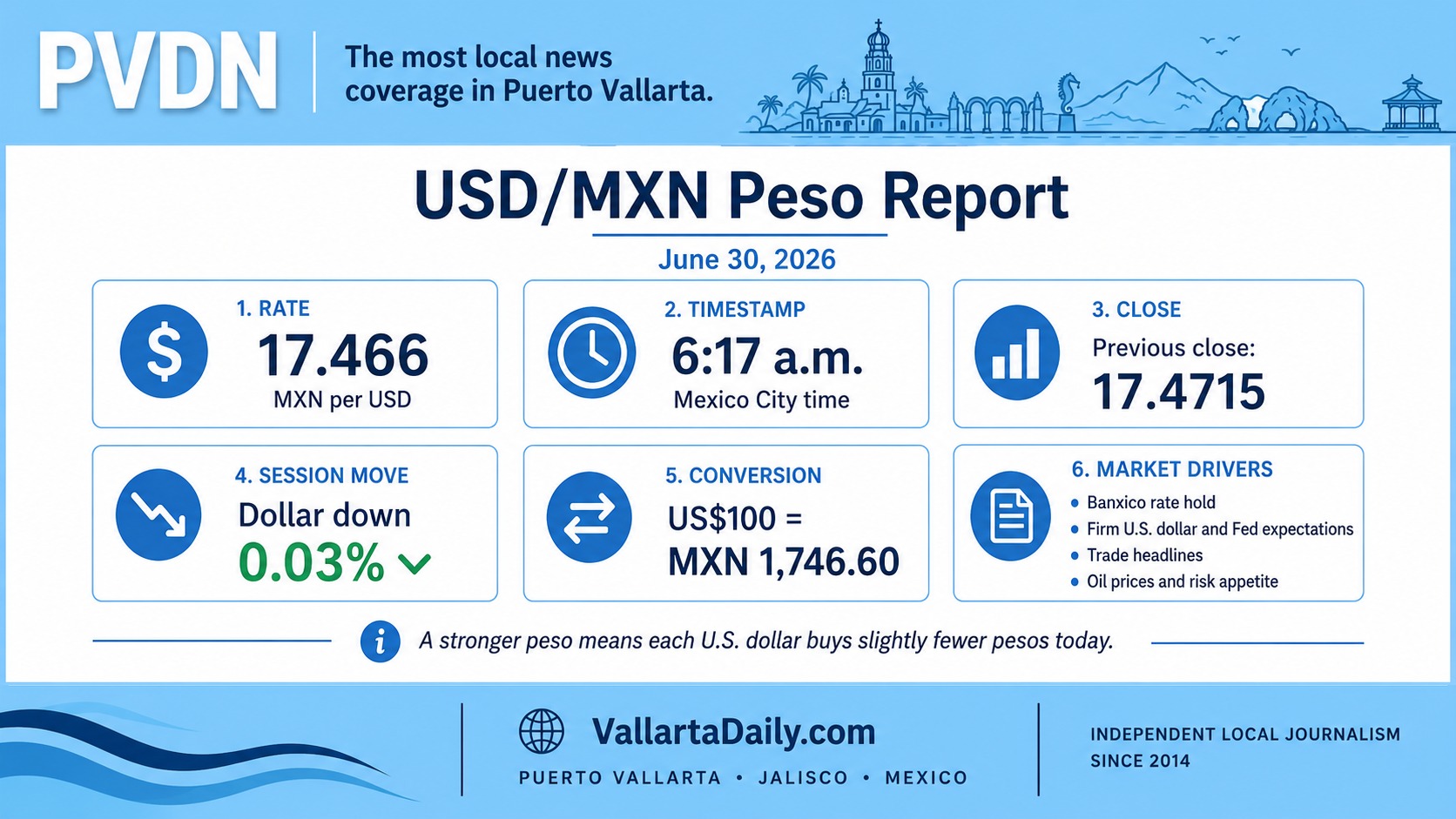
Puerto Vallarta, Jalisco, June 30, 2026 – The Mexican peso opened Tuesday with a small gain against the U.S. dollar, with USD/MXN quoted near 17.466 pesos per dollar at 6:17 a.m. Mexico City time, based on MarketWatch’s live currency quote. The move put the dollar down about 0.03% from Monday’s close of 17.4715 pesos.
The movement was modest, but useful for anyone budgeting in both currencies. At the early-morning mid-market rate, $100 dollars equaled about 1,746.60 pesos, before bank, ATM, exchange-house, or transfer-service spreads.
Peso holds firm in early trading
A lower USD/MXN rate means the peso is stronger against the dollar. Tuesday’s early move kept the currency near the stronger side of its recent range, after several sessions in which the dollar traded roughly between the mid-17.40s and mid-17.60s.
Market data from Trading Economics also showed USD/MXN near 17.4651 on June 30, down about 0.04% from the previous session, while noting that the peso had weakened slightly over the past month but remained stronger than a year earlier.
The Banco de México FIX rate is not a live retail exchange rate. Banxico says the FIX is based on wholesale market quotes and is published on banking business days after noon, while its closing foreign-exchange reference is published later in the day.
Dollar strength limits the peso’s move
The peso’s early gain came despite a firmer U.S. dollar. The U.S. Dollar Index was quoted at 101.38, up 0.27%, at 7:43 a.m. Eastern time, according to MarketWatch.
Global markets were still weighing stronger U.S. rate expectations, a rally in equities, and upcoming U.S. labor and confidence data. Reuters reported Tuesday that the dollar was on track for a quarterly gain as investors adjusted to the possibility that the Federal Reserve could keep policy tighter for longer.
That matters for Mexico because the peso often reacts to the gap between Mexican and U.S. interest rates. When U.S. rate expectations rise, the dollar can become more attractive. When Mexico’s rate remains high by comparison, peso-denominated assets can still draw demand.
Banxico rate pause remains central
Mexico’s central bank remains one of the main supports for the peso. Banxico’s market data showed the target interest rate at 6.50% on June 30.
The rate backdrop follows Banxico’s June decision to hold policy steady. Mexico’s inflation picture has improved, but not enough to remove caution from the central bank’s language. Reuters reported that annual inflation slowed to 3.55% in the first half of June, below expectations, while core inflation remained higher at 4.12%.
For the peso, that mix is important. Softer headline inflation can reduce pressure for higher Mexican rates, but persistent core inflation keeps Banxico from sounding relaxed. Markets are likely to keep watching whether the central bank can maintain a wide enough interest rate gap with the United States without adding pressure on Mexico’s slowing economy.
Trade and oil stay in the background
Trade policy is also part of the currency backdrop. Reuters reported that the U.S. government is expected to formally say it will not extend the USMCA as written, starting a longer review process rather than immediately ending the trade pact. The report said U.S. and Mexican officials are still negotiating proposed changes, including auto-content rules.
Oil was less of a direct driver for Puerto Vallarta households, but it remains part of the broader market tone. Reuters reported Tuesday that oil was heading for its steepest quarterly loss since early 2020, with Brent and WTI both close to pre-war levels after a volatile period tied to the Iran conflict and shipping through the Strait of Hormuz.
Lower oil prices can ease some inflation pressure globally, but the peso’s daily movement is usually shaped more directly by dollar demand, U.S. rate expectations, Mexican rates, trade risk and investor appetite for emerging-market currencies.
Budget math for Puerto Vallarta readers
For residents and visitors earning in dollars, a stronger peso means each dollar buys slightly fewer pesos. The difference is small today, but it can show up in rent, dining, groceries, medical bills, property expenses and tuition when payments are made in pesos.
At the early rate near 17.466, a $1,000 transfer equals about 17,466 pesos before fees and exchange spreads. A rate of 17.70 would put the same $1,000 at about 17,700 pesos, while a rate of 17.25 would put it at about 17,250 pesos.
For people earning in pesos and paying dollar-denominated costs, a firmer peso offers modest relief. For people paid in dollars and spending in Puerto Vallarta, the main practical point is to compare the posted rates from banks, ATMs, exchange houses, and transfer apps against the mid-market quote, because the retail rate can differ meaningfully from the market number.