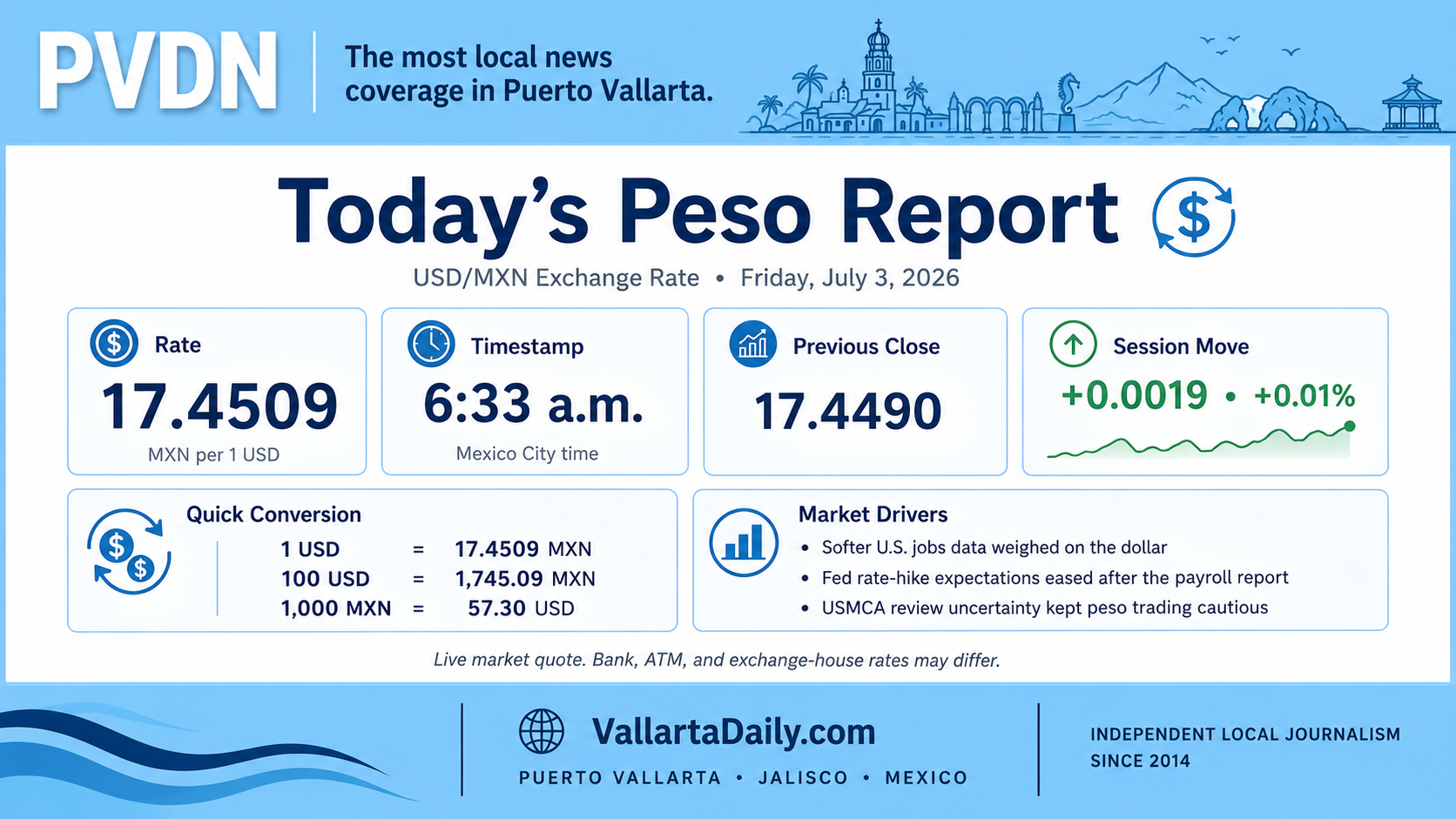
Puerto Vallarta, Jalisco, July 3, 2026 – The Mexican peso was almost unchanged against the U.S. dollar Friday morning, with USD/MXN quoted at 17.4509 at 6:33 a.m. Mexico City time, according to a live market quote. The pair was up 0.01% from the previous close of 17.4490, with the morning range listed between 17.4181 and 17.4992.
For people in Puerto Vallarta earning, saving, or budgeting in dollars and pesos, that rate means $100 was worth about 1,745 pesos before bank fees, ATM charges, exchange-house spreads, or card-network conversion costs.
The morning move was narrow. A softer U.S. dollar gave the peso some support, while uncertainty around North American trade policy kept traders from treating the peso’s strength as a clean one-way move.
Morning Rate and Official Reference
The rate above is a live market quote, not the official daily FIX. Banco de México publishes the FIX after 12:00 p.m. on banking days, based on wholesale foreign-exchange market quotes for settlement on the second banking day after the trade date.
That distinction matters for readers comparing rates. The number shown on a market screen, the Banxico FIX, a bank’s exchange rate, and a cash exchange-house rate can all differ.
Softer Dollar After U.S. Jobs Data
The peso’s morning stability came as the U.S. dollar was headed for its largest weekly drop since April after softer U.S. employment data reduced expectations for near-term Federal Reserve tightening. Global market reporting showed the dollar index at 100.77, down 0.6% for the week.
U.S. employers added 57,000 jobs in June, below the 110,000 expected in a Reuters poll, and traders cut the perceived odds of a July Fed rate hike to below 20%. September was still priced as more likely, but less strongly than before the jobs report.
U.S. markets were closed Friday for the Independence Day holiday, which can reduce liquidity and make currency moves more exaggerated during parts of the session.
Oil was not the main peso driver Friday morning, but it remained part of the broader inflation backdrop. Brent crude was steady near $71.80 as global stocks rose and investors absorbed the weaker U.S. jobs data.
Mexico’s Trade and Rate Backdrop
Mexico-specific attention remains on the USMCA review. The United States declined this week to extend the trade agreement in its current form, starting a long countdown toward possible expiration while seeking changes. The pact remains active, but the decision adds annual review pressure and keeps trade policy in the background for peso trading.
Mexico’s Economy Minister Marcelo Ebrard said the government is looking to address U.S. concerns in the negotiations, including concerns about dependence on foreign trade.
The interest-rate backdrop is also part of the peso story. Banco de México kept its overnight interbank funding rate unchanged at 6.50% on June 25, after earlier rate cuts this year. Higher Mexican rates can support peso demand, but traders are watching whether Banxico’s pause holds if inflation and growth data continue to soften.
A Reuters poll conducted from June 26 to July 1 placed the median one-year forecast for USD/MXN at 17.78, modestly weaker than recent levels, while citing USMCA uncertainty and possible Banxico rate cuts as risks for the currency.
A Practical Rate for Local Budgets
For Puerto Vallarta households and businesses, today’s rate does not mark a large shift from the recent session. It does, however, keep the peso on the stronger side of the levels many residents and visitors used for budgeting in past years.
People who paid in dollars and spent in pesos still had more purchasing power than they would at 16 pesos per dollar, but less than they would during periods when USD/MXN was above 18 or 19. People earning pesos and paying dollar-linked expenses, such as some rents, subscriptions, travel costs, or imported goods, continue to benefit when the dollar stays near the mid-17s.
The rate can change through the day. Friday’s trading is shaped by light U.S. market activity, Fed expectations after the jobs report, and continuing trade-policy headlines tied to North America.