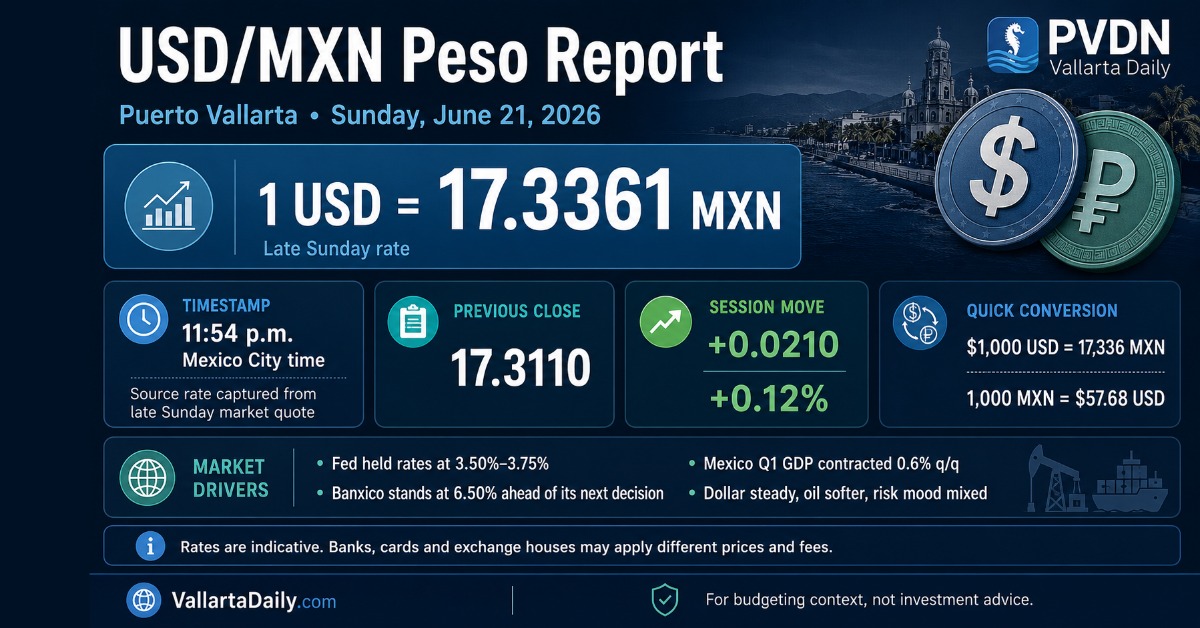
Puerto Vallarta, Jalisco, June 21, 2026 – The U.S. dollar was trading near 17.34 pesos late Sunday, with XE’s mid-market feed showing $1 USD at 17.3361 pesos as of 05:54 UTC Monday, or 11:54 p.m. Sunday in Mexico City.
Because June 21 was a Sunday, the rate should be read as a late-weekend market quote rather than a same-day banking-session fixing from Banco de México.
Market feeds showed a narrow move around the 17.33 level. Investing.com’s USD/MXN page listed the pair near 17.33, with a previous close of 17.3110 and a daily range between 17.3164 and 17.3685.
The peso was little changed in late trading, with the dollar only slightly higher against the Mexican currency on some market feeds. The move was modest enough that travelers, residents, and businesses would see a bigger difference from bank spreads, card fees, or exchange-house pricing than from the market shift itself.
For official reference, Banco de México’s exchange-rate table lists 17.3688 pesos as the latest rate used for dollar-denominated obligations payable in Mexico. That official rate is not the same as the live mid-market price used by currency feeds.
The dollar’s tone was still being shaped by last week’s U.S. rate decision. The Federal Reserve held its target range at 3.50% to 3.75% on June 17 and said inflation remained above its 2% goal, with energy-related price pressure still part of the outlook.
Higher-for-longer U.S. rates can support the dollar and reduce some of the peso’s interest-rate advantage. The connection is not automatic, but it is one of the main factors traders watch when the peso is near recent strong levels.
Broader market signals were mixed late Sunday. The dollar index was nearly flat, while crude oil prices were lower on major market feeds. Lower oil can ease some inflation concerns, but Mexico-specific currency moves still depend more on rates, growth data, risk appetite, and U.S.-Mexico trade expectations.
In Mexico, the next major domestic event for currency markets is Banco de México’s June policy decision. At its May meeting, Banxico lowered its overnight interbank rate by 25 basis points to 6.50% and said it expected to keep the reference rate at that level for now.
Mexico’s growth data also remains part of the peso story. INEGI reported that gross domestic product contracted 0.6% from the previous quarter in the first quarter of 2026, while annual growth remained positive but limited.
For the peso, that leaves traders balancing two forces: Mexico still offers a relatively high interest rate, but weaker economic activity can undermine confidence if it signals slower investment, consumption, or exports.
For Puerto Vallarta readers earning in dollars and spending in pesos, a rate near 17.33 means $1,000 USD converts to about 17,330 pesos before fees or exchange spreads. A 1,000-peso purchase equals about $57.70 at the same mid-market level.
Small daily changes can add up to large amounts for rent payments, school fees, medical bills, property expenses, or business transfers, but the posted exchange rate is only part of the final cost. Banks, ATMs, credit cards, and exchange houses usually apply their own rates and fees.
For households earning in pesos and paying dollar-linked costs, the peso holding near 17.33 keeps the dollar below the levels seen during weaker-peso periods, but it does not remove exposure to sudden moves. The practical point for budgeting is to check the rate close to the time of payment and compare it with the actual rate offered by the service being used.