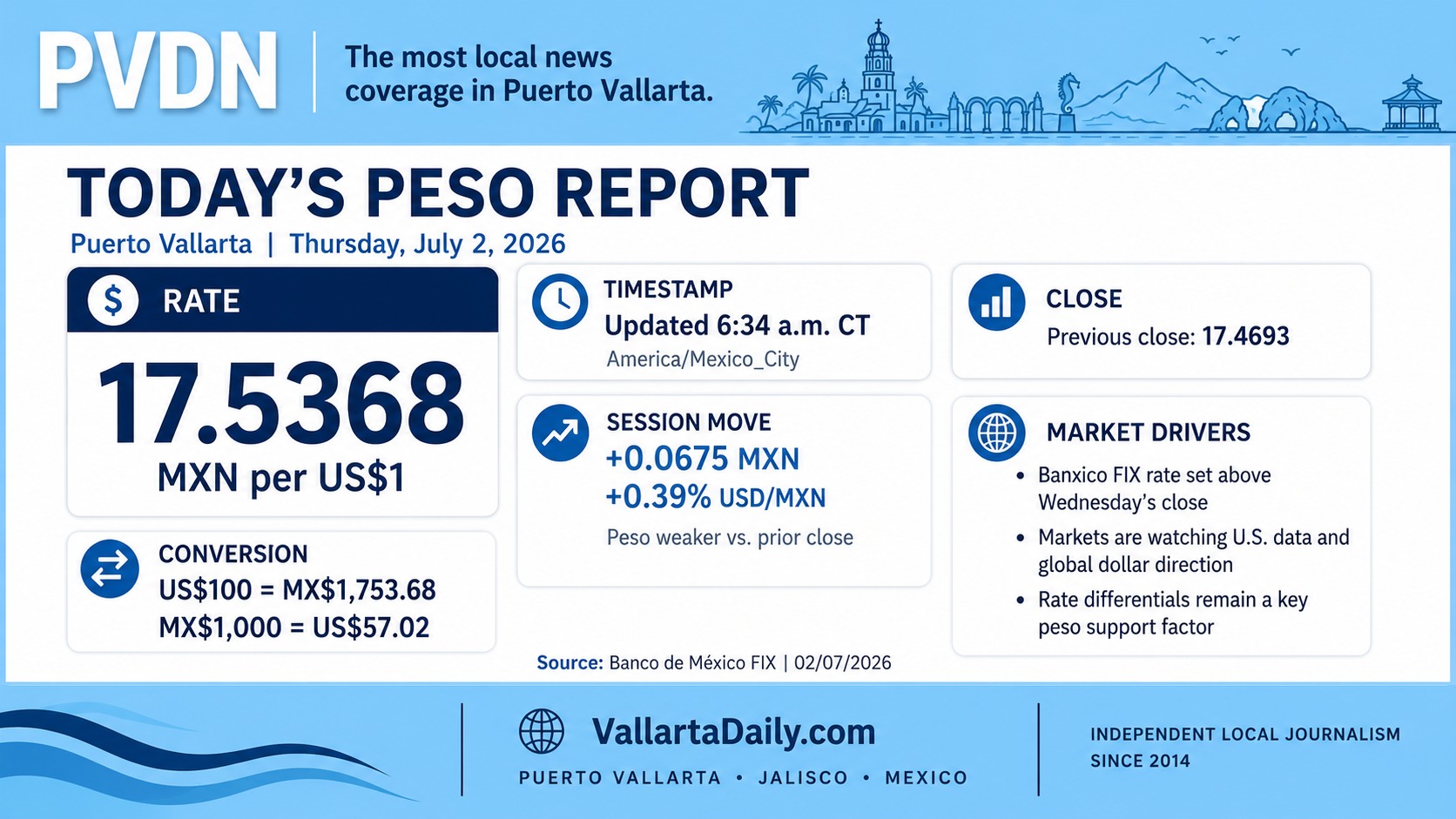
Puerto Vallarta, Jalisco, July 2, 2026 — The Mexican peso was trading slightly weaker Thursday morning, with USD/MXN at 17.5591 pesos per dollar at 8:19:42 a.m. on the live quote display, up 0.07% from a previous close of 17.5470. The day’s trading range was listed between 17.5219 and 17.5734, keeping the peso in a narrow band during the morning session.
For readers in Puerto Vallarta who earn, save, or budget in dollars, that market rate puts $100 at about 1,756 pesos and $1,000 at about 17,559 pesos before bank spreads, ATM fees, card exchange rates, or money-transfer charges.
The move was small, but the direction matters: a higher USD/MXN rate means the dollar buys slightly more pesos, while the peso is marginally weaker against the dollar.
The peso this morning
The peso’s early move came during a busy U.S. data session. The U.S. Bureau of Labor Statistics reported that nonfarm payroll employment rose by 57,000 jobs in June, while the unemployment rate was little changed at 4.2%. The report also revised April and May job gains lower by a combined 74,000 jobs, giving markets a softer read on U.S. labor momentum than previously reported.
A softer U.S. labor report can reduce pressure on the Federal Reserve to raise rates, which often weighs on the dollar. The peso did not strengthen sharply after the data, however, reflecting the mixed nature of the session and the fact that currency traders are also watching global risk appetite, oil prices, and the interest-rate gap between Mexico and the United States.
Banxico remains part of the peso story
Mexico’s central bank is still giving the peso some support through relatively high interest rates, but that support is being watched more closely after the Bank of Mexico paused its easing cycle.
In its June 25 monetary policy statement, Banco de México kept the overnight interbank rate at 6.50% and said Mexico’s economy was expected to expand in the second quarter after contracting in the previous one. The central bank also said headline inflation fell from 4.45% in April to 3.55% in the first half of June, while core inflation eased from 4.26% to 4.12%. Banxico said inflation risks remain tilted upward and that it expects to keep the reference rate at its current level for now.
That matters for the peso because Mexico’s higher rates have helped attract carry-trade demand in recent years. If investors start to believe Banxico will cut again while the Fed stays firm, some of that support can weaken. If Banxico keeps rates steady and inflation continues to cool, the peso may remain more resilient.
A Reuters poll published Wednesday found analysts expect the peso to trade near 17.78 per dollar in 12 months, implying only slight depreciation from Tuesday’s level of 17.48. The same poll noted that uncertainty around the future of the USMCA trade pact and Banxico’s policy bias remain risks for the currency.
Dollar, oil and risk appetite
The broader dollar backdrop was mixed Thursday. Global markets were focused on U.S. jobs data, Federal Reserve expectations, and a pullback in chip stocks. Reuters reported earlier in the session that the dollar had eased against several major currencies while traders waited for the payrolls report, and that Brent crude had fallen to fresh four-month lows as oil markets reacted to signs of progress in U.S.-Iran talks.
Lower oil prices can ease some global inflation concerns, but the effect on Mexico is not one-directional. Cheaper fuel can reduce pressure on some consumer and business costs, while lower crude prices can also affect Mexico’s public finances and energy-related revenue. For the peso, oil is one factor among several, not the whole story.
Mexico’s near-term data calendar is light today. The next local release on the market calendar is June consumer confidence, scheduled for Friday, with the previous reading listed at 43.50.
The rate residents will actually feel
The live market rate is not the same as the rate most people receive at a bank, ATM, exchange house, credit card processor, or money-transfer service. Those rates can vary by institution and by the size and type of transaction.
Banxico’s official exchange-rate table listed 17.5368 as the Diario Oficial de la Federación publication rate for July 2, while the July 2 FIX determination was not yet available in the table at the time checked. That official rate can matter for contracts, accounting, and some formal obligations, but it is not the same as a retail exchange counter rate.
For Puerto Vallarta households, the day’s move is modest. Dollar earners spending in pesos have a slightly better conversion than at Wednesday’s close. Peso earners paying dollar-linked rent, HOA fees, tuition, travel, or imported goods face a slightly higher dollar cost. The difference is not large enough to affect most daily budgets, but it is worth checking the actual bank and card rates before making larger transfers or payments.