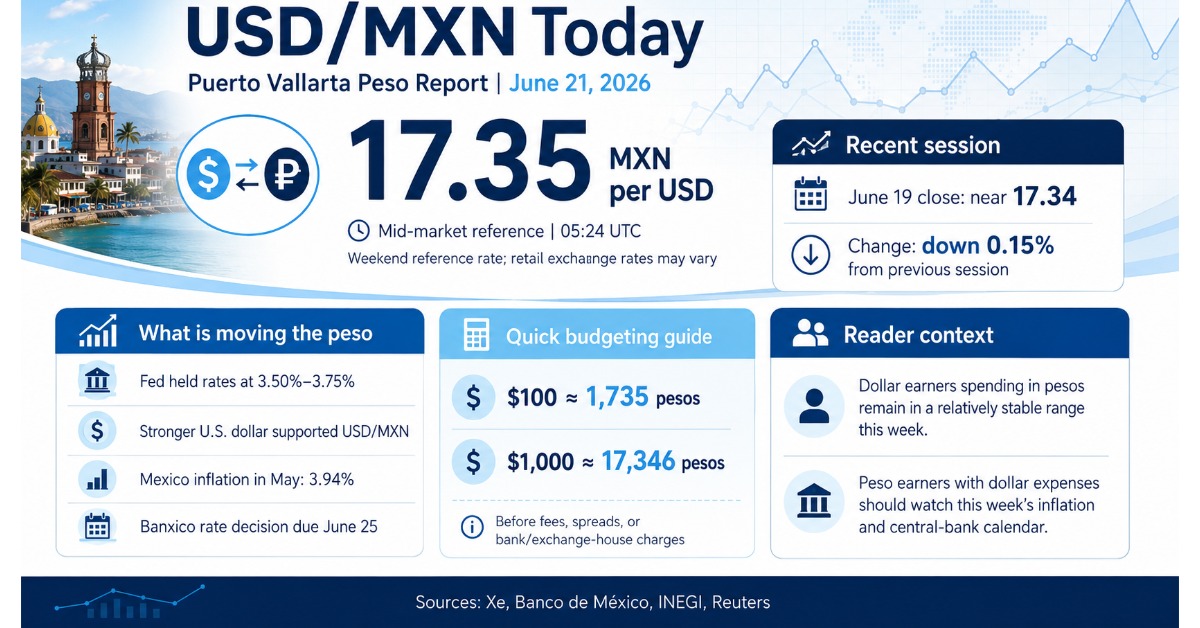
Puerto Vallarta, Jalisco, June 21, 2026 – The U.S. dollar was trading near 17.35 Mexican pesos early Sunday, leaving the peso broadly steady after a week shaped by a stronger dollar, Federal Reserve signals, and Mexico’s next inflation and interest-rate markers.
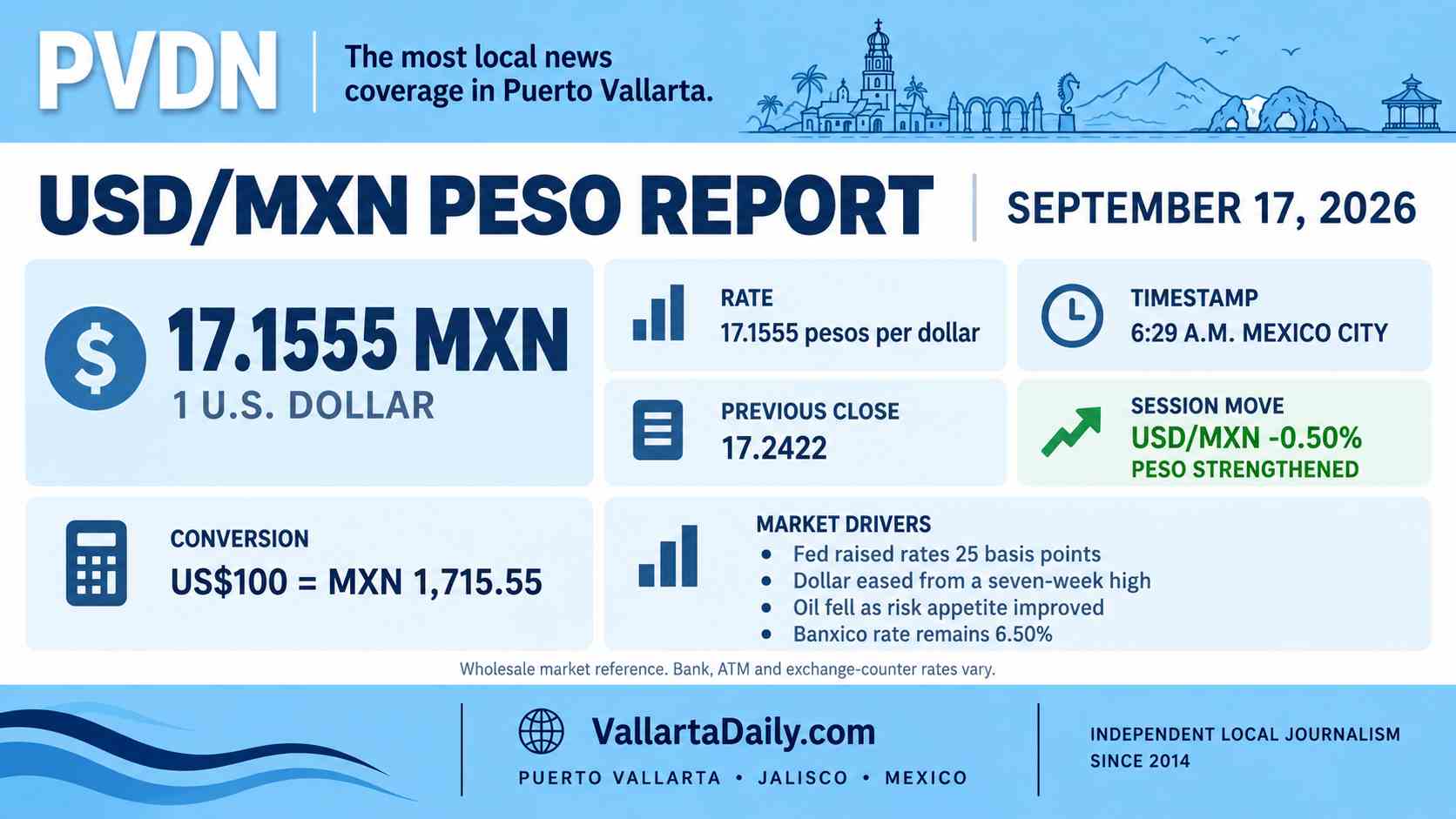
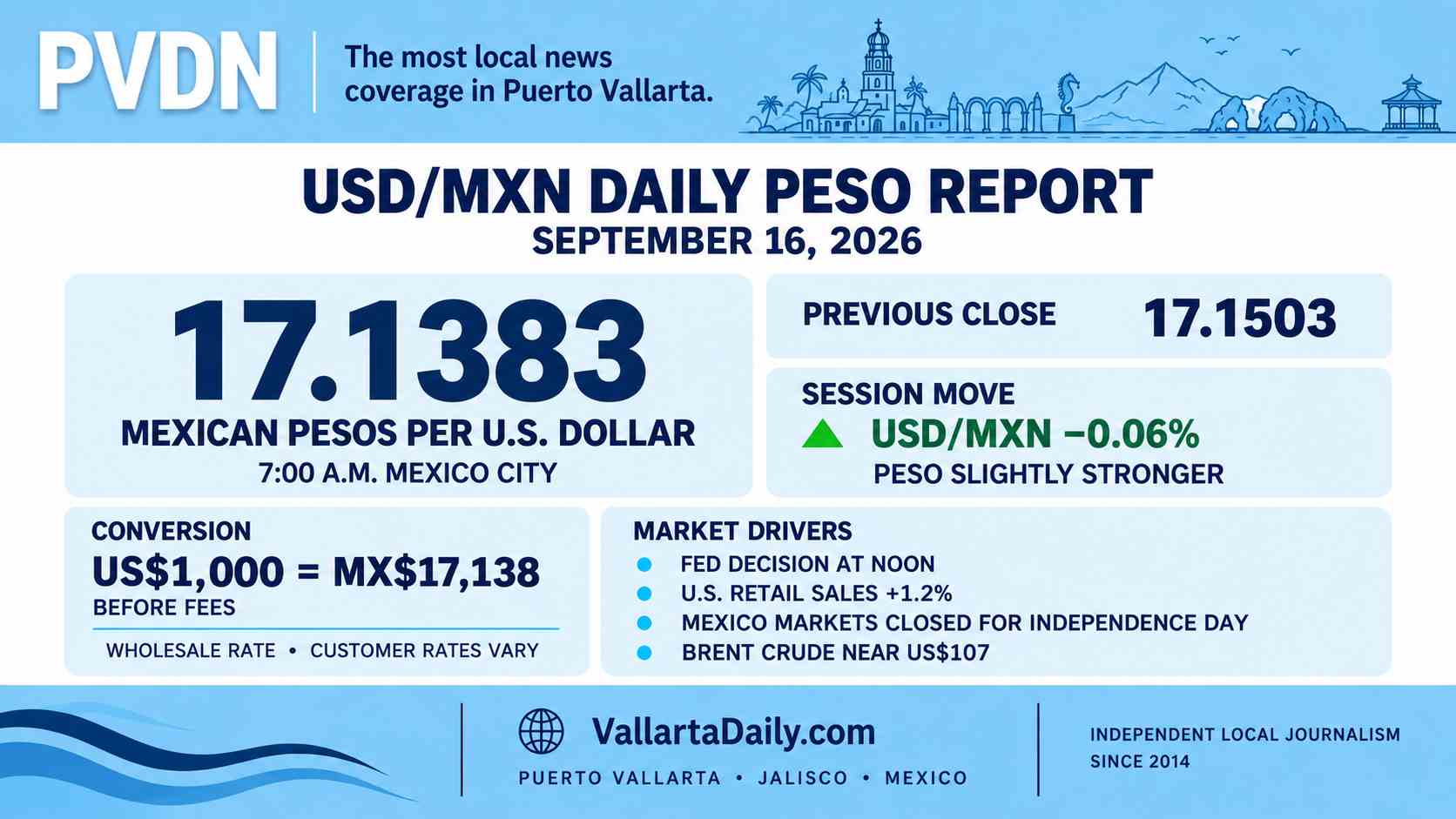
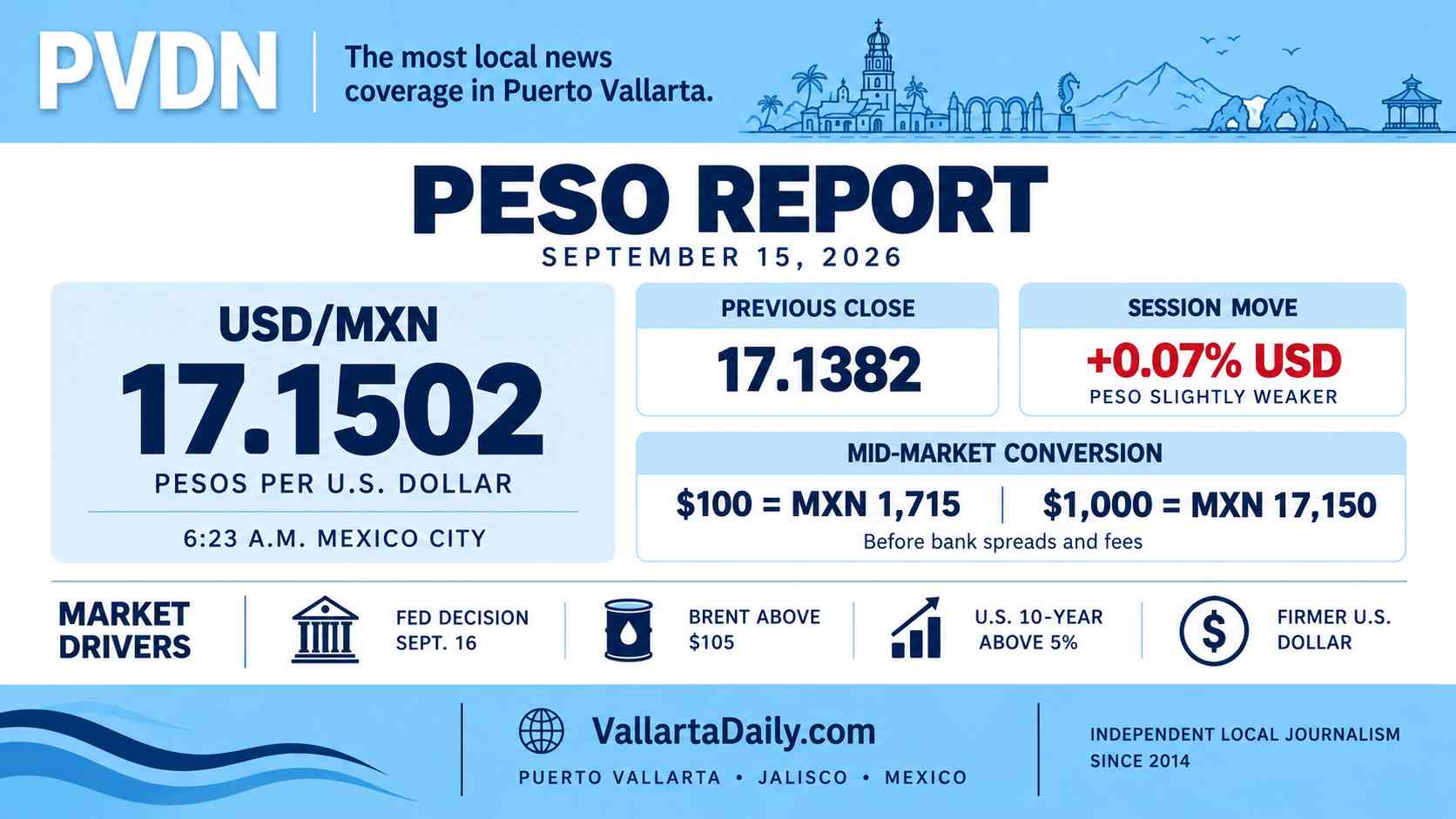
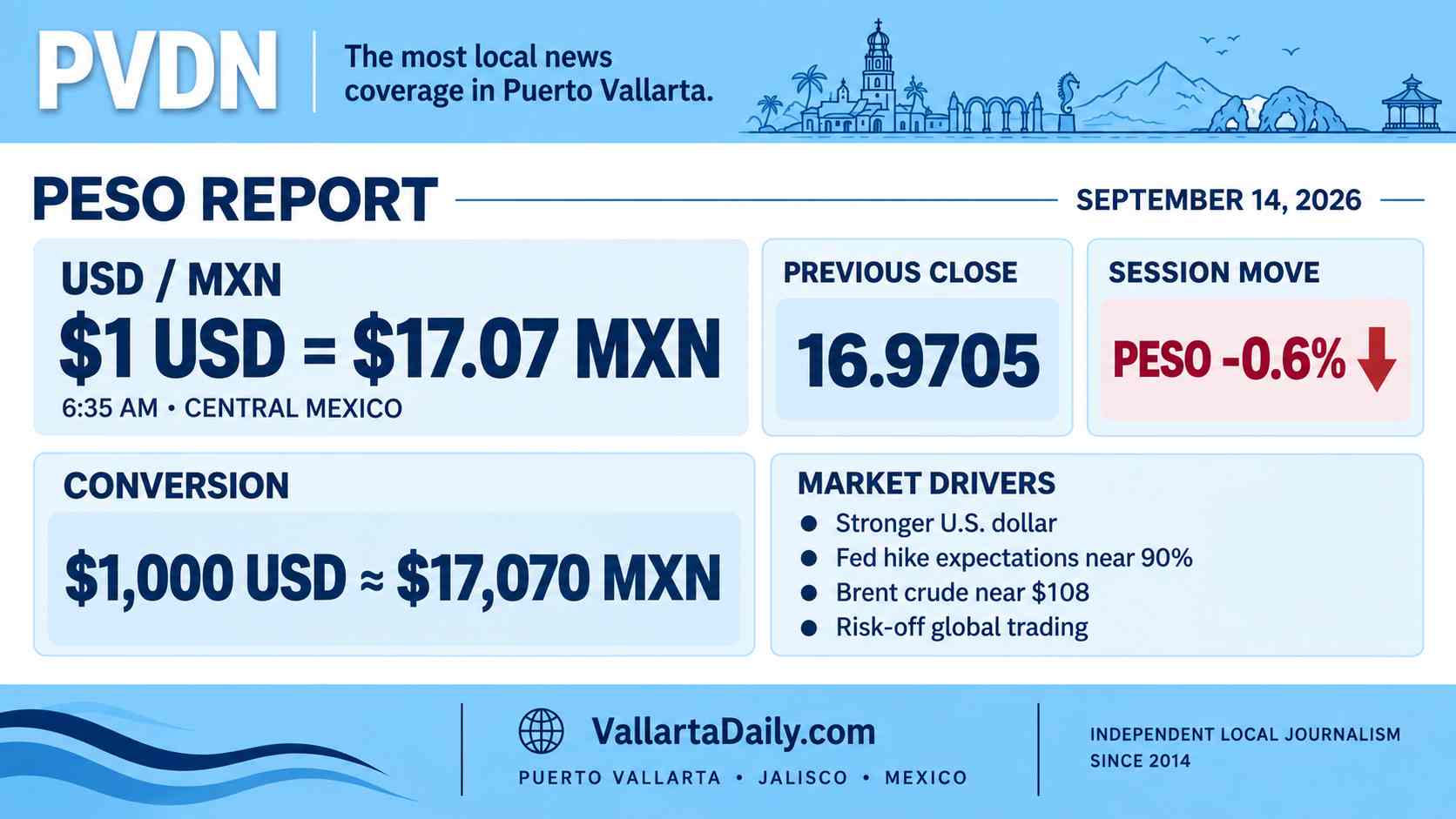
The mid-market USD/MXN rate was 17.3464 pesos per dollar at 05:24 UTC on June 21, according to Xe market data. That timestamp is late Saturday night in Puerto Vallarta and Mexico City, so readers should treat the number as a weekend market reference, not the exact rate available at a bank, exchange window, or transfer service.
The latest available market session data showed USD/MXN in a similar range. Trading Economics listed USD/MXN at near 17.34 on June 19, down 0.15% from the previous session, while Banco de México publishes its official FIX only on banking business days.
Rate check for Sunday
At 17.3464, $100 equals about 1,735 pesos before fees, spreads, or different retail exchange rates. A $1,000 dollar transfer would equal about 17,346 pesos at the mid-market rate, but the amount received can be lower once a bank, card network, exchange house, or money-transfer provider applies its own rate and charges.
For Puerto Vallarta residents and visitors, the practical point is that the peso remains in a relatively firm zone compared with much of the past two years. That helps people spending pesos from dollar income, but it also means each U.S. dollar is buying fewer pesos than it did during periods when USD/MXN was above 18 or 19.
Weekend exchange quotes can vary more at retail counters. Airport exchange desks, hotel desks, ATMs, credit card networks, and bank apps may all show different rates because they are not quoting the same market product.
Dollar pressure returned after the Fed
The main outside pressure on the peso came from the U.S. dollar, not from a Mexico-specific shock. The dollar strengthened last week after the Federal Reserve held its policy rate in the 3.50%-3.75% range and new projections showed that some officials expect a rate increase later this year, according to Reuters reporting on the Fed decision.
That matters for USD/MXN because a stronger dollar can lift the exchange rate even when the peso is not under broad local stress. Higher U.S. rate expectations can also make dollar-denominated assets more attractive, reducing demand for emerging-market currencies, including the peso.
Oil and geopolitical risk remain part of the background. Crude prices fell sharply earlier in the week after an interim U.S.-Iran deal raised hopes that the Strait of Hormuz could reopen, but the situation remained unsettled as negotiations and regional fighting continued. Reuters reported that Brent settled below $79 per barrel on June 16 after the deal news, while subsequent market updates pointed to continued uncertainty about the agreement.
Mexico data in the peso mix
Mexico’s own calendar is active this week. INEGI’s most recent monthly inflation report showed annual inflation at 3.94% in May, with core inflation at 4.19%, according to the June 9 INPC release. The next inflation reading, for the first half of June, is expected this week.
Banco de México is also scheduled to publish its next monetary-policy decision on June 25, according to the central bank’s 2026 publication calendar. That decision will be watched because Mexico’s benchmark rate remains above the U.S. rate, but the advantage has narrowed as Banxico cut rates and the Fed turned more cautious about inflation.
Mexico’s broader economy is another factor. The economy contracted 0.6% in the first quarter from the previous quarter, while growing only 0.2% from a year earlier, according to Reuters reporting on INEGI data. Slower growth can support the case for lower Mexican rates, but sticky core inflation can limit how quickly Banxico moves.
U.S. inflation data is the next dollar test
The U.S. calendar also matters for the peso. Markets are watching the May Personal Consumption Expenditures price index, the Fed’s preferred inflation measure, due Thursday, June 25. A stronger reading could reinforce the Fed’s cautious stance and keep support under the dollar. A softer reading could ease some pressure.
That does not mean a single data point will determine the peso’s direction. USD/MXN is moving inside a mix of rate expectations, oil prices, global risk appetite, and Mexico’s own inflation and growth outlook.
Budget notes for dollar and peso households
For people in Puerto Vallarta earning in dollars and spending in pesos, today’s rate keeps day-to-day purchasing power close to last week’s levels. The bigger concern is planning around fees and spreads. A published mid-market rate near 17.35 does not mean a retail transaction will clear at 17.35.
For people earning in pesos and paying in dollars, including some rents, tuition, travel, insurance, or imported goods, the dollar remains manageable compared with weaker-peso periods, but any move back toward 17.50 or 18.00 would quickly raise monthly costs.
For budgeting, the safer approach is to leave room for movement around this week’s inflation and central-bank calendar. The peso is calm today, but the next few sessions will give markets fresh information from both sides of the border.