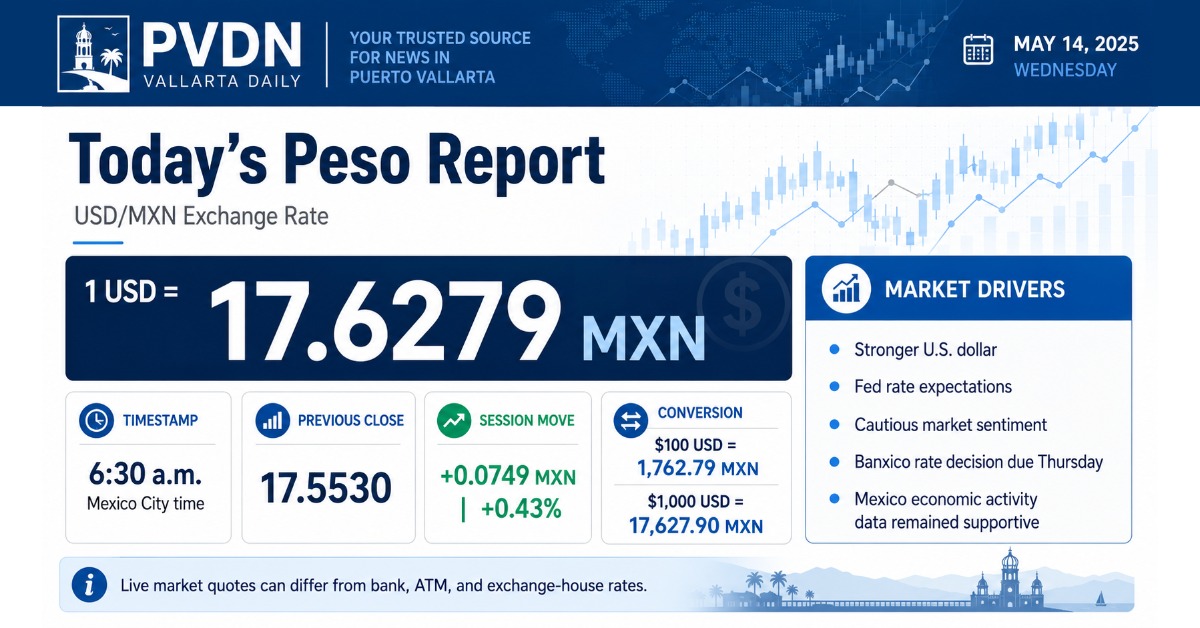
Puerto Vallarta, Jalisco, June 24, 2026 – The U.S. dollar traded near 17.63 pesos on Wednesday morning, giving the dollar a modest gain against the Mexican peso as global markets moved back toward the dollar.
As of 6:30 a.m. Mexico City time, Bloomberg Línea’s USD/MXN quote showed the exchange rate at 17.6279 pesos per dollar, up 0.43% from a previous close of 17.5530. That is a move of about 7.5 centavos per dollar.
Investing.com Mexico showed the dollar near 17.62 pesos, with its historical table placing Wednesday’s trading range between roughly 17.54 and 17.64. Market quotes can change quickly during the session, and bank, ATM, credit card, and exchange-house rates in Puerto Vallarta will include their own spreads and fees.
Market rate and official FIX are not the same
The live USD/MXN rate is the market price used by traders and financial platforms. Mexico’s official reference rate is different.
The Diario Oficial de la Federación listed the official dollar rate for June 23 at 17.3480 pesos. Banco de México uses the FIX rate as a reference for obligations denominated in U.S. dollars and payable in Mexico. That rate is not the same as the price a visitor will see at an airport exchange counter or the rate a resident may receive from a bank transfer.
For people budgeting in Puerto Vallarta, the practical number is usually the rate applied by the card issuer, bank, transfer service, or exchange counter. The market quote gives the direction of the move. The actual pesos received can be lower after fees.
Dollar strength sets the morning tone
The peso’s weaker tone came as the dollar strengthened broadly. Reuters reported that the dollar index reached a 13-month high on Wednesday as investors priced in a greater chance of Federal Reserve rate hikes and moved toward safer assets after volatility in technology shares.
USD/MXN often responds to shifts in dollar demand, U.S. rate expectations, and risk appetite. A stronger dollar can push the pair higher even when Mexico’s own economic data is not weak.
Oil also moved lower on Wednesday. A separate Reuters global markets report said crude prices fell more than 2% and traded near four-month lows as more tanker movement appeared possible through the Strait of Hormuz. Lower oil prices can ease some inflation concerns, but Wednesday’s peso move was more closely tied to dollar strength and cautious positioning.
Investors are also watching U.S. inflation data due out Thursday. Reuters said markets are awaiting the Personal Consumption Expenditures price index, the Federal Reserve’s preferred inflation measure, for further signals on the path of U.S. rates.
Mexico data gives the peso some local support
Mexico’s domestic backdrop was not all negative for the peso. INEGI’s latest IGAE data showed Mexico’s economic activity increased 1.2% month over month in April and 2.2% from a year earlier. The data was updated on June 23.
Reuters reported that the April expansion was the strongest monthly increase in more than five years and beat analyst expectations, supported by construction, manufacturing, and services.
The next Mexico-specific market event is Banco de México’s monetary policy announcement on Thursday, June 25. Banxico’s most recent decision left the benchmark rate at 6.50% after a 25-basis-point cut in May, when the central bank said it was ending its easing cycle. Inflation has cooled, but core inflation remains a concern for policymakers.
For Vallarta wallets, the spread matters
For residents, retirees, property owners, and visitors spending dollars in pesos, Wednesday’s move gives dollar earners a little more buying power than the previous close. On a $1,000 conversion, a move from 17.5530 to 17.6279 pesos is worth about 75 extra pesos before bank fees or exchange spreads.
That is useful for daily budgeting, but it is not a major shift in local costs. Rent, groceries, restaurant bills, maintenance payments, and medical expenses still depend on the payment provider’s actual rate.
For people earning in pesos and paying dollar-denominated costs, the move works the other way. Flights, imported goods, U.S. subscriptions, and dollar invoices become slightly more expensive when USD/MXN rises.