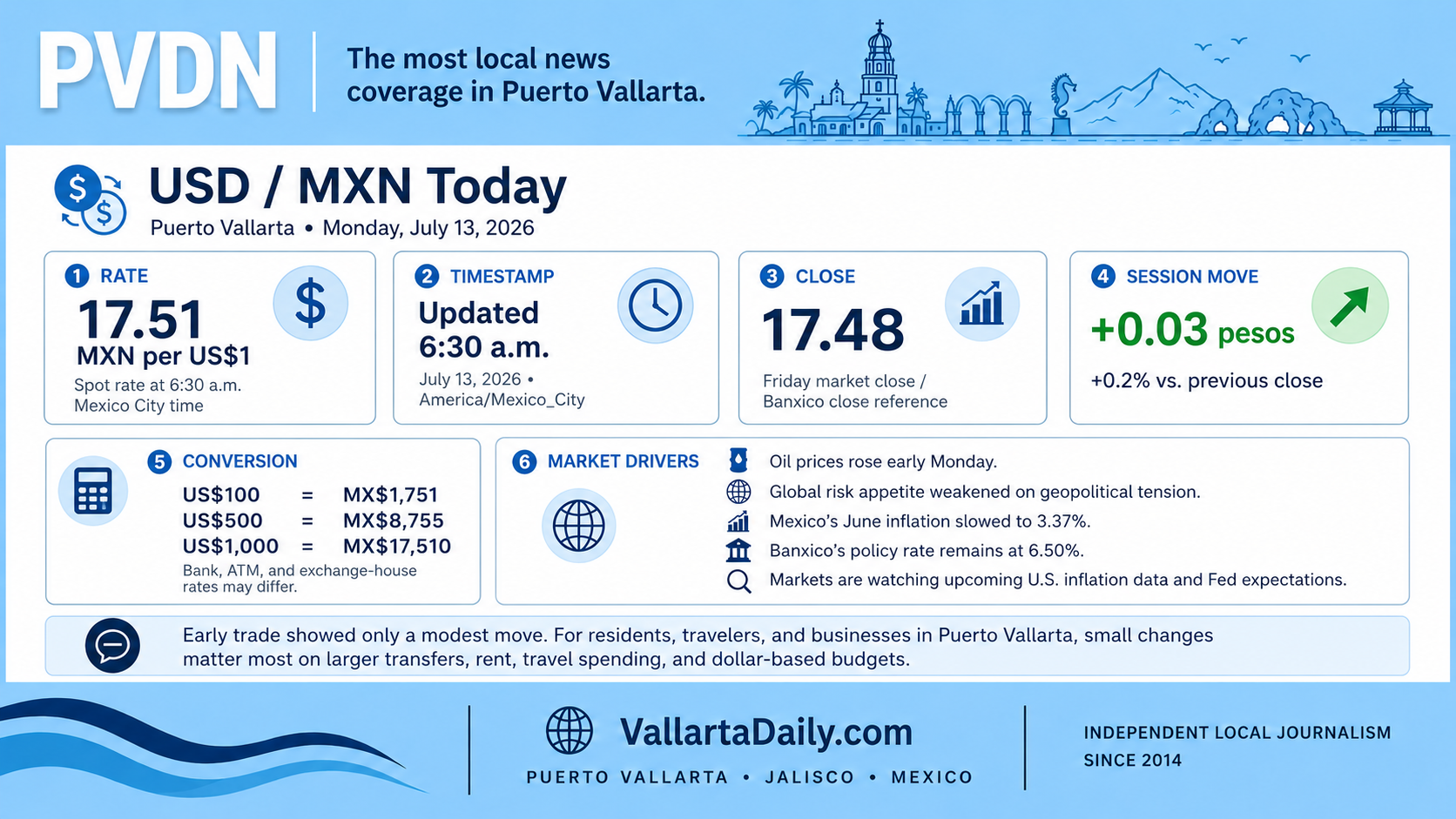
Puerto Vallarta, Jalisco, July 13, 2026 – The Mexican peso opened Monday near 17.49 per U.S. dollar, little changed from the end of last week as traders weighed rising oil prices, geopolitical tensions, and the outlook for interest rates in Mexico and the United States.
At approximately 6:30 a.m. Mexico City time, the live USD/MXN market rate was about 17.48 to 17.49 pesos per dollar, roughly 0.1% above the previous session. A higher USD/MXN quotation means the dollar has strengthened and the peso has weakened.
Banco de México reported a Friday market closing rate of 17.4779 pesos per dollar. Its FIX reference rate, used for certain official and contractual purposes, was 17.4842.
Oil and global risk set the early tone
The peso’s modest decline came as global markets reacted to renewed military exchanges between the United States and Iran and concerns about shipping through the Strait of Hormuz.
Brent crude was about 3% higher at $78.22 per barrel early Monday, while U.S. crude gained 2.4% to $73.75 per barrel. The same global market report showed technology shares falling and government bond yields rising as investors reassessed inflation and geopolitical risks.
Those forces do not push the peso in only one direction. Higher oil prices can boost Mexico’s export income, but sudden geopolitical stress often reduces demand for emerging-market currencies. Rising U.S. bond yields can also make dollar assets more attractive.
The U.S. dollar index was down slightly to 100.87 in early international trading, suggesting the peso’s movement was limited rather than part of a broader dollar surge. U.S. two-year Treasury yields, however, briefly reached 4.2393%, their highest level since February 2025.
Mexican inflation provides a domestic anchor
Mexico’s latest inflation report remains an important source of support for the peso.
The National Consumer Price Index showed annual inflation slowing to 3.37% in June, down from 3.94% in May and within Banco de México’s target range. Core inflation, which removes some of the most volatile prices, remained higher at 4.03%.
Banco de México held its benchmark interest rate at 6.50% on June 25 and said the current rate was appropriate for the economic environment. Mexico’s rate remains above the U.S. federal funds rate, a gap that can encourage some international demand for peso-denominated assets.
Slower inflation could eventually give Banxico room to lower rates, reducing that advantage. Its latest minutes showed policymakers still concerned about core inflation, global trade policy, geopolitical conflicts and the possibility of renewed pressure on the peso.
Trade negotiations remain in the background
Uncertainty surrounding the United States-Mexico-Canada Agreement continues to limit stronger gains for the peso.
The United States declined this month to extend the trade agreement automatically for another 16 years. The pact remains in effect, but it will face annual reviews unless the three governments agree on changes. Further U.S.-Mexico negotiations are scheduled for the week of July 20, with automotive rules of origin among the main unresolved issues.
There was no new USMCA announcement driving Monday morning’s exchange rate. The ongoing negotiations pose a broader risk to manufacturing, investment, and Mexico’s economic growth outlook.
The rate residents will actually receive
At a mid-market rate of 17.49, US$100 is worth approximately 1,749 pesos, while US$1,000 is worth about 17,490 pesos.
Banks, ATMs, money-transfer companies and exchange booths will normally offer a different rate after adding their spread or fees. Airport and hotel exchange counters can be considerably less favorable than the wholesale market quotation.
For Puerto Vallarta residents receiving income in dollars, Monday’s small peso decline provides slightly more local purchasing power than Friday’s closing rate. People earning pesos but paying dollar-denominated expenses face the opposite effect, although the overnight change is too small to materially alter most household budgets.
Anyone planning a large transfer, property payment, tuition bill or extended stay should compare the rate offered by the financial institution with the published mid-market rate. The exchange rate can move during the day, particularly when global markets are reacting to breaking security or trade developments.
Tuesday’s inflation test could bring larger movement
Markets are preparing for the June U.S. Consumer Price Index, scheduled for Tuesday at 8:30 a.m. Eastern time, or 6:30 a.m. in Mexico City.
A higher-than-expected inflation reading could strengthen expectations for additional Federal Reserve rate increases and place pressure on the peso. A softer report could reduce those expectations. Oil prices, developments around the Strait of Hormuz and signals from upcoming U.S.-Mexico trade talks will also remain important.
The 17.49 quotation reflects early Monday trading and may change as markets in Mexico and the United States become fully active.