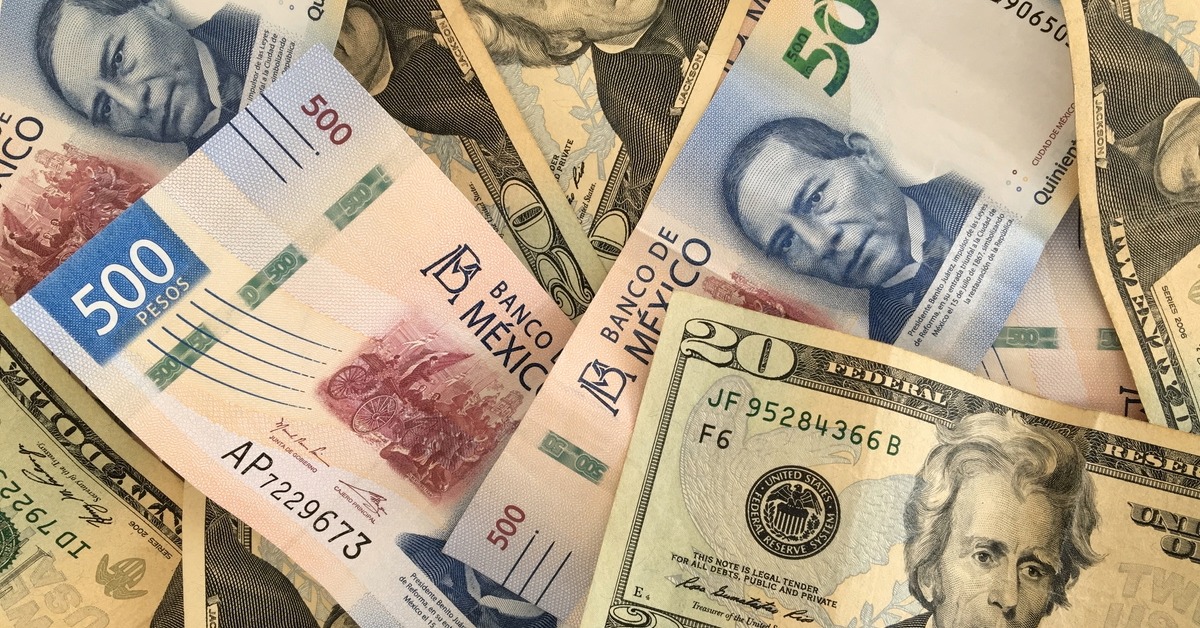
The peso weakens on tariff jitters as markets closed out the week with renewed caution over shifting U.S. trade policy and fresh signals that the Federal Reserve may ease policy sooner than previously expected. The local currency slipped in a session marked by heightened sensitivity to external pressures, ending the day at 18.8886 per dollar, a depreciation of 2.06 cents (0.11%) from Thursday’s close of 18.8680, according to official data from the Bank of Mexico (Banxico).
The dollar traded in a wide intraday range, touching a high of 18.9810 and a low of 18.5109. The broader dollar gauge, the Intercontinental Exchange’s Dollar Index (DXY), eased 1.24% to 98.82 points, reflecting diminishing strength in the greenback as investors digested mixed economic signals out of the United States.
Trade policy and market reaction
The immediate pressure on the peso came as the global market recalibrated after the United States moved to expand tariffs on multiple trading partners while offering Mexico a temporary reprieve. U.S. President Donald Trump granted Mexico a 90-day extension before imposing new tariffs, framing it as a window to negotiate a longer-term agreement, even as duties on other countries including Canada, Brazil, India and Taiwan were raised. The uneven trade signal stirred uncertainty among investors, who worried about the broader implications for cross-border commerce and supply chains.
Early in the session, the peso briefly reached its weakest point in just over a month, but the impact was partially muted as attention shifted to fresh U.S. labor data. A report on July employment showed only modest growth in nonfarm payrolls and a slight uptick in the unemployment rate, weakening the narrative of a robust jobs market. That data prompted traders to sharply increase their expectations of a Federal Reserve interest rate cut in September—pricing in roughly a 90% probability, up from about 45% before the report. The prospect of easier U.S. monetary policy has a dual effect: it takes some support away from the dollar while also aligning with expectations that Banxico might follow with its own easing, lessening the relative appeal of holding pesos.
Fed outlook and economic signals
“Private employment is showing signs of caution in the face of economic uncertainty,” said Valmex Casa de Bolsa. “We reinforce our expectation that the Fed will implement a cumulative cut of 50 basis points in 2025, given a weaker labor market and trade uncertainty.” Their assessment underscores how intertwined the peso’s path has become with both trading friction and evolving rate expectations in the United States.
The combination of trade policy ambiguity and shifting Fed odds weighed on investor sentiment throughout the week, producing a notable weekly reversal for the peso. On a seven-day basis, the currency fell from 18.5469 per dollar recorded at the close of last Friday to this week’s finish—an accumulated decline of 34.17 centavos, or about 1.84%. That slide reflects the growing unease about external headwinds and how they might ripple through Mexico’s open economy.
Weekly slide and forecasts
In its latest survey released Friday, Banxico projected the exchange rate to end the year at 19.80 pesos per dollar. If that forecast holds, it would represent a depreciation of roughly 4.80% from the current levels, an improvement from the prior survey’s projection of 20.13 per dollar. The revised expectation suggests some moderation in anticipated pressure, but the path remains fragile amid ongoing global uncertainty.
Analysts note that the interplay between U.S. trade policy moves and domestic monetary strategy will be critical in the coming months. A softer dollar driven by growing bets on Federal Reserve easing could offer temporary relief, but persistent concerns about new or broadened tariffs—especially if negotiations with major partners falter—could pull volatility back into the peso’s trajectory.
Looking ahead
For now, the market is watching two vectors: whether the temporary pause on Mexican tariffs turns into a durable agreement, and how incoming U.S. economic data influences the Fed’s timing on interest rate cuts. The peso weakens on tariff jitters, but the story remains one of conditional support where a delicate balance of external policy signals and central bank expectations will determine if the currency stabilizes or continues drifting lower.