A Navy cleanup at Playa Los Muertos may look like a simple beach maintenance story. But the effort points to a larger issue for Puerto Vallarta: how one of the city’s busiest public spaces handles waste, tourism pressure, and the daily habits of residents and visitors. The cleanup also connects the city to a national campaign aimed at reducing plastic pollution on Mexico’s coasts by 2030.
Mexican Navy carried out cleanup at Playa Los Muertos
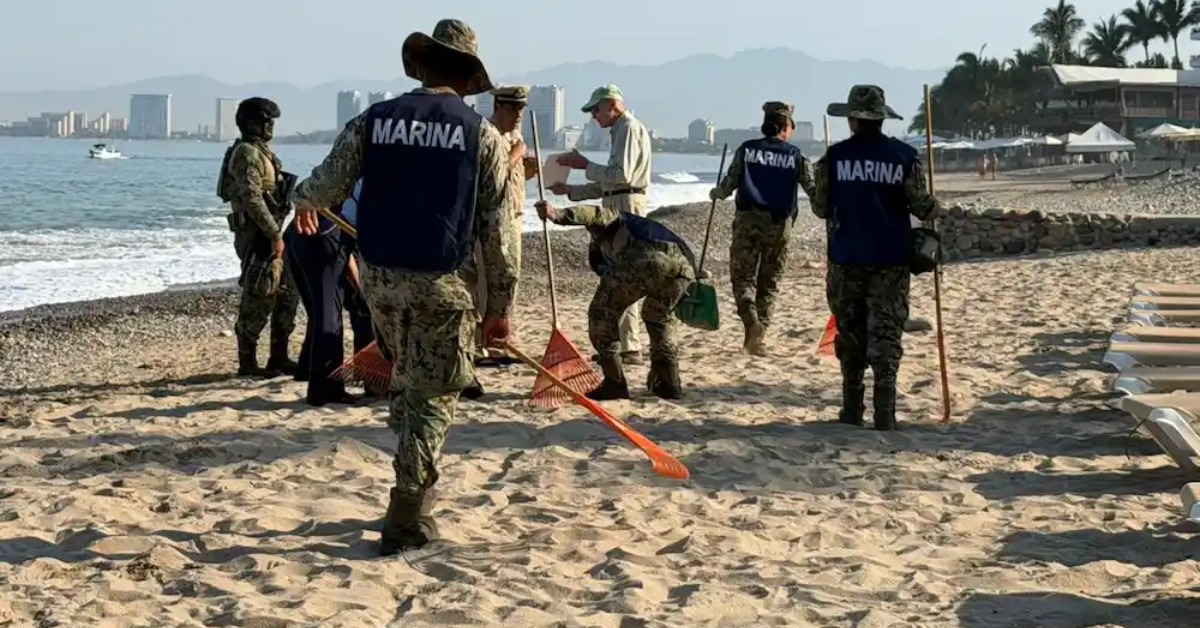
The Mexican Navy carried out a cleanup at Playa Los Muertos in Puerto Vallarta, removing solid waste from one of the city’s busiest and most visible beaches.
The work was led by personnel from the 12th Naval Zone, which is based in Puerto Vallarta. Navy personnel collected inorganic waste along the beach as part of the National Beach and Coast Cleanup and Conservation Campaign, a federal effort aimed at reducing pollution in Mexico’s coastal areas.
The materials collected included glass, aluminum, plastic bottles, plastic bags, cigarette butts, and pieces of driftwood or palizada. The waste was taken to containers for proper handling.
The cleanup was not reported as an emergency response. It was part of a broader conservation effort involving Mexico’s coastal zones, where public use, tourism, storms, runoff, and everyday waste can all place pressure on beaches.
A cleanup at one of Vallarta’s most visited beaches
Playa Los Muertos sits in Puerto Vallarta’s Romantic Zone, close to restaurants, beach clubs, hotels, shops, and the Los Muertos Pier. It is one of the main gathering points for visitors and residents.
That popularity also brings pressure. More people on the sand usually means more food packaging, drink containers, cigarette waste, and other debris. Some trash is left by beachgoers. Other waste arrives through stormwater, streets, rivers, and wind.
For residents and frequent visitors, the cleanup is a reminder that beach maintenance is not only about appearances. Waste left on the sand can be carried into the bay. Sharp objects can create risks for swimmers and walkers. Plastics can break down into smaller particles, making them harder to remove.
The Navy’s presence also shows how coastal care in Mexico often involves several levels of government. In beach cities, environmental work may involve municipal crews, federal agencies, port authorities, tourism offices, volunteers, and naval personnel.
What the Navy removed
The cleanup focused on solid inorganic waste, which usually means materials that do not easily decompose. These items often remain in the environment longer than organic material.
Glass and aluminum can create safety risks on a crowded beach. Plastic bags and bottles can enter the water, especially when waves rise, or heavy rain pushes street waste toward the coast. Cigarette butts are small, but they are among the most persistent forms of beach litter.
The collection of palizada is also common in coastal cities. This material can include branches, wood, and debris washed down by rivers or carried by storms. While some natural materials belong in coastal systems, mixed waste can create problems when it combines with plastic, metal, and other contaminants.
The Navy said the action supports the protection of the marine environment, local fauna, tourism activity, and public recreation spaces.
Part of a national campaign through 2030
The Puerto Vallarta cleanup forms part of Mexico’s National Beach and Coast Cleanup and Conservation Campaign 2025–2030. The campaign was launched as a long-term effort to reduce pollution on beaches and coasts.
The national goal is to move toward beaches and coasts free of plastic waste by 2030. The program has been promoted as an interagency effort involving federal, state, local, private-sector, and civic participation.
For coastal destinations, the campaign goes beyond one-day cleanups. It is tied to a larger conversation about waste habits, local collection systems, tourism businesses, and public responsibility.
Puerto Vallarta was included in the national launch of the strategy in 2025. Since then, cleanup efforts have continued in different parts of the municipality, including beaches, rivers, and public areas that can feed waste into Banderas Bay.
Beach trash does not always start at the beach
One of the harder parts of coastal cleanup is that not all beach trash comes from the beach itself.
In a city like Puerto Vallarta, waste can move through streets, storm drains, canals, rivers, and hillsides. During the rainy season, runoff can carry bottles, wrappers, cigarette butts, and other debris toward the ocean.
That means beach cleanups are only one piece of the solution. A cleaner beach also depends on better waste collection, fewer single-use plastics, responsible businesses, proper disposal by residents and visitors, and visitors who treat public spaces with care.
This is especially important in Puerto Vallarta because the city’s beaches are part of daily life. They are not only tourist attractions. They are also public spaces used by families, workers, fishermen, vendors, boat operators, and residents.
Tourism and the pressure on public beaches
Playa Los Muertos is one of the clearest examples of how tourism and local life overlap in Puerto Vallarta.
The area supports restaurants, bars, water taxis, tours, beach vendors, and nearby lodging. That activity is part of the local economy. But it also means the beach needs constant attention.
A clean beach supports the visitor experience, but it also affects the people who live and work there. Trash can hurt the destination’s image, but it can also create real problems for public health, marine life, and local businesses that rely on the waterfront.
For international residents and visitors, the basic takeaway is simple. Beach care in Mexico is shared. Authorities can enforce rules and clean up, but daily habits still matter.
Discarding cigarette butts, leaving bottles or food containers, or assuming someone else will clean up adds to the problem. So does letting lightweight plastic blow away from tables, towels, or beach chairs.
The role of the 12th Naval Zone
The 12th Naval Zone has a visible role in Puerto Vallarta because of the city’s maritime location. Its work is often associated with safety, port activity, marine emergencies, and coastal operations.
In this case, the Navy’s role was environmental. Personnel collected waste, moved it to disposal points, and used the action to urge the public to help preserve beaches and coasts.
The local naval command also keeps emergency contact numbers available for maritime incidents. The 12th Naval Zone number is 322 216 6618. The national Navy emergency line is 800 MARINA (800-627-4621).
Those numbers are intended for emergencies or reports related to maritime situations, not general trash pickup.
A small cleanup with a larger message
The cleanup at Playa Los Muertos did not solve Puerto Vallarta’s waste problem. No single cleanup could.
But it adds to a pattern. Puerto Vallarta has seen repeated cleanup efforts on beaches, rivers, and coastal areas. Some have removed hundreds of kilos of waste. Others have pulled tons of trash from rivers or the bay.
Together, these efforts show that the issue is not limited to a single beach or neighborhood. Waste moves through the city and eventually reaches the coast.
For a destination built around its bay, beaches, and outdoor life, cleanup work is part of basic civic maintenance. It is also part of protecting the public spaces that make Puerto Vallarta livable for residents and attractive to visitors.
The Navy’s cleanup at Playa Los Muertos is one more reminder that keeping the beach usable takes more than occasional campaigns. It takes daily cooperation from the government, businesses, residents, and visitors.