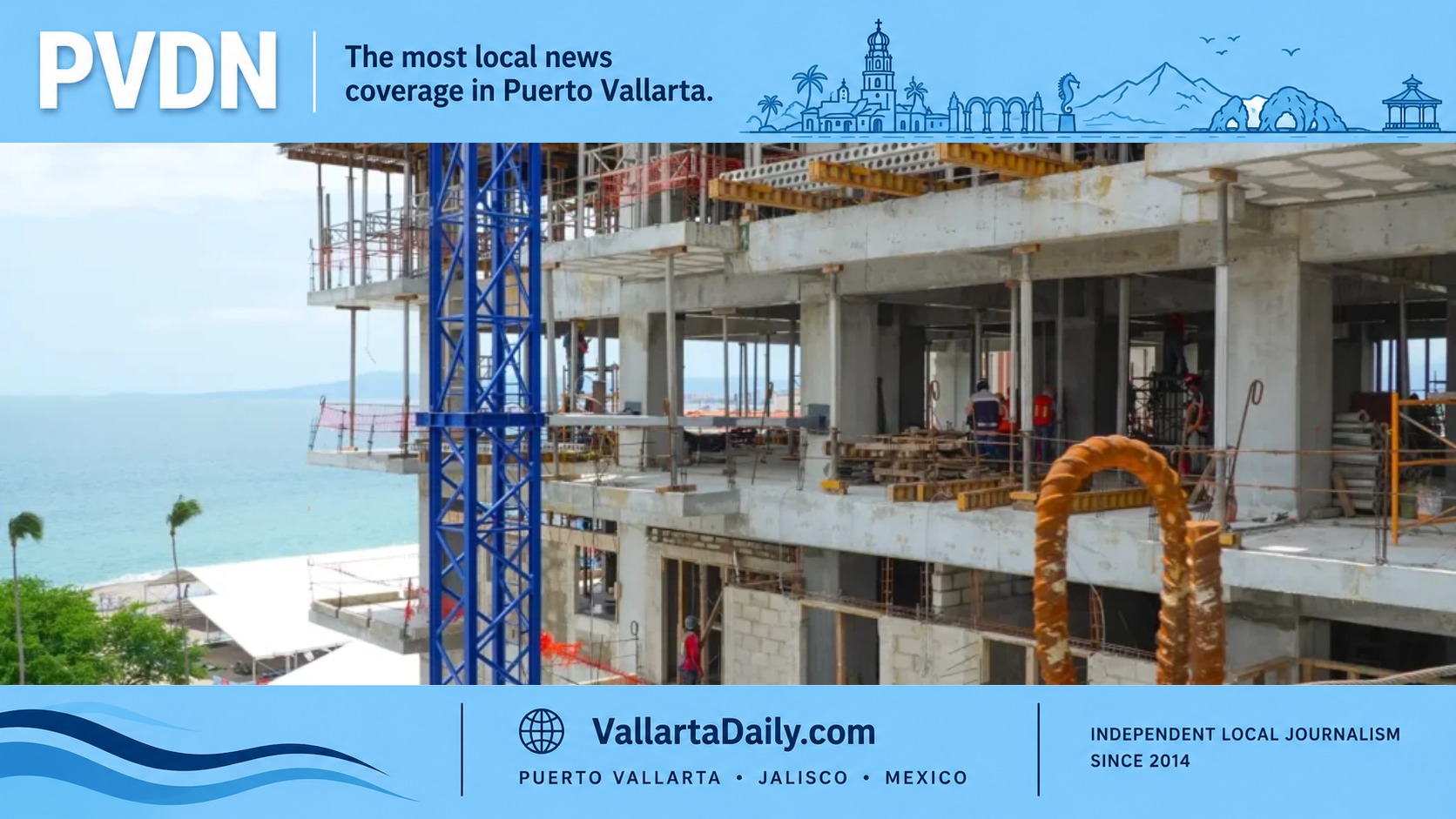
Puerto Vallarta, Jalisco, July 14, 2026 — Puerto Vallarta’s condominium boom is advancing faster than the public can measure its cumulative effect. City Hall has documented new vertical housing licenses and tens of millions of pesos collected when projects receive additional buildable area, but Vallarta Daily could not locate a single public record showing how many homes are entering each neighborhood, how much water and sewer capacity they require, or which off-site improvements each project must pay for.
A Vallarta Daily review of municipal plans, permit files, urban development reports, and SEAPAL records found that the city already recognizes the pressure in its own planning documents. The missing piece is a project-by-project public accounting that connects new density with water production, pipe capacity, drainage, traffic, parking and emergency access.
The city’s Municipal Development and Governance Plan covering 2024 through 2027 identifies road saturation tied to uncontrolled urban growth, a drinking-water deficit and a risk of drainage collapse, with Emiliano Zapata and Versalles named among the most exposed areas.
The same plan cites a 2021 study projecting a water shortfall of 39.1 liters per second by 2030, equal to more than 1.2 million cubic meters each year. That estimate covered urban and tourism consumption but did not include commercial demand. It is a planning projection rather than proof of a current citywide shortage, but it shows that future supply was already a formal concern when the plan was approved.
Permit counts do not show the cumulative load
In April 2025, Puerto Vallarta’s urban development director said the new municipal administration had approved 15 condominium buildings in its first 180 days. Vallarta Daily reported the approvals at the time, based on the original interview published by Tribuna de la Bahía. The projects and extensions cited then reached Marina Vallarta, Versalles, 5 de Diciembre, Emiliano Zapata and the south-coast corridor.
That number was a six-month snapshot, not a full measure of the pipeline. Projects also move through extensions, design changes, regularizations and completion procedures, making a simple count of newly issued licenses incomplete. The municipal urban-development office reported 977 building-related procedures during the final quarter of 2024 and another 1,454 during the second quarter of 2025.
The reports also show how added density generates municipal revenue. During October through December 2024, the city issued six vertical multifamily housing licenses in Versalles, 5 de Diciembre and El Cerro and attributed 23.36 million pesos in special ICUS contributions to those approvals. The April through June 2025 urban-development report attributed another 33.05 million pesos in ICUS contributions to one vertical multifamily license in Marina Vallarta.
ICUS charges apply when a qualifying project receives permission to build more floor area than the base coefficient in the applicable plan allows. The mechanism means that Puerto Vallarta can collect substantial revenue as density increases. The public record reviewed by Vallarta Daily did not show, in a single accessible place, which neighborhood improvements were funded by each payment or whether the money followed the added load into the same water, drainage, and street networks.
Scale is also difficult to understand when projects are counted only as buildings. Marina Towers advertises three buildings of 25 floors with 113 homes in each tower , equal to 339 units in one development. The project is not cited here as an irregular development. It illustrates why a tower count cannot replace unit totals, expected occupancy and service demand.
Puerto Vallarta’s transparency portal publishes land-use changes, subdivision authorizations and separate license files, while quarterly reports summarize hundreds or thousands of procedures. The January 2026 urban-development license spreadsheet lists 130 acts. Its public columns identify the document, legal purpose, holder, and validity dates, but they do not provide standardized fields for a project address, total homes, parking spaces, water demand, sewer discharge, traffic conditions, or required mitigation. The file directs anyone seeking the underlying physical document to make a transparency request.
That fragmentation leaves a basic question unanswered. Is each permit being evaluated only against the rules on its lot, or is City Hall also measuring the combined load of every approved and pending project connected to the same pipes and streets?
Plans are still catching up with construction
SEAPAL has announced projects intended to add 220 liters per second of water-production capacity during the current administration, bringing installed capacity close to 1,500 liters per second. That planned increase is larger than the 2030 deficit cited in the municipal plan, but production capacity alone does not indicate whether distribution lines, storage, sewer collectors, and treatment systems can accommodate growth in each high-density neighborhood.
Recent work shows that the underground network is already demanding attention in the same districts where vertical construction is concentrated. SEAPAL has continued sewer repairs in Marina Vallarta , while night maintenance and grease-control work has been planned in Emiliano Zapata . Those repairs do not establish that condominium construction caused the damage. They do show that aging or stressed infrastructure is being rehabilitated while new units continue to connect.
The 2025 municipal plan orders the preparation of a Municipal Water Master Plan that includes an updated hydrological diagnosis, investment projects, a modernized water registry, and mapped drinking-water and sewer networks. Vallarta Daily found repeated official references assigning SEAPAL’s governing council responsibility for approving that plan, but did not locate a current master-plan document posted under that title on the municipal or SEAPAL public portals.
Urban rules are also being revised. Municipal records from late 2025 show work underway on an updated Municipal Urban Development Program and its district plans, including meetings to set the stages and dates. The city’s public planning page still lists the current municipal program as the version published in August 2023 and the district plans largely as documents approved in 2020.
Vertical development can place more homes near jobs, businesses and established services while limiting expansion into hillsides and rural land. The issue is not whether Puerto Vallarta should build upward. It is about whether approval records, utility capacity, and neighborhood investment are moving at the same pace as sales and construction.
A usable public development ledger would show each project’s address, approved floors and units, base density, added ICUS area, payments, SEAPAL feasibility opinion, expected water demand, sewer connection, parking, mobility conditions, mitigation work and construction status. City departments already collect much of that information at different stages. Publishing it together would allow the public to see whether each new tower is adding only private square meters or also paying its share of the city systems beneath it.