Sea turtle season in Puerto Vallarta is one of those things that sounds cute until you realize it is actually wild, fragile, emotional, and happening right under your beach towel.
Every year, sea turtles crawl out of Banderas Bay and nest on beaches most of us think of as “hotel zone,” “that beach by the restaurant,” “the one near Boca,” or “where I walk the dog.” They are not checking Google Maps. They are not avoiding resorts. They are just trying to lay eggs on the same kind of coast their species has used for generations. Most will return to the same beach where they hatched to lay their own eggs.
And because this is Vallarta — busy beaches, bright lights, curious tourists, dogs, beach chairs, storms, and all — turtle season needs a little help from humans who know when to step in and when to back off.
When sea turtle nesting season starts in Puerto Vallarta
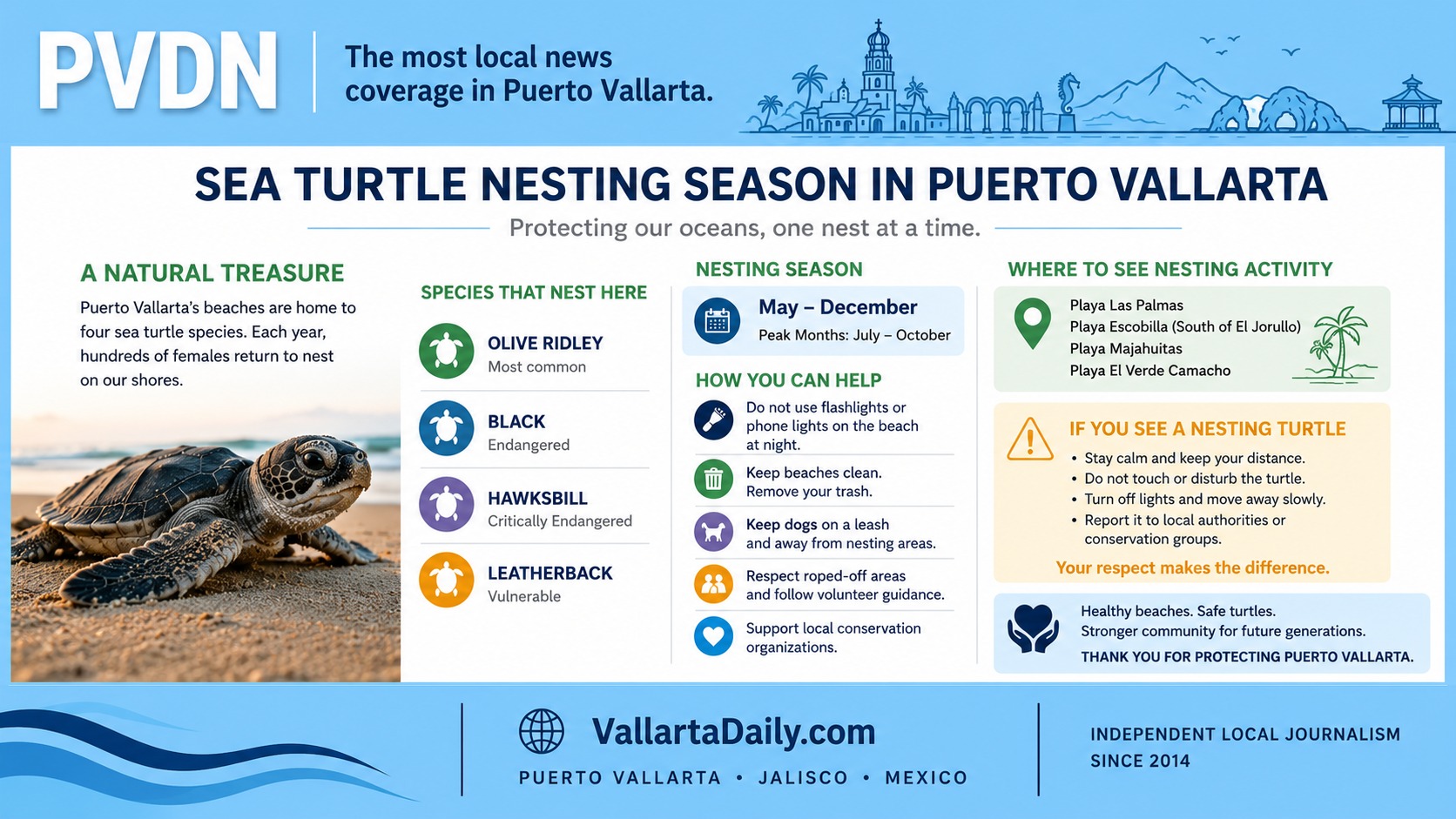
In Puerto Vallarta, turtle season usually gets going in summer, with public hatchling releases most often promoted from July through December.
That does not mean turtles politely wait for July 1 and clock out on New Year’s Eve. Nature is not that organized. Nesting can occur outside the main window, depending on the beach, weather, species, and ocean conditions.
The turtle most people see around here is the olive ridley turtle, called tortuga golfina in Spanish. Along Mexico’s Pacific coast, olive ridleys usually nest from summer into early winter, and some activity can stretch beyond that.
So if you are here in August, September, October, or November — yes, you are very much in turtle season. If you are here a little earlier or later, still pay attention. A turtle does not care what your vacation dates are.
Which sea turtles nest here
The local star is the olive ridley. Smallish, gray-green, determined, and honestly kind of iconic.
Puerto Vallarta is also part of a much larger Pacific turtle corridor. The wider Jalisco and Nayarit coast is also connected to conservation work involving Pacific green turtles, leatherbacks, and hawksbills. But here in Vallarta, when people talk about regular nesting and hatchling releases, olive ridleys are usually the main character.
Mexico protects all sea turtle species found in the country, and for good reason. The country is one of the most important places in the world for sea turtles, with six of the seven recognized species using Mexican waters or beaches through different parts of their life cycle.
So yes, that small roped-off patch of sand near your hotel may look simple. But it is part of something much bigger.
Where turtles come ashore in Puerto Vallarta
This is the part that surprises people.
Turtles do not only nest on remote, empty, moonlit beaches that look like a nature documentary. Would that be more romantic? Sure. Is that how Vallarta works? Not always.
They can come ashore along hotel beaches, condominium beachfronts, Boca de Tomates, Marina-area beaches, Mismaloya, and other sandy stretches around the bay. South of Puerto Vallarta, the Cabo Corrientes coast — especially Mayto — is one of Jalisco’s strongest turtle areas.
That means a turtle may nest near a resort, near a beach restaurant, or near the same place people were dragging umbrellas and coolers around a few hours earlier.
Some nests are left where they are if the spot is safe. Others are moved by trained, authorized people to a protected corral, called a vivero, when the eggs are at risk from foot traffic, flooding, erosion, predators, beach equipment, or people who absolutely should not be touching turtle eggs.
What you might see during turtle season
If you are lucky, you might see a female turtle come out of the water at night, slowly pull herself up the sand, dig a nest, lay her eggs, cover them, and head back to the ocean.
It is quiet. It is slow. It is kind of magical.
You may also see turtle tracks in the sand in the morning. They look like wide flipper marks with a drag line down the middle. Once you have seen them, you will start noticing them.
Other times, you might see a marked nest, a small fenced area, hotel security keeping people back, volunteers walking the beach, or staff preparing hatchlings for a release.
That is your cue to be curious from a distance. Not “let me get closer for the video,” curious. More like “wow, nature is doing something incredible, and I should not ruin it,” curious.
Hatchling releases in Puerto Vallarta
Hatchling releases are probably the most popular way visitors experience turtle season in Puerto Vallarta.
And yes, they are beautiful.
You stand near the sand, usually close to sunset. Staff explain what is happening. Tiny hatchlings are placed on the beach. Then they scramble toward the water like they already have somewhere very important to be.
Because they do.
But here is the thing: releases are not daily shows. They depend on nests hatching. A camp may have hatchlings one evening and none the next. The weather can change plans. Beach conditions are important. The turtles are running the schedule.
One of the best-known local places is Campamento Tortuguero Boca de Tomates, north of the airport. Farther south, Campamento Tortuguero Mayto works along a long stretch of beach in Cabo Corrientes and has become one of the most important turtle protection sites on the Jalisco coast.
If you go to a release, follow the instructions. Stand where they tell you. Do not grab hatchlings for selfies. Do not toss them into the waves like you are helping. You are not helping. You are causing chaos with confidence.
The best release is calm, organized, and boring in all the right ways.
Why beaches are roped off during turtle season
If you see a roped-off patch of beach, do not move it.
I know. Sometimes it looks like someone just fenced off a random square of sand. But under that sand may be a nest full of eggs. You cannot always see the important part.
Ropes help keep people, chairs, umbrellas, coolers, dogs, beach vendors, maintenance equipment, and random wanderers from damaging a nest. They also help during hatching, when baby turtles need a clear path to the water.
A roped-off area does not usually mean the beach is closed. It means something vulnerable is under there, and everyone needs to give it space.
How volunteers protect sea turtle nests
This is the part most visitors never see.
While the rest of us are sleeping, volunteers and trained staff patrol the beach at night. They look for fresh tracks, nesting females, exposed eggs, predators, flooding risks, and people doing dumb things near nests.
When a turtle lays eggs, the team records the location and decides whether the nest can safely stay where it is. If the beach is too exposed, too busy, too close to the surf, or too risky, authorized staff may move the eggs to a protected corral.
Then they wait. They monitor. They count. They protect.
When the hatchlings emerge, staff may check the nest, count shells, record how many hatched, and release the babies under controlled conditions.
So when you see a cute turtle release photo, just know that was not the whole story. That was the visible ending of a lot of sweaty, sandy, mosquito-heavy work.
VallartaDaily has covered some of that local conservation work before, including Puerto Vallarta turtle recovery efforts, the start of sea turtle hatching season, and conservation results from the Jalisco coast, where Mayto Turtle Camp reported its biggest nesting season.
What to do if you see a nesting turtle
First: stop.
Do not run toward her. Do not shout. Do not call everyone over like you found the last parking spot in the Romantic Zone.
Stay back. Give her several meters of space. Do not stand between the turtle and the ocean. Turn off flashlights, phone lights, camera flashes, and bright screens.
If you are at a beach in front of a hotel or condo, alert security or the front desk. Many beachfront properties already know who to call. If you are on an open beachfront, look for lifeguards, Civil Protection, environmental staff, or call 911 if the turtle or nest is in immediate danger.
Do not touch the turtle. Do not touch the eggs. Do not try to dig. Do not “fix” the nest. Do not let your dog investigate.
This is one of those moments where being helpful means doing less.
What to do if you see hatchlings
Same energy: stay calm, stay back, kill the lights.
Baby turtles use natural light over the ocean to find their way. Artificial light can pull them toward hotels, streets, restaurants, parking lots, and other places no tiny turtle needs to be.
If hatchlings are crossing the sand, do not pick them up unless trained staff tell you to. Do not make a human tunnel. Do not crowd around them. Do not put your phone within 2 inches of their face.
They are not lost. They are working.
Can you take photos?
Usually, yes — but only if you can behave.
No flash. No flashlight. No bright screen in the turtle’s face. No stepping into marked areas. No pushing past volunteers. No crouching so close that the turtle has to wonder why a giant glowing rectangle is blocking her life plan.
For nesting turtles, distance is critical. Bright light can interrupt nesting or disorient the turtle when she returns to the water.
For hatchlings, light can send them in the wrong direction. And considering they have just entered the world and are already sprinting from birds, crabs, waves, and bad odds, we really do not need to add iPhone confusion to the list.
The safest photo is from behind the group, without flash, after the staff says it is okay.
Can you help?
Yes. And please do.
But help through the people already doing the work. Contact a recognized turtle camp before showing up to volunteer. Camps may need help with night patrols, donations, materials, sponsors, translators, educational support, or visitors who can follow instructions during releases.
You can also help by not making the beach worse. Pick up plastic. Do not leave beach chairs, umbrellas, toys, fishing line, nets, or trash on the sand overnight. Keep dogs away from nests. A better rule is to keep them leashed; it’s the law after all. Use softer lighting near the beach. Tell your visiting friends not to use flash.
Also, support beach cleanups when you see them. Recent work at Boca de Tomates is a good reminder that turtle protection is not only about the nests. It is also about the condition of the beaches where turtles are trying to survive.
Common sea turtle myths in Puerto Vallarta
Myth: Baby turtles need to be carried into the ocean.
Nope. They need a clear, dark, safe path. Staff will step in if there is a problem, but in fact, they do not need our help beyond protection.
Myth: Hatchling releases happen every night.
I wish it were that convenient. Releases happen when nests hatch and conditions are safe.
Myth: Turtle eggs are okay to take because it is traditional.
Absolutely not. Taking, selling, buying, or eating sea turtle eggs is illegal in Mexico.
Myth: One quick flash photo is harmless.
No. Light can confuse turtles and hatchlings. Turn it off.
Myth: Roped-off sand means a hotel is claiming the beach.
During turtle season, it usually means protection. There may be eggs under there.
Myth: Only quiet, empty beaches get turtles.
Not true. Turtles nest on urban beaches too. Yes, even the beach you walked across after brunch.
Myth: Turtle releases are tourist shows.
The good ones are conservation work with a public-education component. Big difference.
The beach rule I wish everyone followed
If you see a turtle, slow down.
If you see a nest, walk away.
If you see hatchlings, turn off the lights.
If someone from a turtle camp gives instructions, listen.
That is it. That is the whole assignment.
Sea turtle season in Puerto Vallarta is beautiful because it is real. It is not staged for us. It is not on our schedule. It is happening in the middle of a busy beach town, where nature is still trying to do something ancient, stubborn, and, honestly, kind of miraculous.
So yes — go see it if you can.
Just do it like a good guest.