A recent Sedena report shows Texas accounts for 43 percent of arms trafficking routes into Mexico, detailing 11 key corridors and major seizures to curb criminal violence.
A new Semiannual Report from Mexico’s Secretariat of National Defense (Sedena) reveals that Texas serves as the principal gateway for illicit arms flowing into Mexico, accounting for 43 percent of detected trafficking between November 20, 2024, and May 19, 2025. The data underscores how criminal groups exploit cross-border routes to fuel violence in multiple Mexican states while authorities scramble to stem the tide.
Sedena’s analysis—submitted by the Secretariat of Security and Citizen Protection to Congress’s Permanent Commission—breaks down origins by U.S. border state: Texas (43 percent), Arizona (22 percent) and California (9 percent). By mapping these figures, officials aim to pinpoint vulnerability points along the frontier and prioritize enforcement where it matters most.
Investigators identified 11 major arms trafficking routes winding south from the United States through Mexico’s most violence-hit regions. Key corridors include the Arizona-Sonora-Jalisco link running from Phoenix through Parral and Guadalajara, and a Texas-Nuevo León-Mexico City corridor beginning in Laredo and passing Monterrey and Querétaro before reaching the capital. A coastal route from Brownsville through Veracruz down to Tuxtla Gutiérrez highlights the reach of these networks.
Through coordinated information-sharing between Sedena and the Attorney General’s Office (FGR), authorities tied these corridors to criminal groups active in Baja California, Chihuahua, México, Guanajuato, Guerrero, Jalisco, Michoacán, Sonora, Tamaulipas and Zacatecas. The report notes that traffickers adapt quickly, opening new routes or shifting volumes in response to enforcement.
In response, the armed forces launched targeted operations at critical junctures along trafficking lines. Troop deployments shifted to bolster presence in vulnerable sectors, and checkpoints intensified in areas with high seizure potential. Officials credit these moves with disrupting smuggling patterns and pressuring criminal networks.
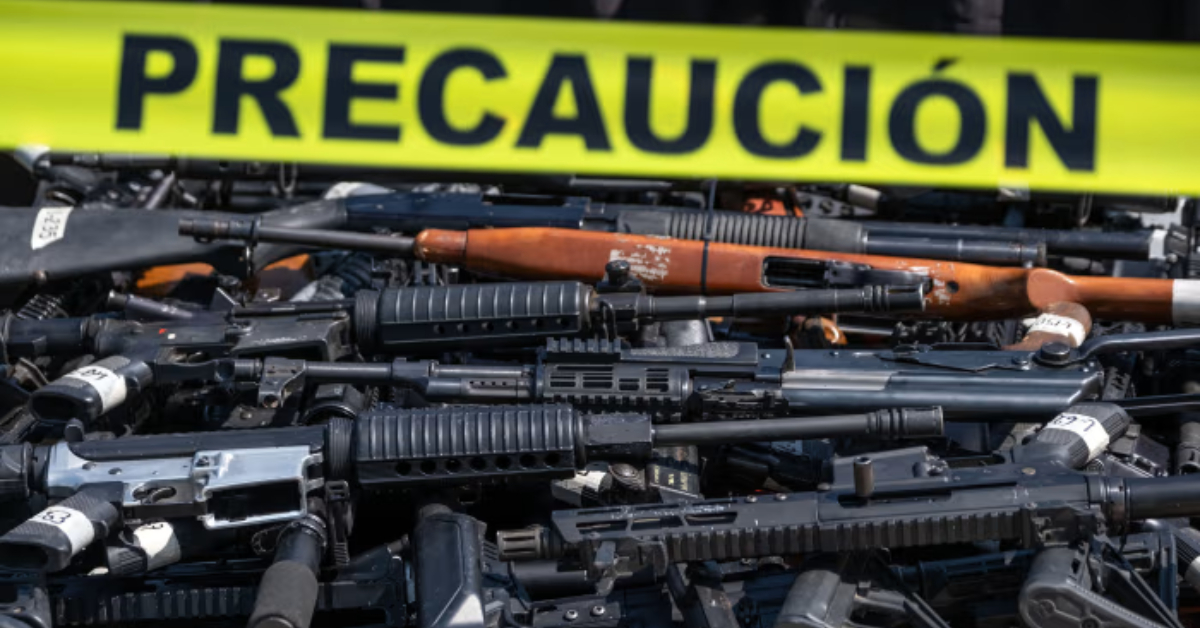
As a result of these containment efforts, Sedena and the FGR seized 5,869 firearms, 31,868 magazines, more than 1.2 million rounds of ammunition and 289 grenades. Those figures mark a significant blow to the operational capacity of cartels and trafficking rings—and a measure of success for the containment strategy.
Defense Secretary Luis Cresencio Sandoval emphasized that while seizures represent progress, dismantling criminal networks requires sustained pressure and cross-border cooperation. “Seizing weapons helps, but cutting off supply lines is key,” he noted in a press briefing. He called on U.S. authorities to strengthen collaboration at the state level, especially in Texas and Arizona, to match Mexico’s enforcement pace.
The report’s findings arrive amid broader debates over border security and gun laws on both sides of the frontier. With Mexico grappling with high homicide rates linked to cartel violence, tracking and blocking arms trafficking routes remains a top priority for Sedena. As authorities refine their strategy, focus will remain on the mapped corridors—with Texas squarely under the microscope as the leading conduit.