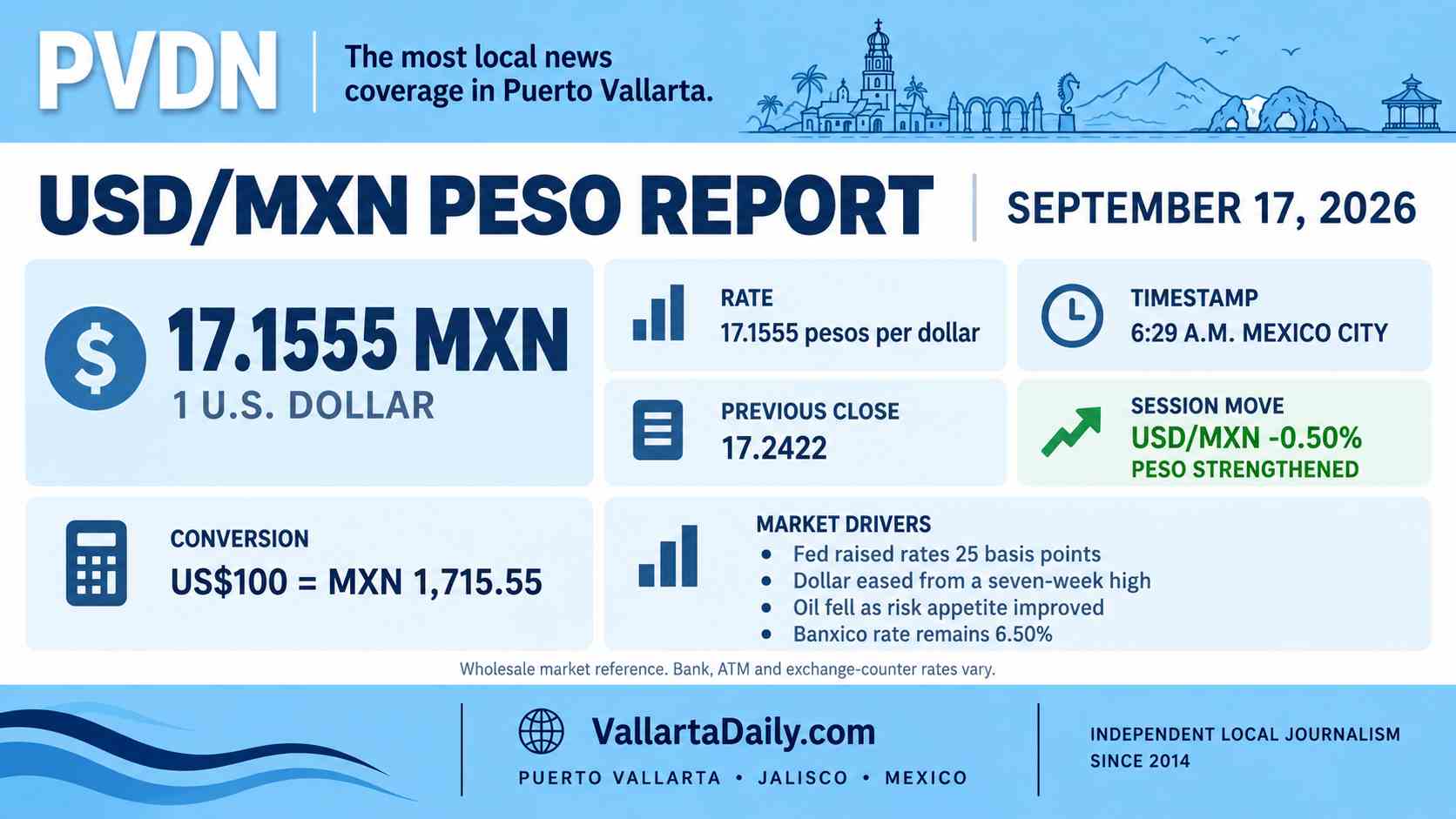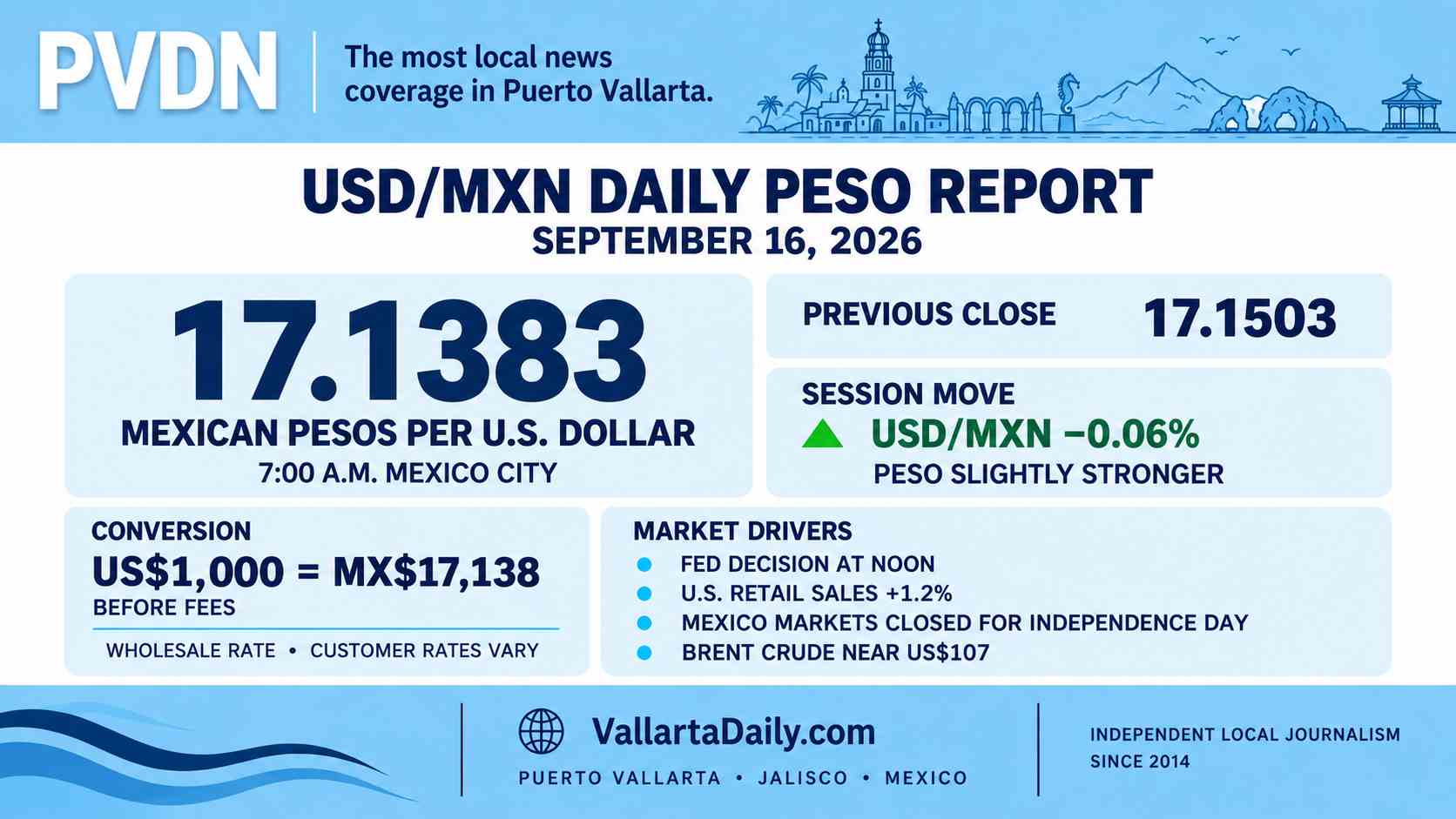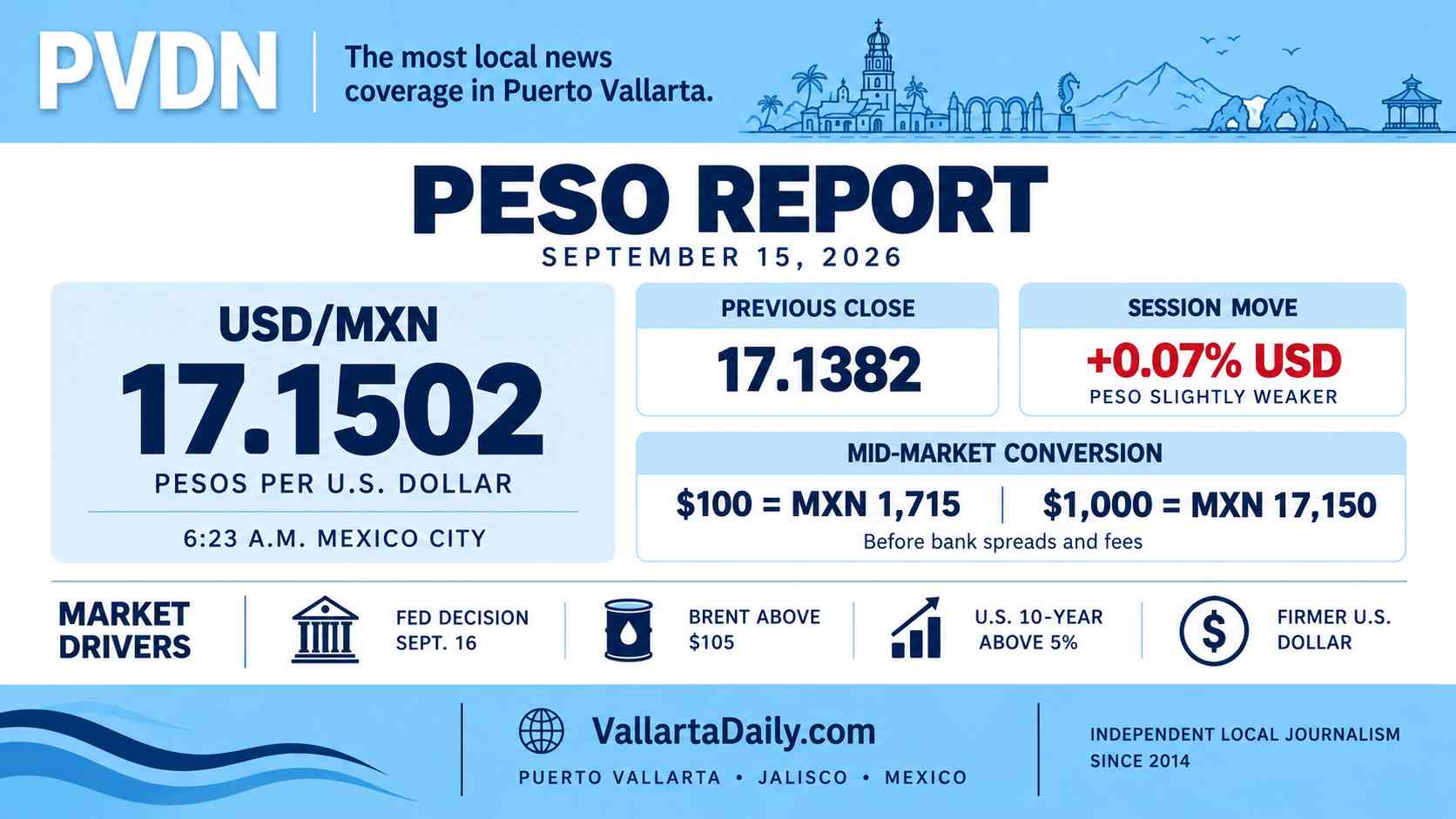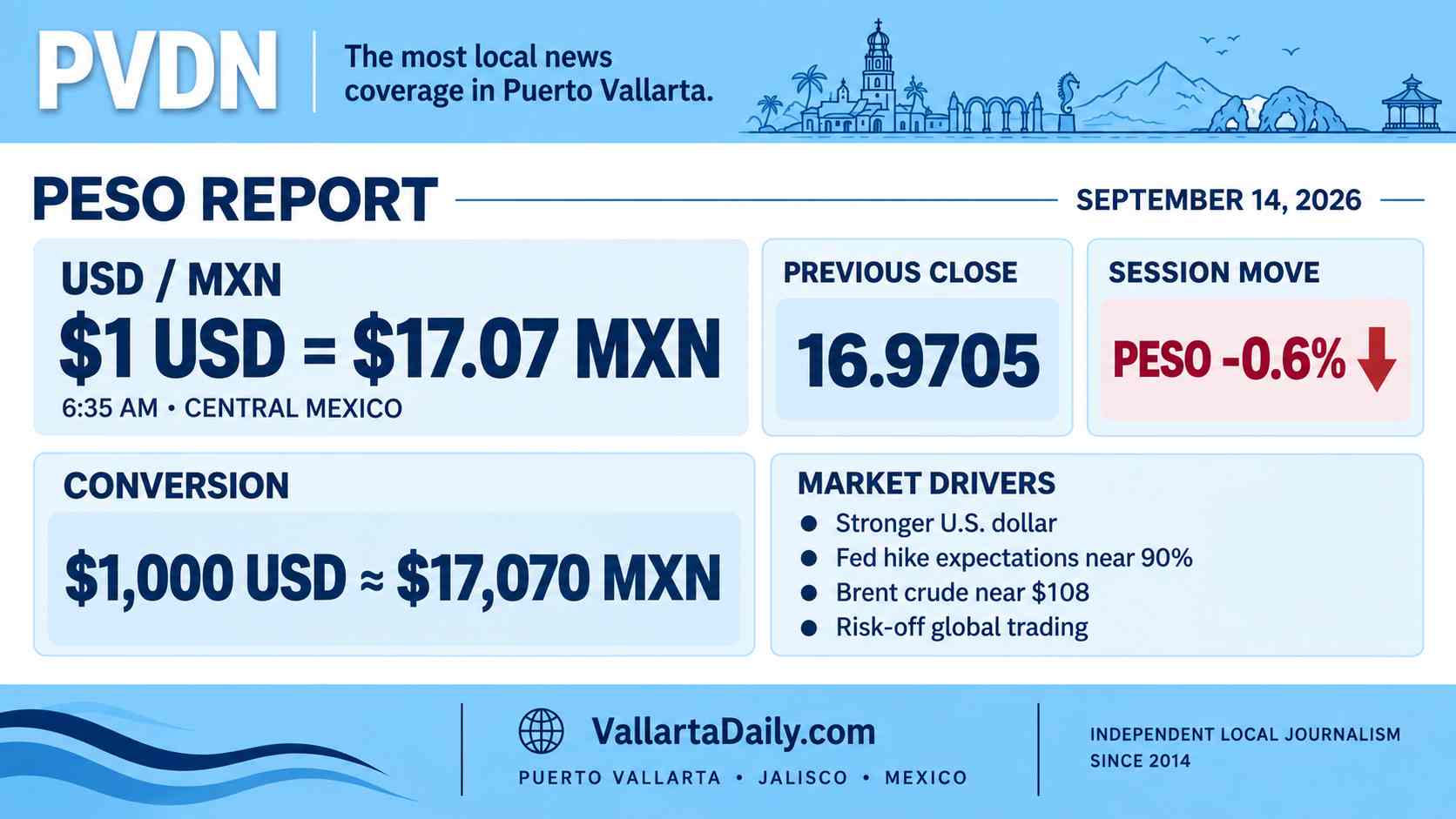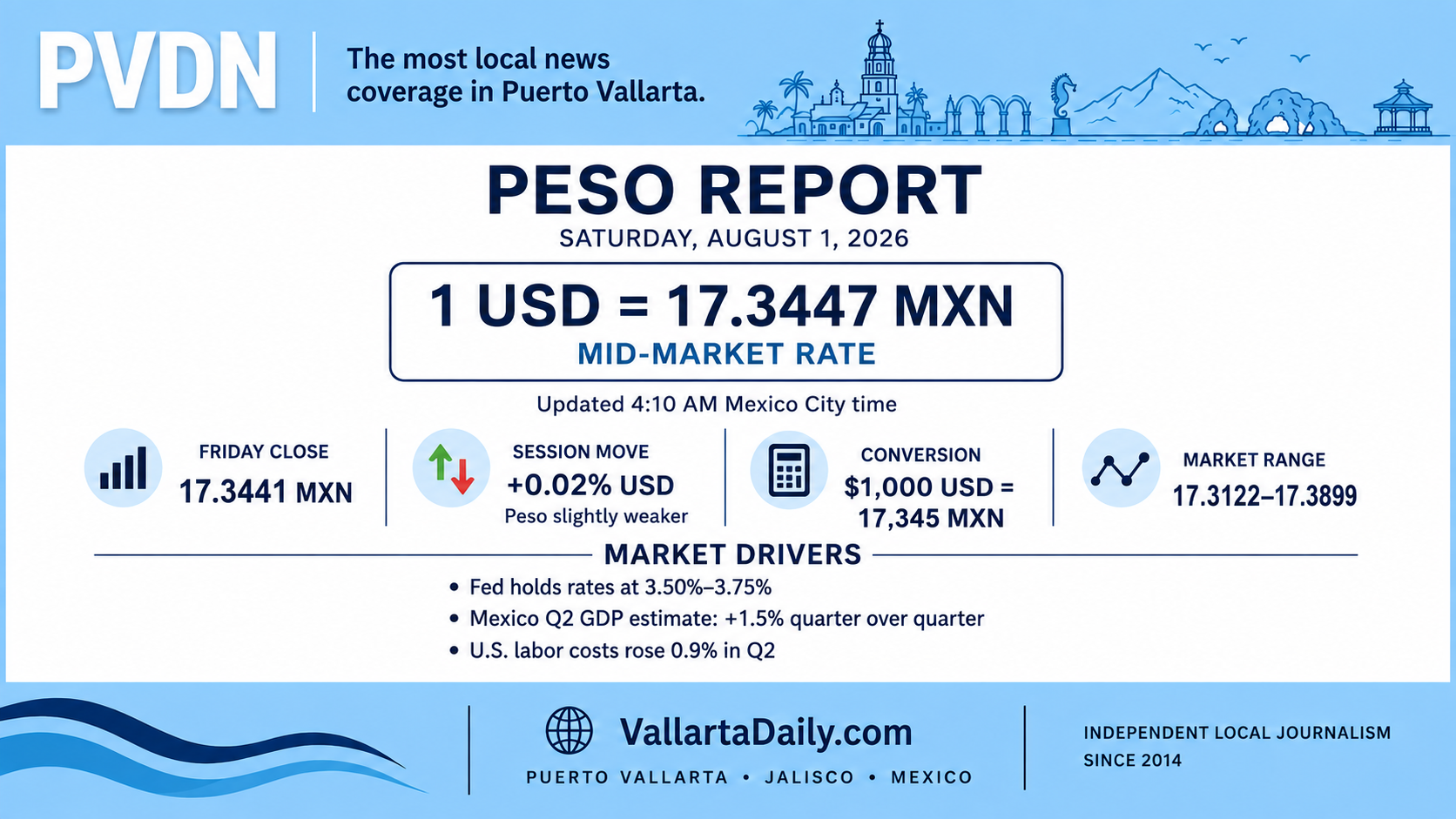
Puerto Vallarta, Jalisco, August 1, 2026 – The Mexican peso was trading near 17.34 pesos per U.S. dollar early Saturday, with the latest available mid-market rate reported at 17.3447 at 4:10 a.m. Mexico City time, according to XE’s currency data.
Because foreign-exchange markets are largely closed over the weekend, Saturday’s rate reflects the final Friday session and limited weekend pricing. Banks, exchange houses and card networks may use different rates and add their own spreads or fees.
Peso closes Friday almost unchanged
The dollar closed Friday at approximately 17.3441 pesos, compared with 17.3412 pesos on Thursday, according to historical USD/MXN prices reported by The Wall Street Journal. That represented a 0.02% increase in the dollar’s value, leaving the peso slightly weaker against the U.S. currency.
During Friday’s session, the exchange rate moved between approximately 17.3122 and 17.3899 pesos per dollar.
For comparison, one U.S. dollar at the mid-market rate was worth about 17.34 pesos, while 1,000 U.S. dollars was worth roughly 17,345 pesos before fees, commissions, or exchange-house adjustments.
Fed decision keeps rate expectations in focus
The Federal Reserve left its benchmark interest-rate target unchanged at 3.50% to 3.75% after its July 28–29 meeting. The decision passed by a 9–3 vote, with three officials favoring a quarter-point increase, according to the Federal Reserve’s official statement.
The divided vote has kept attention on upcoming U.S. inflation and employment data. Higher U.S. rates can support the dollar by making dollar-denominated assets more attractive, although currency markets also respond to expectations about Mexico’s interest rates and broader investor sentiment.
U.S. labor-cost data released Friday showed compensation costs increased 0.9% during the second quarter and were up 3.4% from a year earlier, according to the U.S. Bureau of Labor Statistics. The increase was slightly above economists’ expectations and reinforced uncertainty over how quickly inflation may ease.
Mexico’s economy provides support
Mexico’s economy grew an estimated 1.5% in the second quarter compared with the first quarter, according to the preliminary INEGI gross domestic product estimate released July 30. The result followed a contraction in the first quarter and offered some support for the peso by suggesting that economic activity had regained momentum.
Mexico’s Finance Ministry also maintained its 2026 growth outlook at 1.8% to 2.8%, saying the economy would need to contract during both the third and fourth quarters to fall below a 1.5% annual expansion, Reuters reported.
Mexico’s annual inflation rate stood at 3.37% in June, with the next inflation update scheduled for August 7, according to INEGI’s inflation calendar. The data will be relevant to expectations for future decisions by Banco de México.
Trade policy and global markets remain risks
Trade negotiations between Mexico and the United States continue to influence market expectations. The United States recently introduced new tariffs affecting several trading partners, but Mexican officials said the changes would not materially alter Mexico’s effective tariff treatment, as goods that comply with the USMCA remain exempt. Around 85% of Mexican exports to the United States are covered by the agreement, according to Reuters reporting.
Global markets also ended the week with stronger investor appetite for stocks, while higher oil prices and geopolitical tensions continued to create uncertainty. Those forces can move the peso in either direction depending on whether investors favor higher-risk emerging-market currencies or seek the relative safety of the U.S. dollar.
What the rate means locally
For people in Puerto Vallarta who receive income in U.S. dollars, the current rate provides slightly fewer pesos than a weaker-peso market would. The difference may be noticeable when converting rent, retirement income or business revenue, although the final amount depends on the provider’s exchange rate and fees.
Residents earning in pesos and paying expenses in dollars face the opposite effect. A stronger peso reduces the peso cost of U.S. dollar payments, including some subscriptions, imported goods, travel expenses, and cross-border obligations.
The quoted rate is a market reference rather than a guaranteed consumer rate. Exchange houses may offer different buy and sell prices, and card purchases may be converted at the payment network’s rate on the processing date rather than the purchase date.