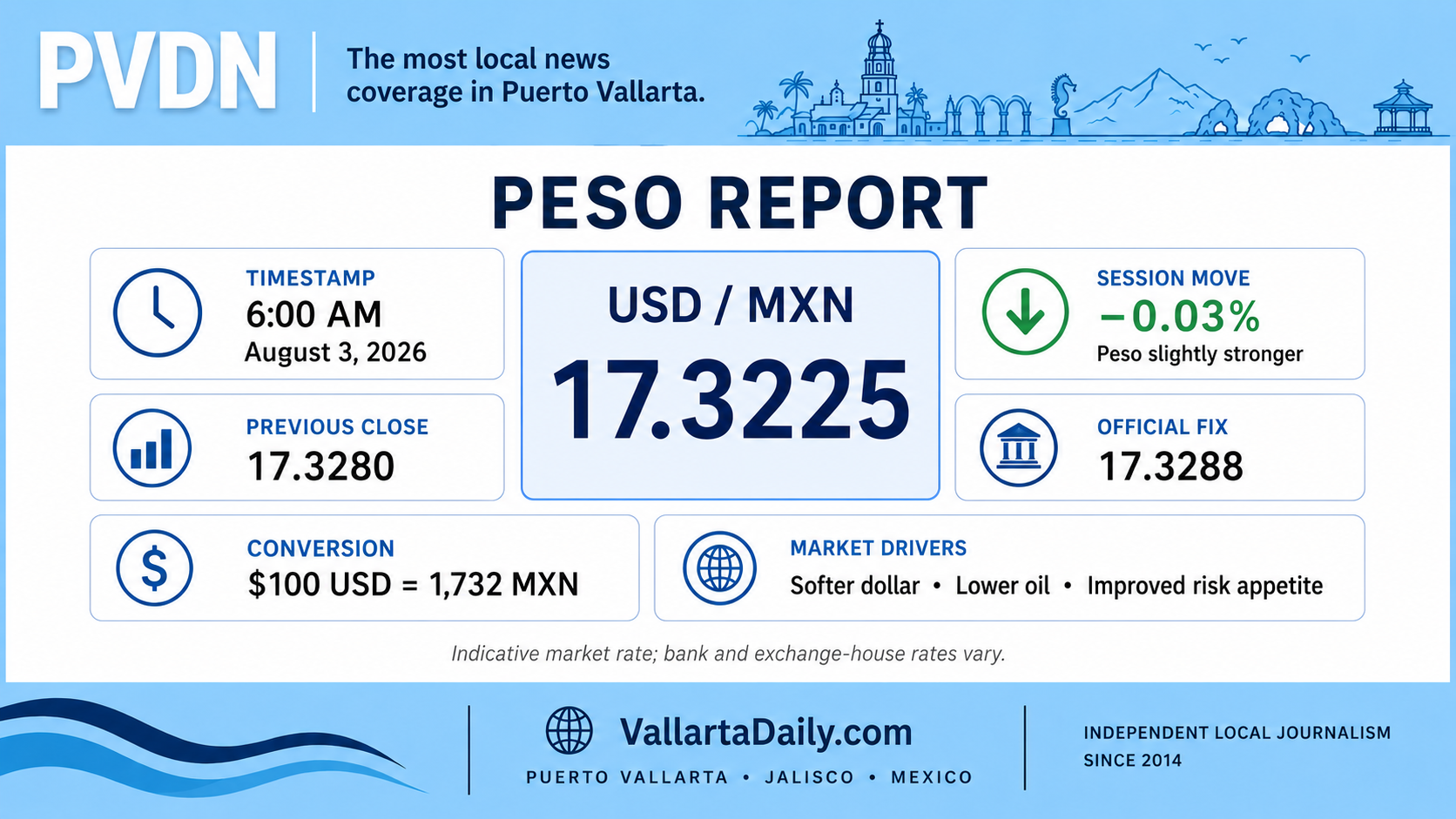
Puerto Vallarta, Jalisco, August 3, 2026 – The Mexican peso was trading near 17.32 to the U.S. dollar early Monday, with the USD/MXN rate at 17.3225 as of 6:00 a.m. Mexico City time.
The dollar was down slightly from the previous close of 17.3280, a move of about 0.03% in favor of the peso, according to live market data. The day’s early trading range was 17.3002 to 17.3490.
Banco de México’s official FIX exchange rate for August 3 was 17.3288 pesos per dollar. The FIX rate is published after midday on business days and is used for certain official payment calculations in Mexico. The central bank’s exchange-rate table is separate from the constantly changing retail and market quotes.
What is moving the peso today
Global markets began the week with a weaker dollar and improved risk appetite after U.S. President Donald Trump said the United States would hold off on another attack against Iran while pursuing talks aimed at reopening the Strait of Hormuz.
That shift also pushed oil prices lower. Brent crude fell more than 5% early Monday to about $83.52 per barrel, while U.S. West Texas Intermediate crude traded near $79.60, according to Reuters market reporting.
Lower oil prices can reduce concerns about renewed inflation and additional interest-rate pressure in the United States. The effect on the peso is indirect, but falling energy prices and calmer geopolitical conditions generally support demand for emerging-market currencies.
The peso also continues to benefit from Mexico’s interest-rate advantage. Mexico’s policy rate was listed at 6.50%, compared with a U.S. Federal Funds target range of 3.50% to 3.75%, according to current economic data. That difference can support demand for peso-denominated assets, although expectations for future rate cuts remain important.
Mexico’s growth and trade position
Recent economic data has provided some support for the peso. Mexico’s economy grew 1.5% in the second quarter from the previous three months after contracting 0.6% in the first quarter, according to figures from INEGI cited in a Reuters report.
The government has maintained a 2026 growth forecast of 1.8% to 2.8%, while acknowledging that the economy would need to contract during both the third and fourth quarters to fall below 1.5% growth for the year.
Mexico’s trade surplus also widened to $4.09 billion in June from $510 million a year earlier, according to market data tracking Mexico’s economic indicators.
Trade policy remains a risk for the peso. The United States imposed new tariffs on goods from dozens of trading partners in late July, while Mexican officials said USMCA-compliant exports would retain preferential treatment. Negotiations over steel, aluminum, automobiles and other trade issues remain part of the broader economic backdrop.
U.S. data and Federal Reserve expectations
Investors are also watching upcoming U.S. employment and services data for clues about the Federal Reserve’s next decisions. A weaker U.S. labor market could reinforce expectations for lower interest rates, which would generally reduce support for the dollar. Stronger-than-expected data could produce the opposite reaction.
The dollar also weakened against the Japanese yen on Monday after the United States and Japan confirmed coordinated action to support Japan’s currency. That intervention added another source of volatility to global foreign-exchange markets, as Reuters reported.
What the rate means locally
At the early market rate of 17.3225 pesos per dollar:
- $100 USD equals about 1,732 pesos
- $500 USD equals about 8,661 pesos
- $1,000 USD equals about 17,323 pesos
The amount received at a bank, exchange house, ATM, or money-transfer service will vary because providers use different buy and sell rates, fees, and spreads.
For Puerto Vallarta residents receiving income in dollars, a stronger peso means each dollar converts into slightly fewer pesos. People earning or holding pesos and paying expenses in the United States receive the opposite effect. The rate can change throughout the day as markets respond to U.S. economic data, trade headlines, oil prices, and central-bank expectations.