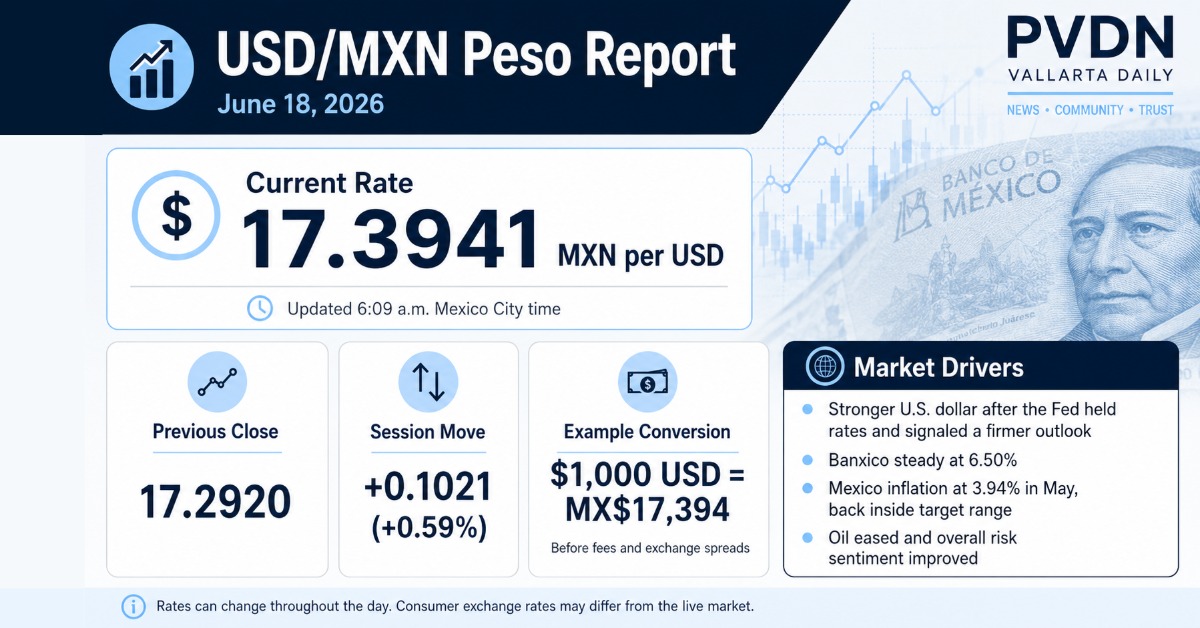
Updated June 18, 2026, 6:09 a.m. Mexico City time
The U.S. dollar was trading near 17.39 pesos early Thursday, with the live USD/MXN quote at 17.3941 at 6:09:17 a.m. Mexico City time.
That put the dollar about 0.59% above the previous close of 17.2920, a move of roughly 10 centavos per dollar. The intraday range was 17.2493 to 17.3994, so the pair was near the upper end of the morning range.
For Vallarta residents, travelers, retirees, and property owners who budget in both currencies, the move means dollar income buys a little more in pesos than it did at Wednesday’s close. A $1,000 conversion at the live market level would equal about 17,394 pesos before fees and spreads, about 102 pesos more than at the previous close.
The same move works in the opposite direction for people earning in pesos and paying dollar-denominated costs, including some rent, travel, tuition, supplier bills, or savings goals.
The peso’s early weakness was tied mainly to broader dollar strength. The Federal Reserve kept its target range at 3.50% to 3.75% on Wednesday, while market attention shifted to policymakers’ projections and the possibility that U.S. rates could rise later this year. Higher expected U.S. rates can support the dollar because investors are paid more to hold dollar-denominated assets.
The dollar index rose after the Fed decision and was near its highest level since May 2025. That broader move matters for USD/MXN because the peso can weaken even without a Mexico-specific shock when the dollar strengthens across major currencies.
Mexico’s domestic backdrop remains more stable, but not risk-free. Banco de México lowered its target rate to 6.50% on May 7 and said it would be appropriate to keep the rate at that level after ending the easing cycle that began in 2024. That still leaves Mexico with a higher policy rate than the United States, a spread that has helped support the peso.
Inflation is still part of the story. Mexico’s annual inflation slowed to 3.94% in May, returning to Banco de México’s target range of 3% plus or minus one percentage point, but core inflation remained firmer. That makes incoming inflation data important for the peso because it affects expectations for how long Banxico can keep rates steady.
Oil and risk appetite were also in view Thursday. Global oil prices fell to around $77 a barrel after a U.S.-Iran agreement eased concern over shipping through the Strait of Hormuz. Lower oil prices can reduce some inflation pressure and support global risk appetite, but early Thursday’s currency move still looked more connected to Fed expectations and dollar strength.
There was no single Mexico-specific event early Thursday that appeared to explain the peso’s move. The next local test will be whether inflation, economic activity, and Banxico’s tone continue to justify a steady-rate position while U.S. markets price in a more hawkish Fed.
For day-to-day budgeting in Puerto Vallarta, the market rate is only a reference. Bank card networks, ATMs, exchange houses, and transfer services set their own rates and fees. Banco de México’s exchange-rate references are published separately from the live market and may not match the rate a consumer receives.