Most days, visitors see the polished version of the city: the beach, restaurants, bars, galleries, tour stands, hotel lobbies, and busy sidewalks of the tourist core. Then a street party fills Emiliano Zapata, the drains smell, wastewater appears near pedestrian areas, trash piles up faster than it is collected, and the machinery behind the destination becomes part of the night out.
That is the uncomfortable part of the current conversation. Infrastructure strain is no longer something discussed only in city meetings, neighborhood chats, or complaints to service agencies. In parts of Puerto Vallarta, it is becoming part of the visitor experience.
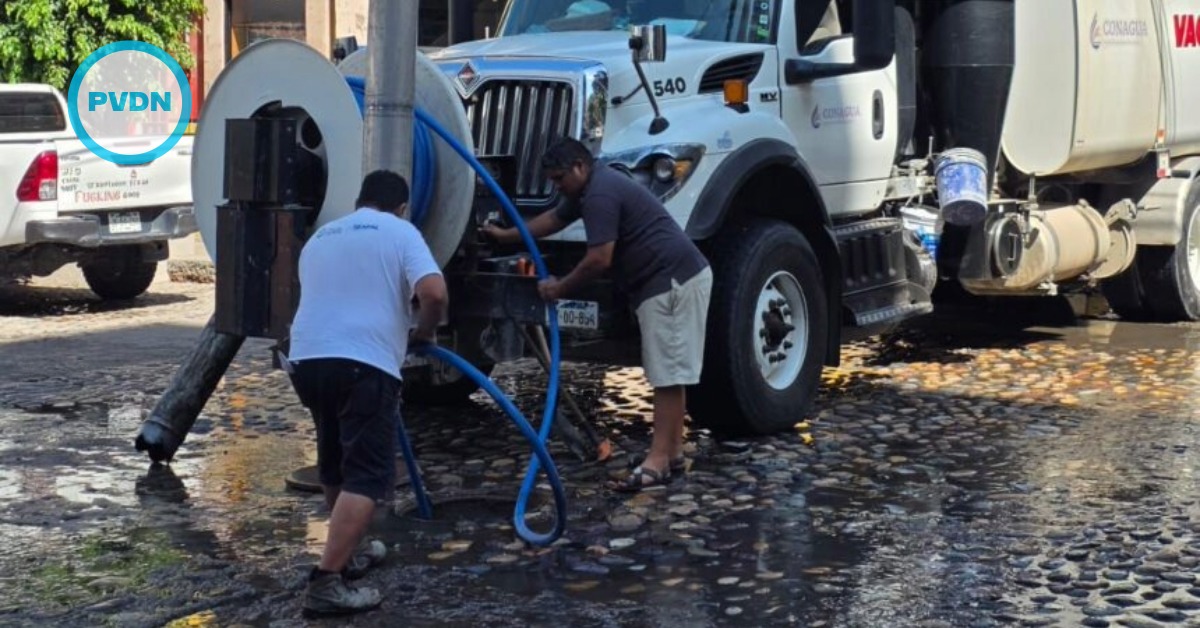
During recent Pride events in Emiliano Zapata, attendees reported sewage odors, wastewater leaks, and accumulated trash near Lázaro Cárdenas and Constitución. The complaints fit a longer pattern in Zona Romántica, where residents and business owners have warned for years that growth, higher foot traffic, restaurant activity, vacation rentals, nightlife, and older underground systems are colliding in the same few blocks.
In recent months, Puerto Vallarta has also dealt with a broken water line near Púlpito and continuing garbage collection problems, both of which show how ordinary service failures can affect central neighborhoods.
That does not mean every street is failing. It also does not mean Puerto Vallarta is broken. It means the city is showing the pressure points of a destination that grew faster than many of its public systems were built to handle.
The problem starts underground
Drainage problems in tourist zones are especially damaging because they turn a technical issue into a public one. A broken pipe, a clogged line, or a backed-up sanitary system may begin underground, but the effects surface where people walk, eat, shop, and celebrate.
In Zona Romántica, the strain is easy to understand. The neighborhood carries a heavy load for a relatively small area. It has older homes, condo towers, restaurants, bars, hotels, beach clubs, short-term rentals, delivery trucks, taxis, pedestrians, party crowds, and daily service workers all using the same urban space.
Every restaurant kitchen adds grease-management demands, while a condo or rental unit adds water and wastewater use. Every event increases trash volume. Each new business depends on the same streets, sidewalks, drainage lines, and collection routes that already serve the people who live there.
When the system works, few people notice. When it fails, the smell travels faster than any city press release.
SEAPAL has previously described issues in the area involving aging wastewater infrastructure, including repairs tied to lines with decades of continuous use. The agency has also warned that grease, solids, and improper discharges can contribute to taponamientos, or blockages, in the sanitary network. Those two realities can coexist: aging pipes need investment, and daily use can cause weak systems to fail faster.
That is why the drainage conversation should not be reduced to a single night, a single street, or a single event. The Pride complaints drew attention because they happened during a crowded public celebration. The underlying issue is older and wider.
Trash is a service problem and a behavior problem
Trash is the visible cousin of drainage failure. It collects in corners, around abandoned vehicles, near event zones, beside overflowing bins, and in places where public cleaning does not keep pace with the daily volume of waste.
Recent complaints in Ixtapa about abandoned vehicles and accumulated trash show that the issue is not limited to the tourist core. In neighborhoods outside the beach corridor, residents face a different version of the same problem: public spaces become harder to clean when vehicles sit for months, dumping starts around neglected areas, and routine maintenance falls behind.
In a destination city, garbage collection has to serve two populations at once. There is the resident population counted in official numbers, then there is the floating population of tourists, weekend visitors, event crowds, seasonal residents, and workers moving in and out of busy zones every day.
That floating population does not always show up in standard planning the way a permanent resident does. Visitors still produce trash. Restaurants serving them produce more. Events compress a week’s worth of waste into a few hours. If collection schedules, staffing, containers, enforcement, and street cleaning do not adjust, the result is visible quickly.
Trash also feeds other infrastructure problems. Debris blocks drains. Grease and solids strain sanitary lines. Litter in stormwater channels can turn into flooding problems when rain starts. A city can spend money on underground repairs and still lose ground if surface maintenance is weak.
Stormwater systems are easy to ignore until something happens
The recent fire inside a stormwater duct beneath Federal Highway 200 highlights another overlooked part of the city: pluvial infrastructure.
Stormwater ducts, channels, culverts, and drains are not part of the scenic image of Puerto Vallarta, but they are essential in a city built between mountains, rivers, streets, and the bay. When rain comes down hard, water needs somewhere to go. If channels are blocked, misused, damaged, or treated as hidden spaces, the risk increases.
A fire inside a duct is not the same kind of problem as a sewage leak, but it belongs in the same broader conversation. Infrastructure is not only pipes and pavement. It includes the spaces under roads, the access points crews need during emergencies, the places where water moves during storms, and the inspections that keep those systems usable.
Puerto Vallarta’s rainy season makes this more urgent. Stormwater systems that appear secondary in dry months become critical when heavy rain begins to move downhill. A blocked or damaged duct can affect traffic, safety, nearby properties, and emergency response.
Stormwater systems become more important during Puerto Vallarta hurricane season, when heavy rain can expose blocked drains and weak maintenance.
Visitors may never think about a drainage channel under a highway. Residents think about it when the road floods, when smoke comes from where it should not, or when crews have to enter a confined space while wearing breathing equipment.
Construction pressure adds another layer
Rapid development changes a city above ground while increasing pressure below it.
The reported collapse of a scaffold at The Lighthouse project on Avenida México, where authorities inspected the site and no injuries were reported, brings construction oversight into the infrastructure discussion. A scaffold incident is different from a sewer backup, but both raise questions about how growth is managed in real time.
Puerto Vallarta’s construction boom affects traffic, water use, drainage demand, debris control, sidewalk access, worker safety, emergency response, and neighborhood quality of life. Each project may be reviewed as an individual development. Residents experience the combined effect.
A new tower not only adds units. It adds construction trucks during the buildout, utility connections, wastewater demand, garbage generation, parking pressure, service workers, delivery traffic, and future residents or guests. Even when a project follows the rules, the surrounding neighborhood may still feel the impact.
That is where construction inspections become part of public confidence. People want to know that scaffolds are secure, sidewalks are protected, drainage connections are adequate, and emergency access remains clear. When an incident occurs, the public rarely separates the technical details from the broader sense that the city is being built faster than it is being managed.
Growth is not the only cause, but it changes the scale
It would be too easy to blame every infrastructure problem on tourism or new development. Puerto Vallarta also has routine maintenance needs, budget constraints, old systems, difficult terrain, rainy-season stress, public behavior issues, and coordination problems between agencies.
Still, growth changes the scale of every failure.
A clogged drain on a quiet street is one kind of problem. The same issue in a nightlife district during Pride becomes a reputational problem for the city. A trash pile in a low-traffic corner is still a public service issue. On a street used by residents, tourists, workers, and businesses every day, it becomes part of the city’s image.
Puerto Vallarta’s population has grown over the past decade, and the official resident count does not fully capture the pressure created by tourism, events, second homes, and short-term rentals. The city’s public systems are being asked to serve more people, more often, in more concentrated areas.
That is the key difference between a place that is simply busy and a place that feels strained. Busy streets can still work when collection, drainage, inspection, enforcement, and maintenance keep pace. Strained streets begin to reveal the gap between what the city sells and what it can support.
Who is responsible for fixing it?
Responsibility is spread across several layers, which contributes to the frustration.
SEAPAL handles water, drainage, and sewer-related systems. Municipal departments deal with garbage collection, street cleaning, public works, permits, inspections, and enforcement. Protección Civil responds when safety risks, fires, collapsed structures, or emergency conditions appear. Developers are responsible for meeting construction and connection requirements. Businesses have obligations around grease traps, waste handling, and proper discharges. Residents and visitors also affect the system through what they throw away, where they park, and how they use public space.
That does not mean everyone is equally responsible. A resident who reports sewage in the street is not the same as an agency responsible for maintaining a collector line. A visitor dropping a cup on the sidewalk is not the same as a city failing to provide enough bins or collection after a major event. A restaurant without proper grease management creates a different burden than a household with a normal water bill.
The hard part is that infrastructure failure rarely has a single, clear cause. Old pipes, high demand, weak enforcement, poor maintenance, bad habits, and delayed investment can all meet at the same manhole cover.
Once you understand who handles public services in Puerto Vallarta, the city becomes easier to navigate when something goes wrong.
The funding question is unavoidable
Sooner or later, every infrastructure story becomes a money story.
Upgrading drainage lines, buying equipment, expanding collection capacity, hiring inspectors, maintaining stormwater systems, and monitoring construction all require funding. That money can come through service fees, municipal budgets, state or federal support, developer obligations, fines, permits, public-private agreements, or some mix of those sources.
The debate should not be limited to whether Puerto Vallarta needs better infrastructure. It clearly does in several areas. The more serious question is who pays, who benefits, and who gets relief first.
Tourist zones generate major economic activity, so failures there are highly visible and politically sensitive. Residential neighborhoods outside the tourist core also need dependable service, even when their complaints do not affect the city’s brand. If upgrades follow only the loudest tourism pressure, local neighborhoods can remain stuck with weak streets, trash problems, and drainage gaps. If investment ignores the tourist core, the city risks damaging the same economy that funds many public services.
A fair infrastructure plan has to deal with both realities.
What residents and visitors are seeing
For residents, infrastructure strain shows up as reports that go unanswered, streets that smell after a backup, trash that sits too long, construction that narrows sidewalks, and storm drains that look neglected before the rains arrive.
For visitors, the signs are simpler. They notice odors, puddles, trash, blocked sidewalks, construction hazards, flooding, traffic disruption, or emergency vehicles outside a place they expected to feel carefree.
That difference matters because residents experience the pattern. Visitors often experience the incident.
A tourist may remember one bad smell near a party. A resident remembers the last five times the same corner had problems. A business owner remembers lost customers, complaints, cleanup costs, and the fear that another event will expose the same weakness again.
That is why the recent Pride complaints landed so strongly. They were not only about one celebration. They exposed a gap between Puerto Vallarta’s public image and the everyday systems needed to support that image.
What would make the conversation more useful
The city does not need another round of vague promises about modernization. Residents need specifics.
Useful reporting would ask which drainage lines in Zona Romántica are most vulnerable, when they were installed, how often they fail, and what repairs are planned. It would ask how many grease trap inspections are conducted at restaurants and hotels, what penalties exist for improper discharges, and whether those penalties are enforced.
Trash coverage should look at collection schedules, staffing, transfer capacity, abandoned-vehicle enforcement, event cleanup plans, and complaint response times. Stormwater reporting should identify ducts, channels, and drains that are considered high risk before the rainy season. Construction coverage should track inspection records, sidewalk protections, scaffolding safety, drainage connections, and whether repeat violations lead to consequences.
Neighborhood associations, longtime business owners, engineers, SEAPAL crews, Protección Civil personnel, construction workers, and residents all see different pieces of the system. The best version of this story would bring those pieces together.
Puerto Vallarta can still be a beautiful, functional, welcoming city. But beauty does not repair a sewer line, clear a stormwater duct, remove an abandoned car, inspect a scaffold, or collect garbage after a crowded night.