A federal court upheld sanctions requiring the demolition of two Punta Paraíso towers on Oct. 7, Mexico’s environmental enforcement agency said.
The court unanimously rejected developer Pacific Lifestyle Properties’ amparo, a constitutional court challenge, over sanctions for construction on federal coastal land. La Jornada reported the decision, citing Profepa, Mexico’s federal environmental enforcement agency.
The measures require restoring about 1,466 square meters of land gained from the sea by demolishing the irregularly built structures, along with a 96,220-peso fine. Vallarta Daily previously reported on the two towers covered by the ruling.
For someone considering a coastal condo around Puerto Vallarta or Riviera Nayarit, the case raises a practical question: How can a buyer assess a development while a dispute over its legality is still unfolding?
The useful starting point is to check whether the ownership documents, coastal concession, and construction approvals describe the same property and the same uses. A building can have paperwork even if not every part of its beachfront footprint is authorized.
The full October judgment and original concession file were not obtained for this article. The case-specific findings follow the agency’s account reported by established news outlets; conclusions about individual owners’ rights or potential claims would require those records and an independent legal review.
The use written into the concession
In Profepa’s account, reported by La Jornada, the original 2009 concession covered roughly 1,470 square meters and required keeping the area in its natural state. A 2014 modification expanded the concession to about 2,534 square meters and allowed recreation and beautification, known as ornato, but did not allow other uses.
That distinction is central to the buyer question. Producing a concession establishes that an authorization exists. Its wording, boundaries, and conditions establish what it actually covers.
Mexico’s General Law of National Assets treats beaches and the federal maritime-terrestrial zone, or ZOFEMAT, as public-use assets. For coasts with beaches, Article 119 defines the zone as a 20-meter-wide strip of walkable, solid ground adjoining the beach.
Article 16 says concessions and permits over federal public-domain assets do not create property rights. They authorize specified uses under the law and the terms of the particular title. A deed for an adjoining private lot therefore answers a different question from a concession governing the federal strip.
Attorney Ana Lozano, founding partner of Lozano & Associates, puts the buyer’s task plainly in published guidance on coastal concessions: “For beachfront property, confirming the concession — its existence, scope, holder, and standing — is often the decisive due-diligence question.”
For a condo buyer, that means finding out who holds the concession the development relies on, when it expires, and which beachfront spaces it covers.
Each approval answers a different question
A coastal concession is one part of the review. Environmental approval and permission to build also have their own scope.
Under Article 28 of Mexico’s federal environmental law, real estate developments affecting coastal ecosystems fall within categories subject to prior federal environmental authorization, as specified by the implementing rules. Article 35 limits that decision to the environmental aspects of the proposed works.
A manifestación de impacto ambiental, usually called an MIA, is the environmental impact statement submitted for evaluation. The buyer needs the authority’s resolution on that proposal, including its conditions, rather than simply evidence that a study was prepared.
Punta Paraíso’s history illustrates the distinction. A 2022 Supreme Court record documents a conditional environmental authorization issued in September 2017 and a residents’ challenge filed in January 2018. That record concerns a separate dispute over environmental approval, rather than the October 2026 decision upholding Profepa’s sanctions.
In published analysis of coastal permitting, environmental law firm Bustamante + Freyre explains that municipal construction licenses do not replace the federal concession or federal permission required for works in ZOFEMAT. A concession authorizing use of the area also does not automatically authorize every proposed intervention.
The federal coastal-use regulation reinforces that point: Article 29 requires concession holders to carry out only the authorized uses and approved works.
Consider a hypothetical condo advertised with a beachfront pool. The apartment’s ownership documents might be in order, but that leaves further questions: Where does the private lot end? Is the pool within federal land? Which approval covers its construction and use?
Answering those questions requires comparing the plans and coastal boundaries with the development as built. The apartment number alone cannot resolve the status of a common area that helps make the property attractive.
A pending case needs a current answer
The Punta Paraíso sanctions did not begin with last week’s headlines. As La Razón reported, inspections in December 2021 led to sanctions in August 2022. The company challenged the decision; an administrative tribunal upheld it in May 2025, and the company then sought the amparo, which was rejected Oct. 7.
For a buyer looking at another development today, “the case is in court” leaves too much unanswered. Relevant questions include which authorization is disputed, whether sanctions have already been imposed, and what the latest orders say about enforcement.
A suspension also needs careful reading. Articles 146 and 147 of Mexico’s Amparo Law distinguish a court measure preserving the subject of a case during proceedings, with defined effects and conditions, from the eventual judgment. A suspension should not be read as a final decision validating the development.
The practical request to an independently retained lawyer is specific: review the administrative resolution, the relevant case files and any current suspension order, then explain how they relate to the proposed purchase. That review should identify whether the disputed area includes the unit, its tower or shared amenities.
Published due diligence guidance from Bustamante + Freyre recommends checking a concession’s validity, authorized area and use against actual operations, and reconciling federal permissions with municipal approvals.
The firm also describes ways unresolved gaps can affect transactions, including conditions that must be met before closing, retained purchase funds, and additional guarantees. For an individual buyer, those are matters to discuss with counsel before signing: What must be verified before money is released, and what does the contract provide if that verification fails?
A seller’s forecast that a dispute will be resolved favorably is different from a court order already in the file. Recording that difference gives the buyer a clearer basis for deciding whether to proceed.
Keep structural safety in the review
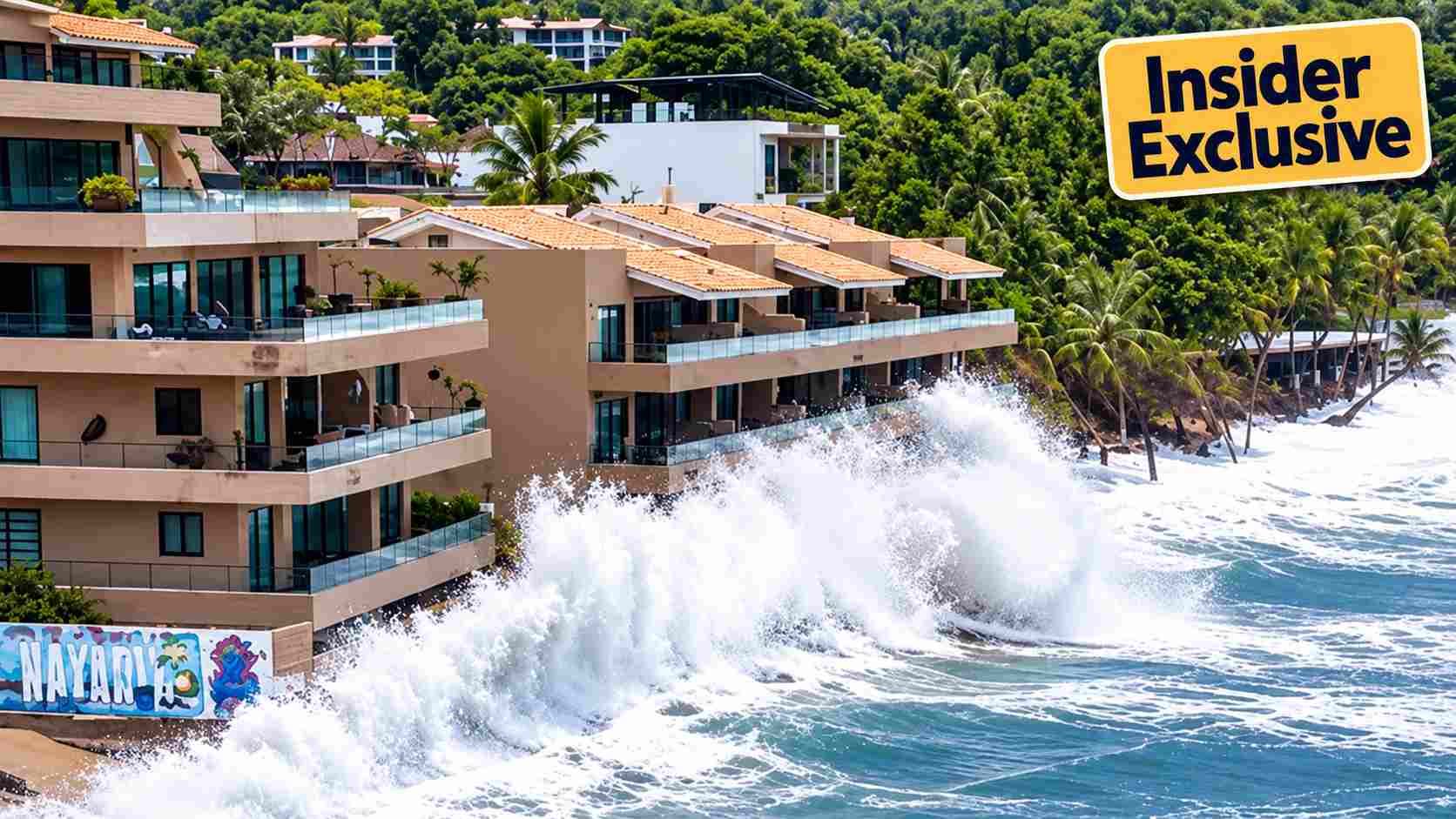
The legal dispute also needs to remain separate from the recent wave damage. In its Oct. 3 report on Punta Paraíso’s evacuation, Vallarta Daily cited Bahía de Banderas’ Civil Protection director, who said authorities evacuated 13 tourists and closed the property after waves undermined two towers.
That was a safety action. The environmental sanctions upheld in October date back years. Their chronology does not support treating the wave damage as the reason for the demolition ruling.
For buyers, both inquiries remain necessary. Legal review addresses the right to occupy and build on the relevant land; a qualified engineer’s assessment addresses the structure’s condition.
In San Pancho, the reported remedy is restoration of about 1,466 square meters through demolition. Before a buyer commits elsewhere on this coast, the approvals should be traceable to the exact tower, terrace, or pool being offered.