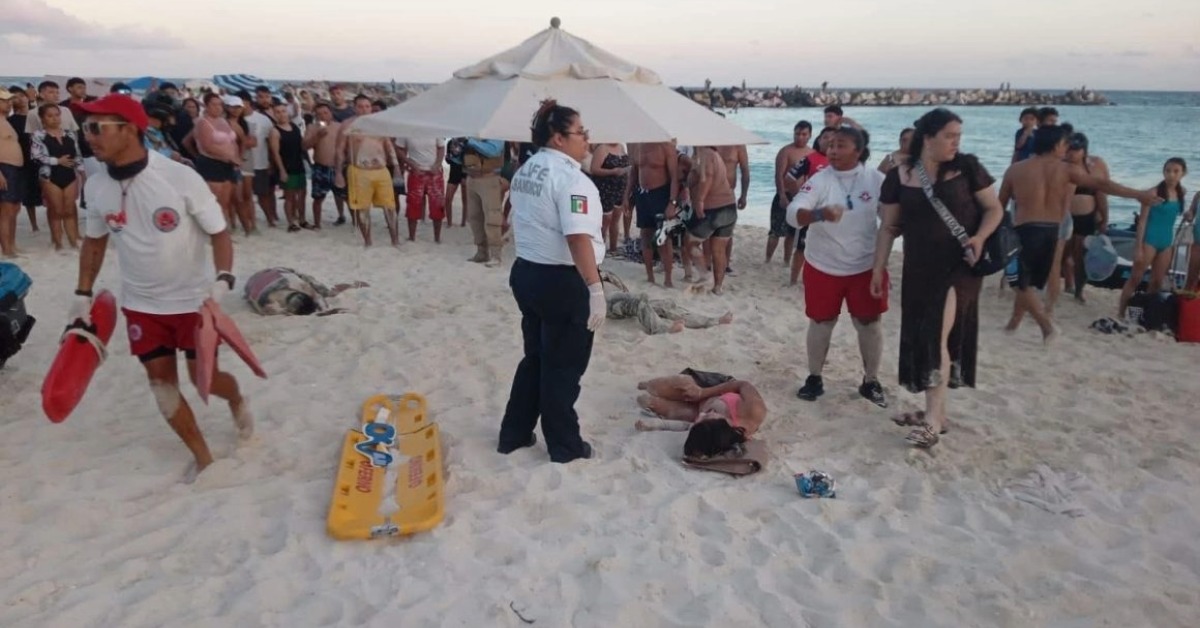
Five people were injured Sunday after a jet ski reportedly lost control and struck beachgoers at Playa Forum, one of the busiest areas in Cancun’s Hotel Zone.
The incident occurred near kilometer 8.5 in the Hotel Zone, an area frequently used by residents, tourists, and beach clubs. Emergency calls were reported around 6:50 p.m. after witnesses said the watercraft moved erratically and reached the beach area.
Municipal emergency personnel responded to the scene. The injured were treated on site, and two people were later taken to a hospital for further medical care.
Authorities detained the jet ski operator and a companion. Early reports said they were allegedly under the influence of alcohol. The case was turned over for investigation to determine possible responsibility.
No deaths were reported. Available accounts did not identify the injured people by name, age or nationality.
What authorities reported after the crash
Local emergency response included Tourist Police, Civil Protection lifeguards, firefighters, and personnel from the Navy. The beach area was cordoned off while responders assisted the injured and controlled the scene.
The municipal government said five people were hurt in the incident at Playa Forum. Officials also said the response from rescue teams helped prevent a worse outcome.
Early accounts differed on the seriousness of the injuries. One report said two people were taken to a hospital, while another said the injured were stabilized before receiving specialized care. As of the available reporting, authorities had not released a full medical update for each injured person.
The state prosecutor’s office is expected to determine whether criminal or administrative responsibility applies. That review may include the conduct of the operator, possible alcohol use, the speed of the watercraft, and whether the jet ski was operating in an authorized area.
Why this matters beyond one beach accident
For many international residents and visitors, Cancun’s beaches can feel highly organized. There are lifeguards, flags, signs, beach clubs, and visible police patrols. But the coastline also includes a busy mix of swimmers, boats, jet skis, tour operators, and private users.
That combination can create risk when motorized watercraft operate close to shore. A jet ski can move quickly, turn sharply, and become difficult to control in crowded areas. When it reaches the sand or a swimmer zone, people on the beach have little time to react.
This incident is not only about one operator. It points to a wider safety question in Mexico’s beach destinations: how authorities separate recreation zones, enforce operating rules, and respond when tourist activity overlaps with public beach use.
For expats and long-term residents, the issue is practical. Cancun, Playa del Carmen, Puerto Vallarta, Los Cabos, and other coastal cities all depend on beach tourism. Residents also use these same beaches for daily recreation. Clear safety rules matter for both groups.
Cancun has been reviewing beach and nautical safety
Cancun officials had already been working on beach and nautical safety before this incident. In late March, municipal authorities reviewed a digital beach platform designed to provide real-time information for beach users.
That platform includes information such as crowd levels, beach flag status, lifeguard presence, and beach locations. It is meant to help residents and visitors make safer choices before going to the beach.
Authorities also discussed adding affiliated marinas to the system. The stated goal was to improve vessel records and strengthen prevention and response mechanisms.
Those steps matter because beach safety is no longer limited to swimming conditions. A safe beach also depends on how watercraft, tour operators, and beach users navigate one another.
The Playa Forum crash may increase pressure for closer supervision of motorized recreation in high-traffic beach zones.
What beachgoers should watch for
For readers who live in Mexico or visit beach destinations often, the lesson is not to avoid the beach. It is to pay closer attention to the space around you.
Motorized watercraft should not be ignored, even from the shoreline. If jet skis are operating near a swimming area, keep a distance when possible. Parents should also keep children away from launch points or areas where watercraft come in and out.
Beach flags remain important, but they mainly warn about sea conditions. They do not always tell the full story about nearby boat or jet ski activity.
Crowded beaches can also become more dangerous near sunset, when visibility changes, and alcohol use may increase. That can affect both swimmers and operators of recreational equipment.
The safest areas are usually those with visible lifeguards, clear signage, and separation between swimmers and watercraft. If that separation is not clear, it is reasonable to move farther down the beach.
Investigation could test local enforcement
The next step is the investigation. Authorities will need to determine whether the operator was negligent, whether alcohol was involved, and whether the watercraft was being used legally.
They may also review whether the jet ski was rented, privately operated or connected to a nautical service. That distinction can affect which rules apply and who may be held responsible.
If a business is involved, regulators may examine permits, supervision, safety instructions, and operating zones. If it were private use, investigators may focus on the operator’s conduct and possible criminal liability.
For Cancun, the case comes at a sensitive time. The city is working to promote itself as more than a beach destination, while still relying heavily on its coastline. Safety incidents in visible tourist zones can affect public confidence, even when they are isolated.
The main question now is whether this crash will result only in individual penalties or in stronger supervision of jet ski operations near crowded beaches.