Neighborhood Watch Reports is a weekly series that focuses on different areas of Puerto Vallarta for insider subscribers.
The neighborhood change this week is easy to miss but likely to affect your sidewalk, your morning routine, and possibly your patience. Centro and 5 de Diciembre will follow different garbage collection schedules beginning Wednesday.
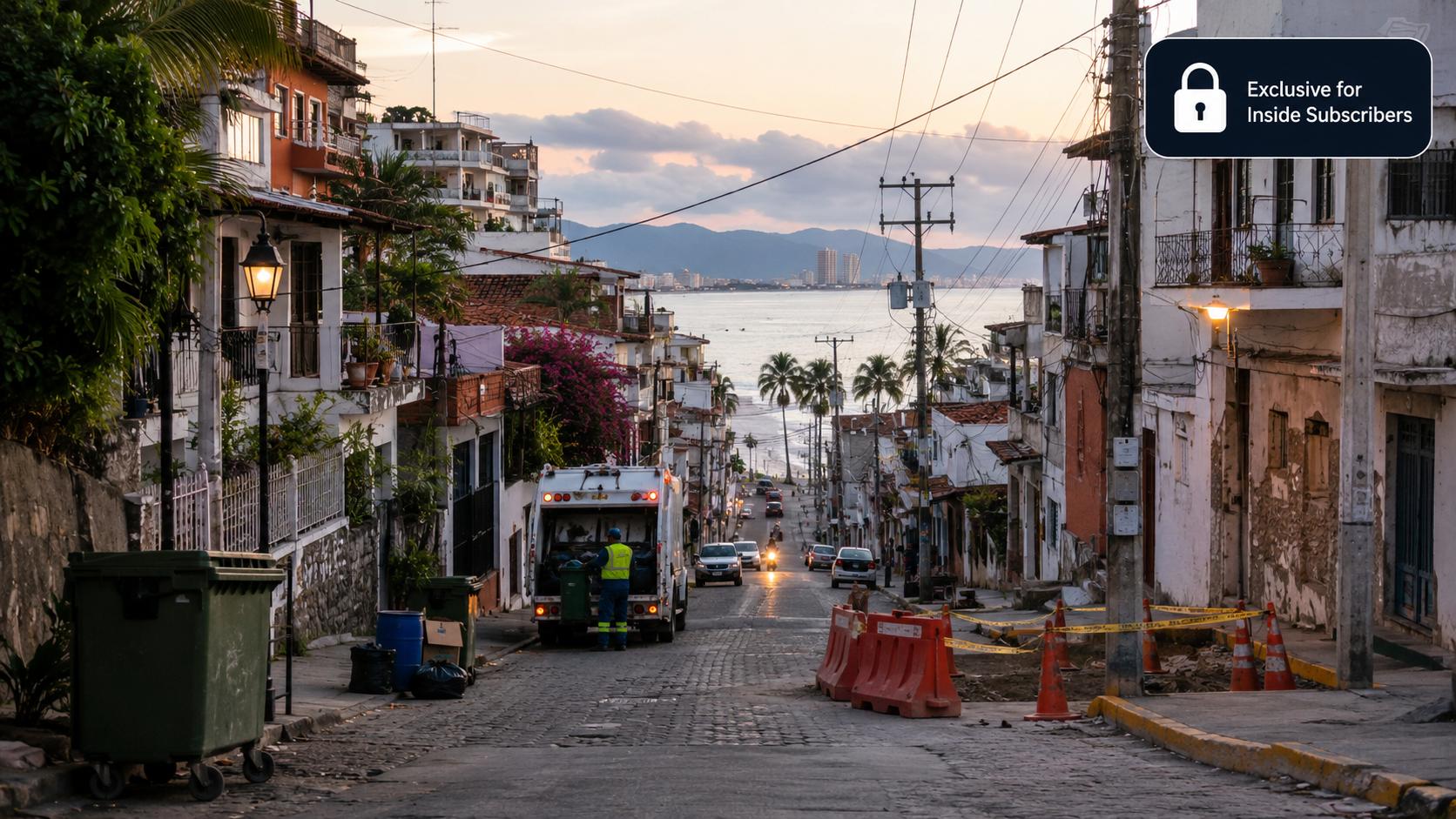
Centro is listed for daily collection beginning at 6:30 a.m. In 5 de Diciembre, the truck is scheduled for Monday, Wednesday, Friday, and Sunday, beginning at 6:30 a.m. The change is part of the citywide garbage calendar taking effect July 15.
Some abbreviated reports have described 5 de Diciembre as receiving daily service. The more detailed neighborhood lists published by Tribuna de la Bahía and Out & About Puerto Vallarta agree on the four-day schedule. The municipal government has also posted the official collection announcement and route graphics.
My advice for the first week is not to treat the calendar as a promise carved in stone. Put household garbage out shortly before the scheduled route rather than leaving it overnight, especially with rain in the forecast. If the truck does not arrive, bring the bags back inside when practical, rather than allowing animals, runoff, or passing vehicles to spread them across the street.
The regular trucks will not collect mattresses, furniture, appliances, construction debris or tree branches. The city has warned that leaving waste outside the assigned schedule or placing prohibited items at collection points can result in action by the Guardia Ecológica.
Parque Hidalgo remains the neighborhood trouble spot
The unfinished work between Parque Hidalgo, Avenida México, and the north end of the Malecón remains the most obvious daily nuisance in this combined neighborhood beat.
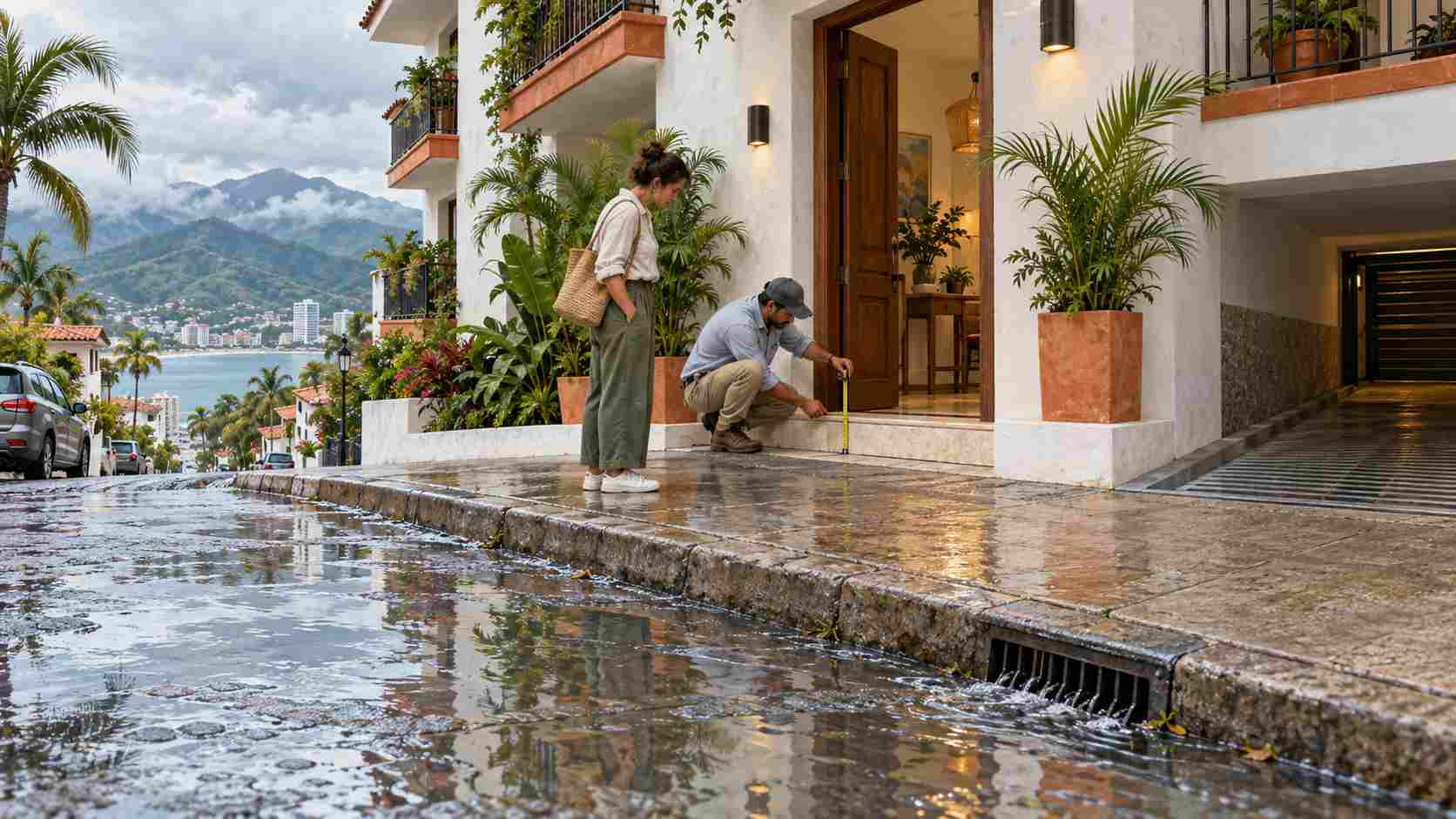
The problem is concentrated around Jesús Langarica and 31 de Octubre, where standing water, loose construction material and damaged barriers have made the route less comfortable and, after rain, less predictable for pedestrians.
This is not simply a case of workers needing a few more days. The larger Avenida México-to-Malecón project was already reported as approximately four months behind schedule in April. At that point, officials said remaining work included storm drains on 31 de Octubre, and a rainwater collector on Jesús Langarica intended to discharge toward Playa Camarones. Those details were expected to be completed in May, yet visible hazards remained in early July.
That matters more now than it would in February. Water collecting beside unfinished surfaces can conceal holes, uneven pavement, and loose material. Anyone walking between Parque Hidalgo and the Malecón after an afternoon storm should use the better-lit side of the street, avoid squeezing between barriers and parked vehicles, and assume that a puddle may be deeper than it looks.
Drivers should also expect awkward movement around 31 de Octubre. Between construction edges, delivery vehicles and people entering or leaving the Parque Hidalgo parking area, the problem is less a formal closure than a series of small obstructions that can quickly back up traffic.
Centro is losing buildings faster than it is settling the rules
A traditional property at Morelos and 31 de Octubre was demolished July 2 after Civil Protection determined that it had serious structural damage and presented a public risk.
The demolition appears to have followed the required government reviews, including consultation with the Jalisco Culture Secretariat. Still, the Puerto Vallarta College of Architects questioned whether more of the property could have been preserved, even if the unstable portions had to come down.
The building was not classified as one of the city’s highest-value monuments, but it stood within the Fundo Legal, the protected area covering much of Puerto Vallarta’s traditional center. The architects’ concern was about the loss of the larger streetscape: individual buildings that may not be famous on their own but collectively give Centro its scale, rooflines, colors, and older architectural rhythm.
This is the development issue I would keep closest to the neighborhood file. Puerto Vallarta does not need to preserve every unsafe wall, but the city still lacks a process that provides the public with a clear account of what must be demolished, what can be retained, and what is approved for replacement.
The Morelos property is also not an isolated dispute. Questions surrounding Casa Ipanema and other Centro buildings have already shown how quickly structural deterioration, private development plans, and heritage rules can become tangled.
Watch the replacement project, not just the empty lot. The height, massing, parking arrangements and street-facing design of whatever comes next will tell us more about Centro’s direction than the demolition itself.
The Río Cuale market warning needs precise language
The structural concern at the Río Cuale Municipal Market deserves attention, but it also needs to be described carefully.
The warning does not apply equally to every shop, floor, and passage in the entire market. The reported danger concerns the older northwestern section on the ground floor, commonly described as the casco viejo. A Civil Protection inspection identified advanced deterioration in wooden beams, insect damage, sagging roof elements, cracked structural components, and exposed reinforcing steel.
Civil Protection recommended considering an evacuation of that section while a detailed structural assessment and repairs were completed. However, the older market area reportedly remained occupied months later, and no publicly confirmed structural clearance had been issued as of the latest reporting.
There is no reason to claim that the whole market is about to collapse. There is equally no reason to dismiss an official warning involving rotten load-bearing wood and deformation in a roof system.
People using the market should follow any barriers or access restrictions placed by merchants or authorities and avoid entering areas where active repairs, temporary supports or visibly damaged roofing are present. The city owes the public a clearer update stating whether the affected section has been reinforced, partially closed, inspected again or left operating under temporary conditions.
Electrical problems remain part of the 5 de Diciembre story
There has not been another major neighborhood electrical emergency reported this week, but the recent pattern is worth keeping on the board.
A transformer exploded near Brasilia and Prolongación Bolivia on June 30, injuring a 53-year-old man and interrupting electricity in part of 5 de Diciembre. That followed a separate residential fire reportedly linked to an electrical short only days earlier.
At the same time, the Federal Electricity Commission is preparing a new substation in 5 de Diciembre intended to strengthen the corridor extending south toward Olas Altas.
The encouraging part is that the infrastructure problem is being recognized. The less reassuring part is what prompted the investment: central Vallarta’s electricity demand has grown, and failures can cascade into other services. SEAPAL and CFE recently agreed to resume preventive tree trimming near power lines serving wells and pumping stations after electrical failures contributed to broader water disruptions.
For the neighborhood, the useful habit is to notice whether an outage affects only one building, one block or a wider area. That detail helps distinguish an internal property problem from a transformer or distribution failure. Record the time, the nearest intersection, and whether streetlights are also out before reporting it.
Centro gets a welcome cultural addition
Not every neighborhood item this week is a complaint.
The parish museum beside Our Lady of Guadalupe Church is hosting a month-long program that combines photography, poetry, and artwork produced by students. The new exhibition gives the small museum a broader cultural role beyond its permanent religious and historical collection.
It is the kind of modest Centro activity that can be overlooked because it does not arrive with a major festival stage or tourism campaign. It also gives people another reason to spend time around the main plaza without adding another bar, souvenir shop, or large commercial project.
I did not find a sufficiently verified major business opening or permanent closure in either neighborhood that deserved inclusion in this report. I would rather leave that space empty than turn a temporary social-media announcement into a supposed neighborhood trend.
A few things I would keep an eye on this week
The July 14 weather outlook includes continued humidity and the possibility of afternoon thunderstorms. In these two neighborhoods, the first places to check after heavy rain are the unfinished work around Parque Hidalgo, low sections of sidewalk near Avenida México, and drainage points where garbage bags or construction materials can block runoff.
Centro receives daily morning garbage collection under the new plan. In 5 de Diciembre, remember the Monday-Wednesday-Friday-Sunday schedule unless the city issues a correction.
No new neighborhood-specific noise enforcement action or public safety alert surfaced in the official reporting reviewed for this edition. That does not mean there were no complaints. It means there was not a public record strong enough to report responsibly.
The most useful reader tips will include an exact intersection, the day and time, a photograph taken from a public place, and a brief explanation of whether the issue is recurring. Streetlights that remain dark, garbage missed repeatedly, dangerous sidewalk breaks, construction blocking access, and unexplained business closures are all worth sending through the PVDN Reddit account.
For now, the neighborhood picture is mixed: a new garbage experiment begins, an overdue street project remains unfinished, Centro continues losing pieces of its older architecture, and two unresolved structural questions—the Río Cuale market and the central electrical network—deserve more public information than they are currently receiving.