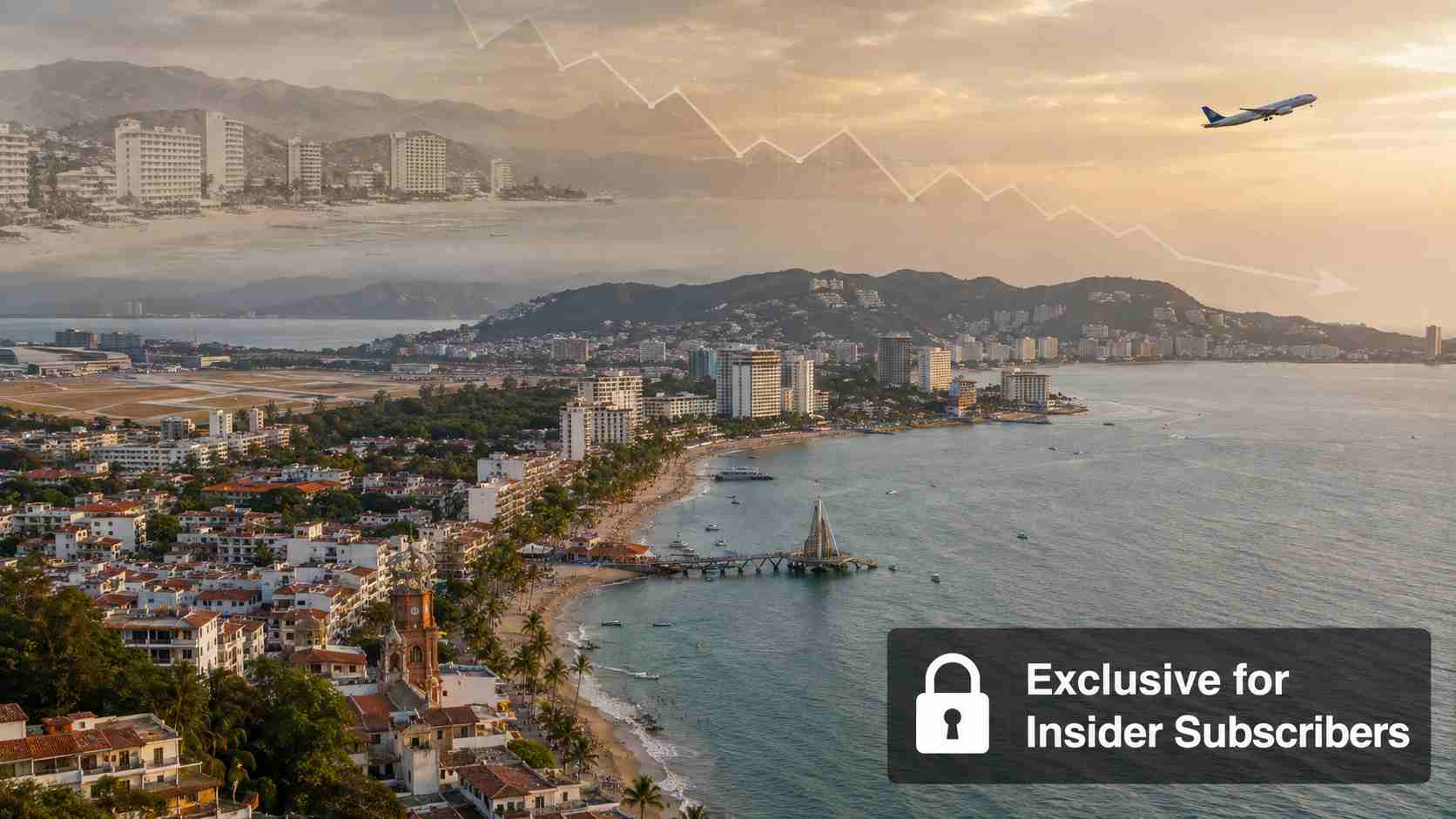
Puerto Vallarta, Jalisco, August 12, 2026 — Puerto Vallarta’s international terminal traffic fell 19.3 percent during the first seven months of 2026, extending a foreign-market weakness that was visible well before the violence of February 22.
The decline does not mean Puerto Vallarta has become Acapulco. The two cities remain separated by major differences in security, market scale and international access. The comparison matters because Acapulco did not lose its international position in a single season. Its foreign market weakened over years while domestic travel kept hotels, beaches and streets busy enough to soften the headline numbers.
That is the risk now facing Puerto Vallarta. A destination does not need to become empty to lose its standing abroad. It can remain one of Mexico’s busiest beach cities while attracting fewer high-spending international travelers, depending more heavily on Mexican vacation periods and producing less income from each visitor.
The decline started before February
GAP airport data filed with the U.S. Securities and Exchange Commission show 3.824 million international terminal passenger movements at Puerto Vallarta airport in 2025, down 3.5 percent from 2024. Domestic traffic rose 9.9 percent to 3.123 million, leaving total airport activity 2.1 percent higher despite the international loss.
The annual result concealed a persistent split between the two markets. International traffic recorded year-over-year declines through most of 2025. PVDN reported an eleventh consecutive monthly decline by May of that year. A modest increase in January 2026 interrupted the sequence, but it did not erase the broader weakening.
The security crisis on February 22 produced a much sharper break. Air Canada temporarily suspended operations, and United canceled flights after a military operation against cartel leader Nemesio Oseguera set off violence and travel disruption across parts of Jalisco, Reuters reported that day. March international traffic at the airport dropped 32.1 percent from a year earlier.
The first seven months now provide a wider measure. GAP’s July filing recorded 2.059 million international terminal movements from January through July, down from 2.551 million during the same period of 2025. Domestic traffic fell 3.2 percent, while combined traffic declined 12.6 percent. July alone recorded a 29.8 percent international drop, while domestic traffic increased 0.6 percent.
Hotel performance moved in the same direction. DATATUR figures reviewed by PVDN placed average occupancy at 69.38 percent during the first half of 2026, compared with 75.41 percent a year earlier. March fell to 59.1 percent from 81.2 percent. January through May each finished below the comparable 2025 month, while June improved.
February intensified the decline. It did not begin it.
The airport numbers also require careful reading. They count passenger movements through the terminal, not unique tourists. One round-trip traveler can appear twice. The series still provides a consistent measure of direction, and the market split is now too large to dismiss as a brief monthly fluctuation.
A busy destination can still earn less
Puerto Vallarta’s 2025 visitor total was presented as a record. Figures released by the Puerto Vallarta Tourism Trust placed annual visitation at 6.265 million, slightly above 2024. Yet the composition of that growth carries the stronger economic message.
The Tourism Trust’s estimates classified 67.5 percent of visitors as domestic and 32.5 percent as international. Mexican travelers generated an estimated 16.757 billion pesos in local economic activity. International travelers generated 24.167 billion pesos despite representing less than one-third of the total.
Using those estimates, an average international visitor generated about three times the spending attributed to an average domestic visitor. The exact amount varies by lodging choice, length of stay, and exchange rate, but the imbalance is clear. Replacing a lost international traveler with one domestic traveler can preserve the arrival count without preserving the revenue.
That distinction reaches beyond hotels. Restaurants, bars, tours, airport transportation, retail, entertainment, short-term rentals and real estate sales all depend partly on the spending depth of each market. Domestic travel is economically valuable and has prevented a steeper downturn. It cannot be treated as an equal financial substitute when the available local estimates show such a large spending gap.
Acapulco demonstrates where that substitution can lead. FONATUR reported 5.446 million hotel tourists in Acapulco during 2025, a 26.6 percent increase after the destruction caused by Hurricane Otis. The destination is not abandoned. Its recovery, however, rests almost entirely on Mexican demand. Domestic tourism represented 98.9 percent of the total.
Acapulco still fills beaches and hotels during major Mexican vacation periods. What it largely lost was the international market that once defined its global identity and supported a different level of spending.
Acapulco’s fall began before cartel violence
The simplified version of Acapulco’s history says foreign travelers left because the city became violent. Violence was decisive, but the decline had already begun.
Acapulco became Mexico’s first major international beach resort after World War II and reached its golden period from the 1950s through the 1970s. It remained a prominent U.S. vacation choice into the 1980s. Its early success depended heavily on air travel, hotel investment, and celebrity visibility.
Success also produced uncontrolled urban growth, sewage and pollution problems, congestion, pressure on public services and an aging tourism core. Research published in Revista Geográfica de América Central identified excessive and unregulated early urban growth as a trigger that increased waste, pollution, insecurity and other problems tied to the tourism decline.
At the same time, Mexico was building newer beach markets. Cancún opened as a planned resort in the 1970s with modern hotels, coordinated infrastructure, international marketing and an air-access model suited to package travel. A recent review of Mexico’s resort development found Cancún had surpassed Acapulco in international arrivals by 1986.
Acapulco responded partly by moving investment outward. Tourism development shifted from the Traditional Zone to the Golden Zone and later to Diamante. New towers, resorts, and private investment continued, but they did not restore the original city or reverse the international decline. Construction became evidence of activity, not proof of renewed foreign demand.
Cartel conflict beginning in the mid-2000s then turned a long competitive decline into a reputational crisis. International airlines reduced service, cruise lines withdrew calls and repeated violent images became attached to the destination. Hurricane Pauline in 1997, Hurricane Otis in 2023 and Hurricane John in 2024 added severe physical and economic damage.
Acapulco’s experience was cumulative. Competition, weak planning, environmental stress, aging infrastructure, outward development, violence and natural disasters reinforced one another over several decades.
Old strengths are not permanent protection
Puerto Vallarta’s current advantages are real. The airport still handles millions of international passenger movements. The city has a large repeat-visitor base, a substantial foreign resident population, strong hotel brands and more U.S. connections than Acapulco now receives.
Those advantages describe the present. They do not guarantee the next decade.
Acapulco once had extensive U.S. air service and a global name that few Mexican resorts could match. Its airline network contracted as demand and route economics weakened. Puerto Vallarta is now seeing the first part of that process. Airlines do not create a durable market simply by publishing schedules. They keep routes when bookings, fares and operating economics justify the aircraft.
OAG schedule data show U.S. airline capacity to Puerto Vallarta down 29.6 percent during summer 2026 compared with summer 2025, from 739,371 scheduled seats to 520,624. OAG described Puerto Vallarta as one of the leisure markets hit hardest by the wider U.S. airline pullback from Mexico.
The order of events matters. Flight reductions did not cause Puerto Vallarta’s initial international decline. Weak demand and less attractive route economics led airlines to reduce capacity. Once service is removed, the loss can deepen the problem by reducing nonstop choices, raising trip friction and making competing destinations easier to book.
The same caution applies to airport construction. GAP announced a five-year, 52 billion peso investment program in February 2025, including completion of a new terminal at Puerto Vallarta airport. The project is expected to double terminal capacity.
It is a second terminal, not a second runway, and the plan was already underway before the current downturn. The investment gives the airport room to handle future growth. It does not guarantee that travelers will fill that capacity. It is hopeful planning by GAP, not evidence that international demand has recovered.
Puerto Vallarta’s LGBTQ market is also not a decisive difference in this comparison. Acapulco was a major LGBTQ beach destination before Puerto Vallarta assumed that position. Guerrero tourism officials traced Acapulco’s recognized gay tourism market to the 1980s, centered on Playa Condesa. Academic research describes Acapulco as a popular queer vacation destination during the 1980s and early 1990s before Puerto Vallarta surpassed it.
A loyal niche can support businesses and repeat travel. Acapulco shows that no single traveler segment can offset a broad loss of competitiveness, access or confidence.
Real estate adds another warning signal
Puerto Vallarta’s housing market has not collapsed. Sales across Puerto Vallarta and Banderas Bay increased during the latest trailing 12-month period, and median sold prices remained above the prior year. The deeper measures show a cooler, more selective market with heavy inventory and slower decisions.
A separate Puerto Vallarta-only FlexMLS snapshot comparing July market activity showed 2,145 active listings, up from 2,084, while completed sales fell to 58 from 79. Average time on market increased to 242 days from 206. Condo sales drove most of the closing decline, while the average condo sale price remained nearly unchanged. One month does not establish a lasting trend, but the result adds a recent sales-volume warning to the longer bay-wide measures.
A FlexMLS-based report covering the 12 months ending July 2026 counted 1,340 residential closings, up 17.8 percent. The median sold price rose 8.3 percent to US$403,000, but the report attributed much of that increase to the mix of properties sold. Median value per square meter declined 1.8 percent.
Median time on market reached 232 days, up 45 percent. Existing resale supply stood at 20.8 months. Supply across all listings reached 30.1 months, although that figure is inflated by projects still under construction. About half of active listings were pre-construction units, yet they represented only 28 percent of closings. Their median market time was 373 days, compared with 199 days among resales.
Negotiating data also shifted toward buyers. Sixty-seven percent of completed sales closed below asking price, with a median reduction of 5.2 percent from the original price. Twenty-nine percent of listings remained unsold after one year. Median sold prices declined 4.9 percent in the Romantic Zone, 5.6 percent in Centro and 5 de Diciembre, and 7.1 percent in Versalles and Fluvial. Other neighborhoods recorded increases, confirming that the slowdown is uneven.
These figures describe a cooling market, not a broad crash. FlexMLS does not capture every private, direct-developer or off-market transaction. Pre-construction inventory can also make the available supply appear larger than the number of completed homes ready to occupy.
The connection to tourism still deserves attention. Many foreign property buyers begin as vacationers, then become repeat visitors, renters, and eventually owners. Investment purchases often rely on expected short-term rental income. If international demand weakens while the number of rental units and new condominiums keeps rising, occupancy and nightly rates face pressure. Lower rental returns can slow investment purchases, increase resales, and leave developer inventory on the market longer.
Real estate data do not prove that tourism weakness caused the current slowdown. They show that two foreign-demand-sensitive sectors are softening at the same time. Acapulco offers a related warning. Luxury construction in Diamante continued even as the city’s older tourism zones and international position weakened. New buildings can coexist with deterioration elsewhere in the destination economy.
The three-to-five-year risk
The current 19.3 percent international decline includes an extraordinary security shock and should not be projected mechanically across five years. A restrained scenario using a 10 percent annual decline still shows how quickly the economic mix could change.
The table starts with Puerto Vallarta airport’s 3.824 million international terminal movements in 2025. The spending estimate applies the Tourism Trust’s 2025 market mix, keeps domestic spending unchanged and assumes constant real spending within each visitor group. It is an illustration, not a prediction.
| Continued annual decline | International terminal movements | Loss from 2025 | Estimated loss in total tourism spending |
|---|---|---|---|
| Three years at 10 percent | 2.79 million | 27.1 percent | 16.0 percent |
| Four years at 10 percent | 2.51 million | 34.4 percent | 20.3 percent |
| Five years at 10 percent | 2.26 million | 41.0 percent | 24.2 percent |
If the current 19.3 percent rate repeated, the five-year result would be far more severe. International terminal movements would fall to about 1.31 million, 65.8 percent below the 2025 base. Under the same spending assumptions, total tourism spending would be about 38.8 percent lower even with domestic spending unchanged.
The likely trouble would not appear only as an airport statistic. Hotels could rely more heavily on discounting and domestic holiday peaks. Restaurants and tour operators could face weaker weekday demand and lower average checks. Airlines could consolidate routes around peak winter months. Vacation-rental revenue could fall as unit supply expands. Developers could delay projects, resale inventory could rise and construction employment could soften.
The city could still look crowded during Christmas, Semana Santa and summer school holidays. Annual earnings could weaken beneath those peaks. That is the Acapulco parallel that total visitor counts can hide.
The differences remain substantial
Puerto Vallarta has not reached Acapulco’s level of chronic violence or international isolation. The current U.S. State Department advisory places Jalisco under Reconsider Travel, yet it lists no specific U.S. government employee restrictions in Puerto Vallarta or neighboring Riviera Nayarit. Guerrero carries Do Not Travel status, and U.S. government employees may not travel anywhere in that state, including Acapulco.
Puerto Vallarta also retains a much larger foreign air market, stronger nonstop access, a deeper base of repeat international travelers and an established cross-border resident community. Its tourism economy has time to recover before international retreat becomes structural.
Acapulco’s history shows why those strengths should be treated as assets to protect, not permanent shields. Air routes can disappear. Specialized traveler markets can move. New resorts elsewhere can offer newer rooms, easier packages or better value. Airport and condominium investment can continue after demand has begun to weaken.
The clearest test will be whether international traffic stabilizes after comparisons move beyond the February 2026 shock, whether airlines restore capacity, whether hotel occupancy recovers without heavy discounting and whether longer real estate marketing times begin to ease. Visitor spending by market should carry as much weight as total arrivals.
Puerto Vallarta is not Acapulco. The warning is that Acapulco was not always the destination it is today. Its international decline developed while many familiar defenses still sounded convincing. It had fame, flights, repeat travelers, new construction, and a loyal LGBTQ market. What it eventually lacked was enough sustained international demand to keep those advantages working together.
Puerto Vallarta still has that demand. The numbers show it is losing part of it, and domestic growth cannot indefinitely conceal the economic cost.