Puerto Vallarta, Jalisco, July 16, 2026 — The Mexican peso traded near 17.43 per U.S. dollar early Thursday, giving back a small part of its recent gains as markets balanced a softer dollar against high oil prices, geopolitical tension and uncertainty over North American trade policy.
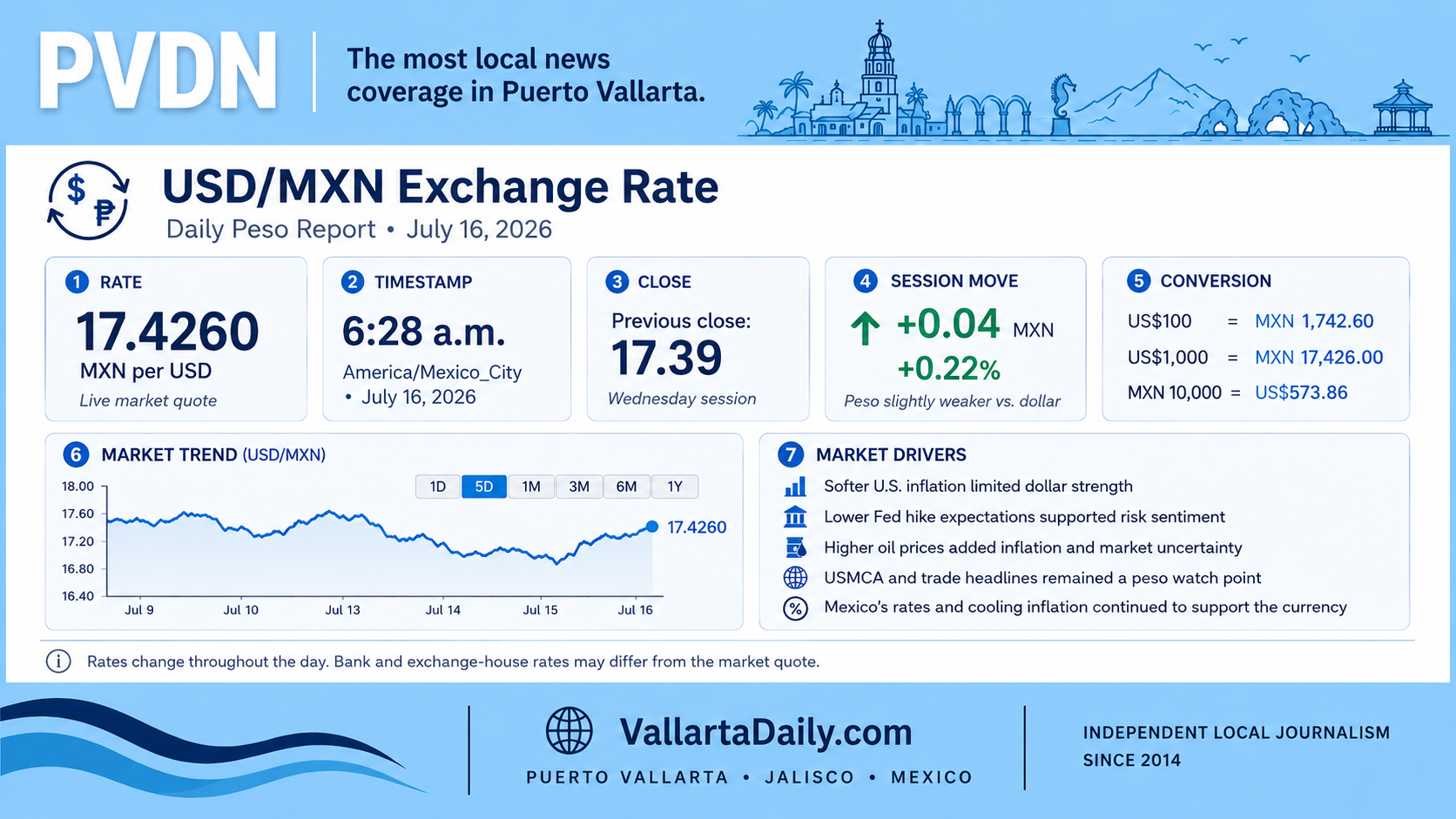
At 6:28 a.m. Mexico City time, the live USD/MXN market quote stood at 17.4260 pesos per dollar. Separate market data tracking the currency pair placed it between 17.42 and 17.43, about 0.22% above the previous session’s reference near 17.39. A higher USD/MXN rate means the peso is weaker against the dollar.
The movement amounted to roughly four centavos per dollar and remained modest for the frequently traded peso. Quotes may change quickly as Mexican and U.S. markets open and new economic figures are released.
Live Rate Differs From the Official FIX
Thursday’s live market quote should not be confused with Banco de México’s official FIX exchange rate, which is calculated from wholesale market quotations and normally published after noon on banking days.
The latest rate listed by the Diario Oficial de la Federación was 17.4278 pesos per dollar for Wednesday, July 15. Banco de México explains that the FIX rate is intended for certain dollar-denominated obligations and is not necessarily the rate offered by banks, exchange houses, credit cards or money-transfer services.
Retail customers in Puerto Vallarta will normally see different buying and selling rates because providers add fees and exchange-rate margins.
Softer U.S. Inflation Limits Dollar Strength
The peso entered Thursday with some support from weaker U.S. inflation figures released earlier in the week.
The U.S. Producer Price Index fell 0.3% in June, while annual consumer inflation slowed to 3.5%. Those reports reduced expectations that the Federal Reserve would raise interest rates at its July meeting. A global currency market update showed the dollar index falling to its lowest level since mid-June on Wednesday.
By Thursday morning, the dollar index was near 100.52 after dropping about 0.4% in the previous session. Traders priced in about a 10% probability of a July Fed rate increase, down sharply from levels seen in recent weeks.
Markets were awaiting U.S. retail sales, weekly unemployment claims and regional manufacturing data scheduled for 6:30 a.m. Mexico City time. Results that point to stronger U.S. demand could support the dollar, while weaker figures could reinforce expectations that the Fed will leave rates unchanged. The relationship is not automatic, especially when energy prices and geopolitical risks are moving at the same time.
Oil and Global Risk Remain Pressure Points
Oil prices remained a source of uncertainty for the peso and other emerging-market currencies.
Brent crude traded near $84.50 a barrel Thursday morning after rising roughly 11% during the week. The increase followed renewed U.S. strikes on Iran and concern about shipping through the Strait of Hormuz.
Mexico is an oil producer, which can allow the peso to benefit from higher crude prices under some market conditions. Sharp energy increases can also revive global inflation concerns, push bond yields higher and reduce demand for currencies viewed as carrying greater risk.
Thursday’s cautious tone across international stock markets added another possible restraint. Large declines in Asian technology shares and mixed U.S. stock futures showed investors were not moving uniformly toward riskier assets.
Mexico’s Rates, Inflation and Trade Talks
Mexico’s domestic interest-rate environment continues to provide some support for the peso.
Banco de México kept its benchmark interest rate at 6.50% on June 25. The rate remains above the Federal Reserve’s current 3.50%-3.75% range, although the gap between the two countries’ rates is narrower than it was during the earlier stages of Mexico’s tightening cycle.
Mexico’s annual inflation rate fell to 3.37% in June, according to the latest official consumer price report. The result brought headline inflation back within Banco de México’s target range, though the central bank continues to monitor core inflation, energy costs and trade-related risks.
Trade policy also returned to the market agenda Thursday. The U.S. trade representative described Mexico as taking a pragmatic approach to negotiations over the United States-Mexico-Canada Agreement, while continuing to raise concerns about the U.S. trade deficit and regional content requirements.
A third round of bilateral discussions is expected in Mexico City. No new tariff measure against Mexico was announced in the report, but trade headlines can still trigger rapid peso movements due to the close link between Mexican manufacturing and the U.S. market.
For Dollar and Peso Budgets Today
At the early market rate of 17.4260, US$1,000 converted at the wholesale midpoint would equal approximately MXN 17,426. A MXN 10,000 expense would equal about US$573.86. Actual customer transactions will usually be less favorable after bank spreads, card charges, or transfer fees.
For people earning dollars and spending pesos in Puerto Vallarta, Thursday’s small peso decline slightly increases the local purchasing value of dollar income compared with Wednesday’s market close. Peso earners paying dollar-denominated bills face the reverse effect.
The difference is limited at current levels, but it becomes more noticeable on rent, property transactions, tuition, medical bills and large transfers. Readers making time-sensitive payments should compare the final amount delivered rather than relying solely on the headline USD/MXN quote.