Puerto Vallarta, Jalisco, July 23, 2026 – The Mexican peso traded slightly weaker against the U.S. dollar early Thursday as markets waited for fresh inflation and economic activity data from Mexico.
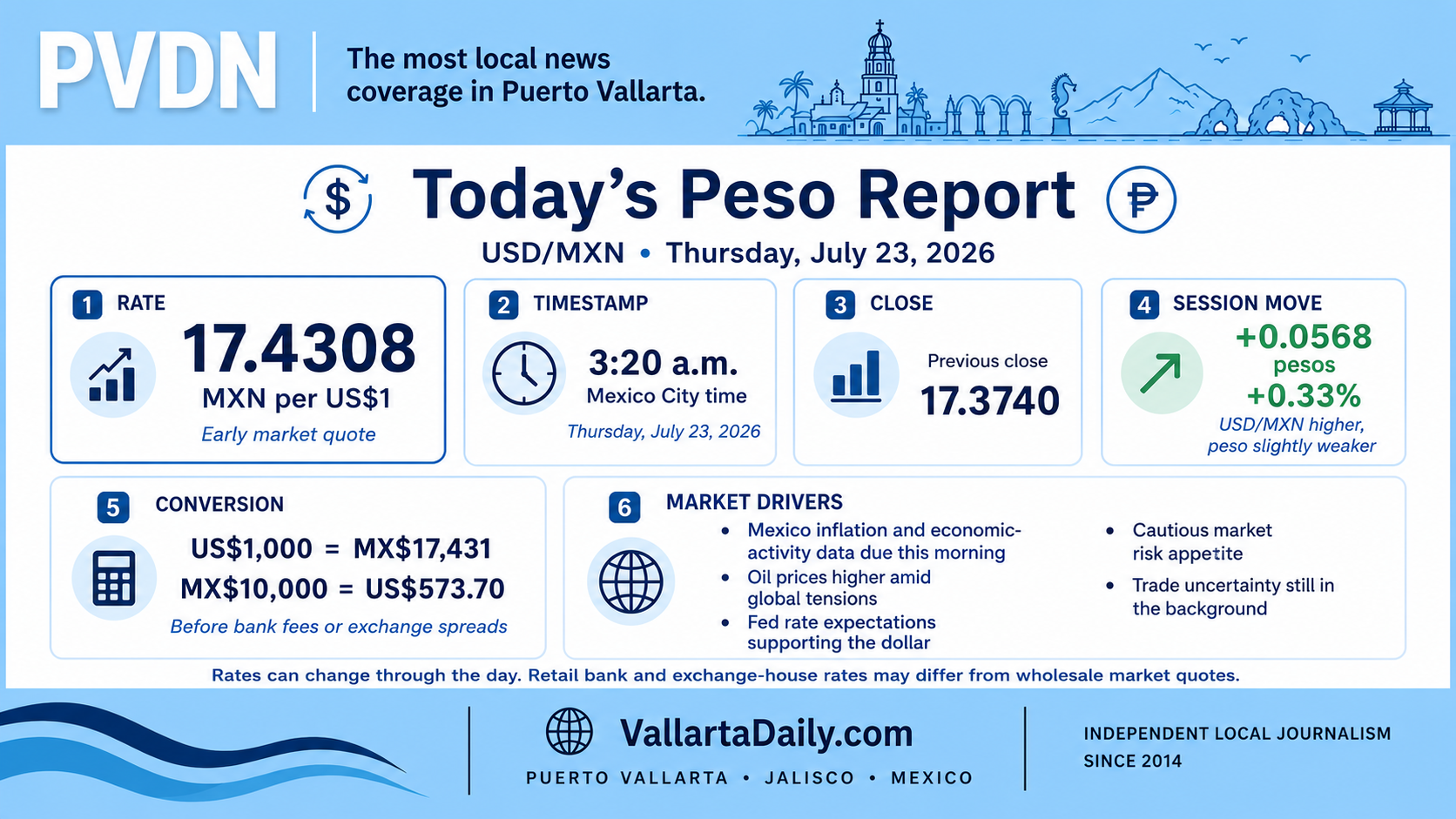
At approximately 3:20 a.m. Mexico City time, the dollar was trading at 17.4308 pesos, up 0.33% from the previous close of 17.3740. The session range stood between 17.3776 and 17.4472 pesos per dollar, according to a live USD/MXN market quote.
A higher USD/MXN rate means the peso has weakened. The early movement was limited, however, and remained within the range seen during recent sessions.
Mexico Inflation Data Could Shift the Peso
Mexico’s first major market test Thursday comes at 6:00 a.m. Mexico City time, when the national statistics agency is scheduled to publish inflation figures for the first half of July and economic activity data for May.
The releases are listed in the INEGI 2026 publication calendar. They could affect expectations for future interest-rate decisions by Banco de México.
Higher-than-expected inflation may support the peso by reducing the likelihood of further Mexican interest-rate cuts. Weaker inflation or economic activity could have the opposite effect, although exchange rates also depend on international markets and demand for emerging-market currencies.
Banco de México’s benchmark interest rate currently stands at 6.50%. The central bank kept the rate unchanged in June after cutting it by 25 basis points in May.
The difference between interest rates in Mexico and the United States remains important for the peso because higher Mexican yields can attract foreign capital. That support can weaken when investors expect Mexican rates to fall or U.S. rates to rise.
Oil Rally Raises Inflation and Risk Concerns
Oil prices climbed sharply Thursday as fighting involving the United States and Iran increased concerns about shipping through the Strait of Hormuz and other major transit routes.
Brent crude rose about 4% to $97.87 a barrel, while West Texas Intermediate gained more than 3% to $89.63 during early trading, according to international oil-market reporting.
The effect on the peso is not straightforward. Mexico is an oil producer, and higher prices can increase the value of petroleum exports. At the same time, a sustained rise in energy costs can increase inflation, slow global growth and push investors toward currencies viewed as safer.
Thursday’s modest peso decline occurred while broader risk concerns were increasing. U.S. stock futures were lower, Treasury yields were rising, and volatility indicators had moved higher during the overnight session.
Markets Reconsider the Fed’s Next Move
The Federal Reserve is scheduled to hold its next policy meeting on July 28 and 29, according to the official FOMC calendar.
Markets widely expect rates to remain unchanged at that meeting. Expectations for a possible increase later in the year have strengthened as higher oil prices raise concerns that U.S. inflation could remain elevated.
Interest-rate futures indicated roughly a 78% probability of a Federal Reserve rate increase in September, up from 68% a day earlier, according to market pricing reported Thursday. Those probabilities can change quickly and do not guarantee a policy decision.
The wider U.S. dollar index was down about 0.1% near 101.009 in early trading, despite the dollar’s gain against the peso. That suggests the early USD/MXN move was not part of a uniform rise in the dollar against every major currency.
Trade Uncertainty Remains in the Background
Concerns about the future of the United States-Mexico-Canada Agreement continue to weigh on Mexico’s longer-term economic outlook, although there was no clear new trade announcement driving the peso overnight.
A recent survey of economists lowered Mexico’s expected 2026 economic growth to 1.1%, citing weaker investment and uncertainty surrounding future USMCA reviews.
Trade headlines can produce fast movements in the peso because the United States is Mexico’s largest export market. Thursday’s immediate focus, however, remains on the domestic inflation and economic activity releases.
The Exchange Rate for Puerto Vallarta Budgets
At the early market rate, US$1,000 was worth about 17,431 pesos, before bank fees, transfer charges, or currency-exchange spreads. That was approximately 57 pesos more than at the previous closing rate.
A 10,000-peso expense would equal about US$573.70 at the early rate, compared with approximately US$575.57 using the previous close.
The difference is small for a single purchase but becomes more noticeable for rent, property expenses, tuition, medical bills or business payments. Residents receiving income in dollars gain slightly when the dollar rises, while people earning pesos face a higher cost when paying dollar-denominated expenses.
Bank, ATM, credit-card and exchange-house rates will normally differ from the wholesale market quote. The peso may also move after the 6:00 a.m. Mexico data releases and again when U.S. markets open.