Semarnat Secretary Alicia Bárcena warned that more than 3 million people in Mexico could be forced to move by 2050 if rising temperatures and other climate pressures are not brought under control, placing displacement at the center of Mexico’s climate policy debate.
Her warning came during the federal presentation of the Plan Estratégico de Género, Derechos Humanos y Cambio Climático, a policy instrument tied to Mexico’s updated climate commitments under its NDC 3.0. The plan connects climate action with gender, human rights, rural inequality, and communities already exposed to water shortages, fires, hurricanes, and biodiversity loss.
By 2050, Bárcena said, “more than 3 million Mexican women and men could be displaced” if climate change and temperature increases are not controlled. She added that the impacts are not equal across the country, especially in territories that contribute little to the causes of warming but absorb much of the damage.
A warning about movement before disaster strikes
The estimate is not tied to one storm, one drought, or one coastline. It points to slow pressure on places where life becomes harder to sustain. Heat can cut work hours. Drought can weaken agriculture. Fires can destroy assets. Hurricanes can turn temporary damage into a permanent move.
Mexico’s NDC 3.0 places human mobility linked to climate impacts within its losses and damages agenda, alongside emergency response, reconstruction, risk transfer, and economic losses. That means displacement is now being treated as a climate-policy issue, not only as an emergency response to disasters.
The federal climate impacts portal has warned that climate change has deeper consequences in areas where poverty is more severe and where communities have fewer resources to adapt. That framing matters because climate migration rarely begins with a single event. It usually builds through years of repeated losses.
Bárcena described the climate crisis as visible “when lands crack, hurricanes arrive and forest fires occur with greater intensity.” Her remarks placed the issue in communities first, where failing crops, damaged homes, lost water access, and repeated cleanup costs become the real measure of climate stress.
Climate policy meets inequality
The new plan gives Semarnat a rights-based frame for climate action. According to Mexico’s NDC 3.0, the gender and human rights climate plan is meant to guide policy across mitigation, adaptation, losses and damages, and implementation. It also identifies priority groups, including women, children, Indigenous and Afro-Mexican communities, older people, people with disabilities, LGBTIQ+ people, and people already in situations of mobility.
Carsten Schneider, Germany’s environment minister, joined Bárcena at the presentation and said climate impacts fall unevenly. He described the crisis as having “a very selective effect,” especially on women, girls, Indigenous populations, and rural communities.
The policy question now becomes implementation. A plan can name displacement, but the work depends on budgets, risk maps, water planning, fire management, housing policy, early-warning systems, and local coordination. Without those pieces, climate migration becomes visible only after people have already left.
The World Bank’s Groundswell research has warned that climate change could force up to 216 million people across six regions of the world to move within their own countries by 2050. The same work says early action on emissions, adaptation, and development could sharply reduce that number.
The Pacific coast is already part of the pattern
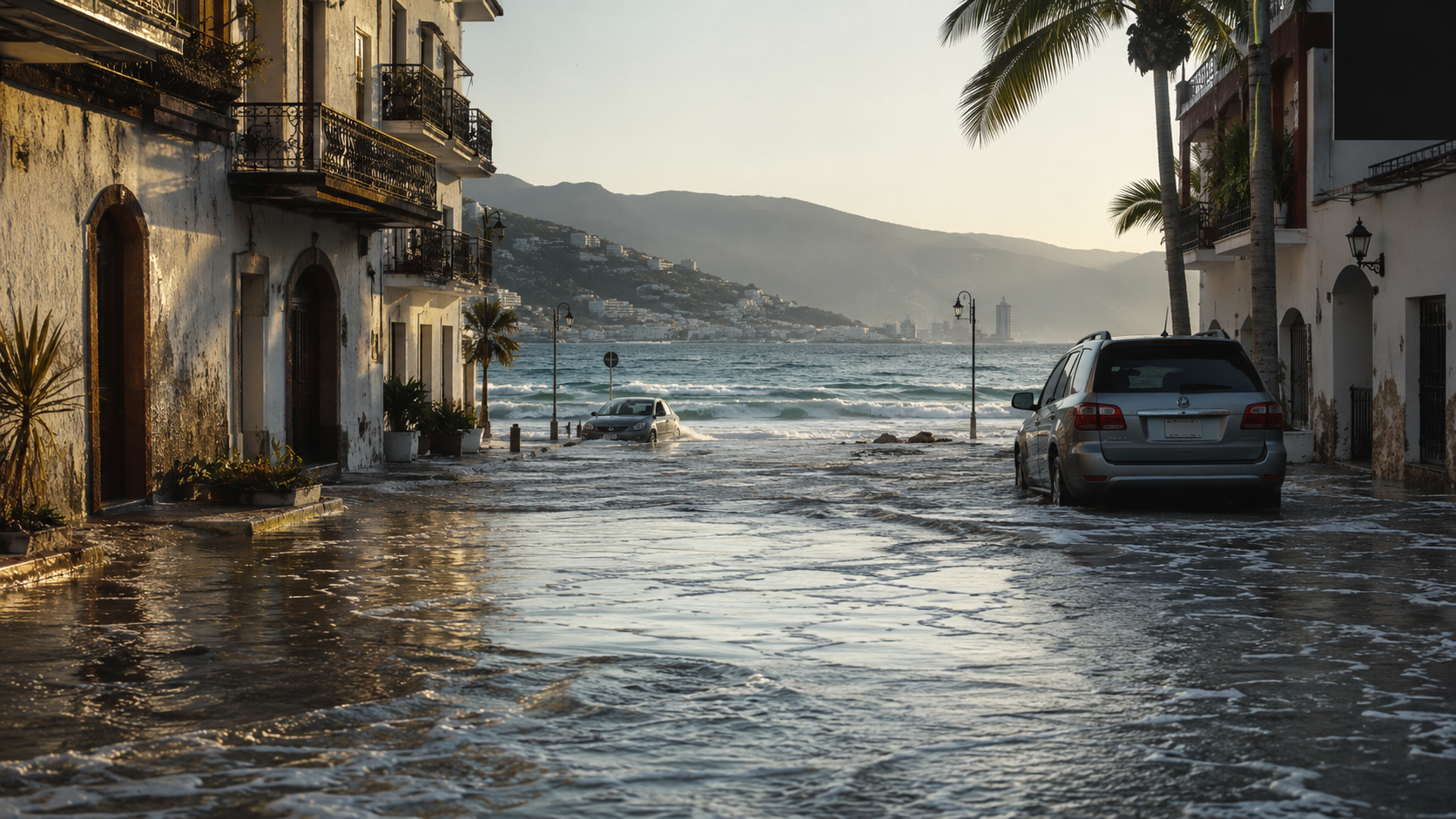
Mexico’s Pacific coast gives the warning a familiar shape. Puerto Vallarta and nearby coastal communities already face heavy rain, river flooding, landslide risk, hotter seasons, and pressure on water systems. A previous local analysis of Puerto Vallarta’s climate exposure found that the region faces rising temperatures, greater rainfall variability, stronger hazards, and increased coastal erosion over time.
Recent reporting on droughts in Mexico also showed how quickly dry conditions can spread across the country. Drought does not need to destroy a town to force movement. It can push households slowly through lost income, higher water costs, crop failure, and fewer local options.
The warning also arrives as Mexico experiences more extreme weather. A recent report on Mexico warming faster than the rest of Latin America placed heat, drought, heavy rain, and flooding within a larger regional pattern. Semarnat’s displacement estimate adds another layer to that story because climate damage can translate into demographic change.
Climate-displaced people do not move for climate alone. They move when climate damage meets weak housing, low wages, land insecurity, scarce water, and limited local services. That is why the new federal plan frames the issue in terms of inequality as much as temperature.
Mexico has now put climate displacement into its national policy language. The next measurable step is whether that language changes funding, planning, and local preparedness before families are forced to move.