Long before modern Mother’s Day flowers and family meals, early civilizations told stories of mothers who created worlds, healed the sick, guarded children, and ruled over death. From Ixchel in Maya tradition to Frigg in Norse mythology, these figures show how ancient cultures understood birth, loss, protection, and power. The stories are familiar, but the details are often more complex than modern retellings suggest.
[adinserter block=”3″]
A Mother’s Day story with much older roots
As Mexico approaches Día de las Madres, a recent cultural explainer has revived interest in one of humanity’s oldest religious patterns: the mother goddess.
The modern holiday is relatively recent. In Mexico, Mother’s Day has been celebrated every May 10 since the early 20th century. But the idea of honoring motherhood through sacred symbols reaches much farther back.
Across early civilizations, maternal figures were not limited to tenderness or family care. They could represent creation, fertility, healing, weaving, kingship, death, storms, mourning, political order, and the earth itself. Some were protective. Others were frightening. Many were both.
That complexity is what makes the subject more than a seasonal Mother’s Day feature. These goddesses help explain how ancient societies understood the most basic cycle of life. Birth did not stand apart from death. Nurturing did not stand apart from power. A mother could feed the world, but she could also swallow it back.
For readers in Mexico, the story carries special weight because Ixchel and Coatlicue are part of Mesoamerica’s cultural memory. They are often used today in museums, tourism, art, feminist symbolism, and popular retellings. But their older meanings were layered, and some details remain debated.
[adinserter block=”3″]
Ixchel and the Maya memory of birth, healing and weaving
Goddess Ixchel, often written as Ix Chel, is one of the best-known female figures associated with Maya tradition. She is commonly described as a goddess linked to the moon, fertility, childbirth, medicine, and weaving.
That popular image is familiar across the Yucatán Peninsula and the Mexican Caribbean. Travelers encounter her name in Cozumel, Isla Mujeres, hotels, parks, cultural tours, and artwork. In many modern retellings, she appears as a gentle lunar mother, watching over women, pregnancy, and healing.
The historical record is more complicated.
Ixchel appears in colonial-era references as a deity connected with medicine and childbirth. She is also tied to weaving, a practice with deep social and symbolic meaning in Maya communities. In that sense, her maternal role was not only biological. It also touched daily labor, ritual knowledge, and women’s skills.
Cozumel has long been linked to Ixchel. The island is often described as a pilgrimage site where Maya women traveled to honor the goddess. The archaeological zone of San Gervasio is frequently presented to visitors through that association.
At the same time, Mexican archaeological authorities have noted an important caution. Spanish-era chronicles connect Cozumel with the cult of Ixchel, but the oracular site described in those references may have stood near what is now San Miguel de Cozumel. That site no longer exists in the same form. San Gervasio itself has not produced clear archaeological evidence directly linking its buildings to Ixchel.
That does not erase the cultural importance of the tradition. It does remind readers that mythology, archaeology, tourism, and memory do not always line up neatly.
Modern scholarship has also challenged the idea of a single, simple Maya “moon goddess.” Some researchers argue that Postclassic Maya sources depict several female deities with distinct roles, rather than a single universal goddess encompassing every female function. This matters because modern culture often prefers a clear symbol. Ancient religion was rarely that tidy.
Ixchel remains meaningful because she sits at the crossing point of several ideas. She connects women’s health, medicine, textile work, fertility, water, and sacred geography. She also shows how modern Mexico continues to reinterpret Indigenous heritage for new audiences.
For expats and visitors, Ixchel is a useful example of how Mexican culture often carries deep layers under familiar names. A statue, hotel name, or tour stop may point to centuries of belief, debate, and reinvention.
Coatlicue shows motherhood without softness
If Ixchel is often remembered through fertility and healing, Coatlicue brings a very different image of divine motherhood.
Coatlicue was a central figure in Mexica religion. Her name is commonly translated as “she of the serpent skirt.” She is linked to the earth, fertility, death, and the divine family of Huitzilopochtli, the Mexica patron god associated with war and the sun.
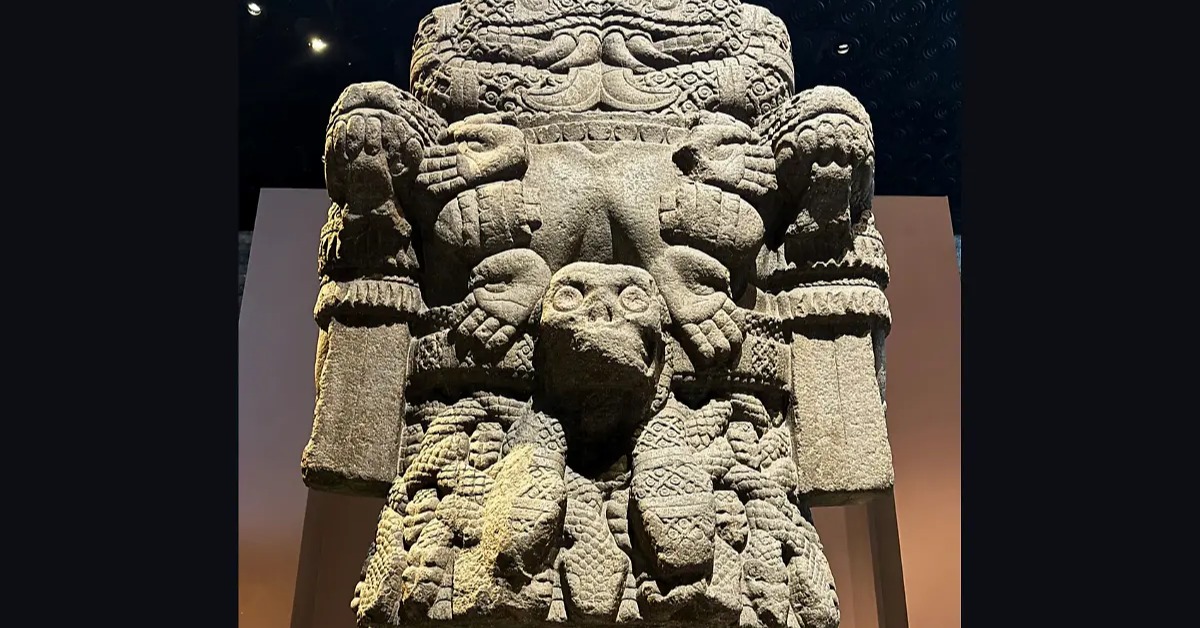
Her most famous image is the monumental sculpture now associated with the National Museum of Anthropology in Mexico City. The sculpture was found in 1790 during work in the old Plaza Mayor, in what was then the capital of New Spain.
It is not a soft image. Coatlicue wears a skirt of snakes. Her body carries symbols of hearts, hands, skulls, and claws. Her face is formed by two serpents. The figure is often read as a statement about Earth as both creator and destroyer.
That dual role is essential. Coatlicue is not simply “Mother Earth” in the modern sentimental sense. She represents the earth that gives life and receives the dead. She nourishes, but she also consumes. Her motherhood is cosmic, not domestic.
In the Mexica myth, Coatlicue becomes pregnant after a ball of feathers falls from the sky while she is sweeping. Her daughter Coyolxauhqui and her sons, the Centzon Huitznahua, see the pregnancy as dishonor and move against her. Huitzilopochtli is born fully armed and defeats them.
The story connects birth to conflict, celestial order, and political identity. It is also tied to the symbolic geography of Mexica power. Through Coatlicue, motherhood becomes the center of a cosmic drama.
For modern readers, Coatlicue can be difficult because she does not fit the expected Mother’s Day image. That is precisely why she matters. Ancient mother figures did not exist to flatter modern ideas of motherhood. They carried social fears, religious duties, and political meanings.
Coatlicue reminds us that, in ancient belief, motherhood could be awe-inspiring and dangerous. It could stand for creation, sacrifice, and the authority of the earth itself.
[adinserter block=”3″]
Gaia, Nut and Izanami made motherhood cosmic
Other ancient traditions placed maternal figures at the beginning of the world.
In Greek mythology, Gaia was the personification of the earth. She was not just a goddess who lived in the world; she was the world as a living force. She was connected with Uranus, the sky, and became the mother of Titans, giants, and other beings.
Gaia’s role shows a common pattern in ancient religion. The earth was not viewed as empty ground. It was active, fertile, and sacred. Humans depended on it for food, shelter, and burial. That made the earth easy to imagine as a mother, but not always as a gentle one.
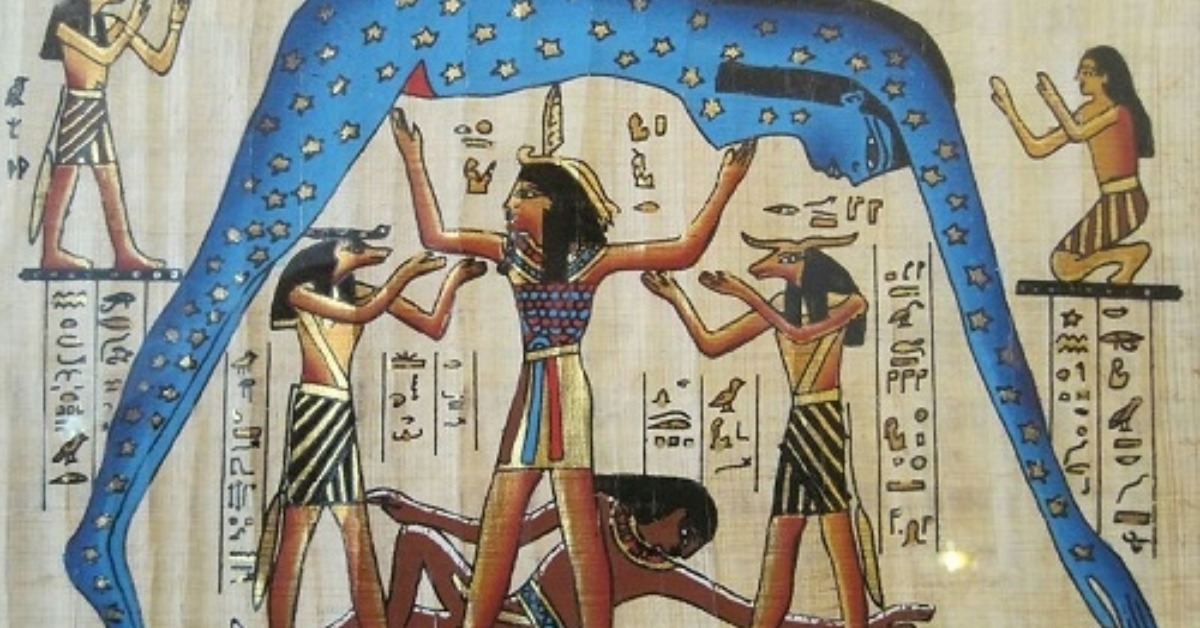
In ancient Egypt, Nut carried a different version of cosmic motherhood. She was the sky goddess, often shown arching over the earth. Each evening, she swallowed the sun. Each morning, she gave birth to it again.
That daily cycle turned the sky into a maternal body. The movement of the sun was not only in astronomy. It was birth, death, and renewal repeated every day.
Nut was also said to have given birth to major Egyptian deities, including Osiris, Isis, Seth, and Nephthys. Her motherhood shaped the divine family at the heart of Egyptian myth.
Isis, one of Egypt’s most important goddesses, developed another maternal image. She was the wife of Osiris and the mother of Horus. She was also a mourner, healer, and protector. In art, Isis nursing Horus became one of the ancient world’s most recognizable mother-child images.
In Japanese mythology, Izanami adds another layer. Along with Izanagi, she helps create the islands of Japan and gives birth to many deities. But her story turns tragic when she dies after giving birth to the fire god. She descends to Yomi, the land of the dead.
Izanami is therefore tied to creation and death at once. She is a mother of gods and lands, but also a figure of loss, separation, and mortality.
Together, Gaia, Nut, Isis, and Izanami show that mother goddesses were not simply fertility symbols. They helped explain the structure of reality. They answered questions about where people came from, why crops grew, why the sun returned, and why death could not be avoided.
[adinserter block=”3″]
Frigg brings motherhood into grief and memory
The Norse goddess Frigg offers a different kind of maternal figure.
Frigg was the wife of Odin and mother of Baldr. She is associated with marriage, fertility, and motherhood. Her name also survives in the English word Friday, through older Germanic traditions.
The most remembered story about Frigg is not about birth. It is about a mother trying to prevent loss.
In Norse mythology, Baldr dreams of his own death. Frigg tries to protect him by securing promises from things in the world not to harm him. But mistletoe is left outside that protection. Loki exploits the gap, and Baldr is killed.
Frigg’s motherhood is defined by care, foresight, and grief. Her story casts the mother goddess as an emotionally vulnerable figure. She has divine status, but she cannot stop fate.
That is a powerful contrast with Coatlicue or Gaia. Frigg is not the earth consuming the dead. She is the mother who mourns. Her role does not make her weak. It gives the myth its emotional force.
In this way, Frigg shows another reason mother goddesses endured. They could hold feelings that communities needed to name: fear for children, grief after death, the limits of protection, and the pain of fate.
[adinserter block=”3″]
The danger of making ancient goddesses too simple
Modern culture often turns mother goddesses into easy symbols. They become icons of fertility, feminine wisdom, or universal motherhood. Those meanings can be valuable, but they can also flatten the past.
Ancient goddesses were not interchangeable. Ixchel was not the same as Coatlicue. Frigg was not the same as Nut. Each came from a specific world, language, ritual system, and social setting.
Even the phrase “mother goddess” can mislead. It is useful as a broad category, but it can hide important differences. Some figures were cosmic mothers, and some protected children. Some ruled the earth and were healers. Others were tied to weaving, childbirth, death, monarchy, or warfare.
This is especially important in Mexico, where Indigenous symbols are often used in tourism and national identity. A goddess can become a brand, a mural, a necklace, a hotel name, or a simplified story for visitors. Those uses keep names alive, but they can also strip away context.
A more respectful approach is to accept complexity. It is possible to value Ixchel as a meaningful symbol while also recognizing that scholars debate her older roles. It is possible to admire Coatlicue while understanding that her image was never meant to be merely comforting.
That complexity does not make the stories less powerful. It makes them more human.
[adinserter block=”3″]
Mother’s Day sits inside a longer story in Mexico
Mexico’s Día de las Madres is celebrated every May 10. The date became established in 1922, promoted by journalist Rafael Alducin and supported by José Vasconcelos, then a major figure in public education.
The holiday grew in a society where motherhood was tied to family, religion, public morality, and national identity. It was also shaped by debates over women’s rights, education, and family planning.
That history matters because Mother’s Day is often treated as timeless. In reality, the modern celebration is a recent social invention. It reflects the politics and values of its own era.
The older stories of mother goddesses show something different. They reveal how societies long before modern holidays used sacred figures to think about birth, food, kinship, danger, and loss.
For many families in Mexico, May 10 remains a personal and emotional day. It is marked with meals, flowers, music, phone calls, cemetery visits, and family gatherings. For others, it can be complicated, especially where motherhood is linked to loss, pressure, or expectation.
Looking at mother goddesses can widen that conversation. These ancient figures show that motherhood has never been one thing. It has been honored, feared, idealized, politicized, and mourned.
[adinserter block=”3″]
What ancient mothers still tell modern readers
The enduring appeal of mother goddesses may come from the fact that they speak to experiences that never disappear.
Every society must explain birth and face death. Every society depends on food, care, shelter, and memory. The mother goddess gave ancient cultures a way to connect those realities to the sacred.
For readers living in Mexico, Ixchel and Coatlicue also offer a window into how Indigenous heritage remains present in daily life. It appears in museums, archaeological sites, festivals, language, place names, and public art. Sometimes it appears clearly. Sometimes it is hidden under tourism or habit.
For international readers, these goddesses can also correct a common misunderstanding. Ancient religion was not a set of simple stories for entertainment. It was a way of organizing the world.
A goddess of motherhood might also be a goddess of medicine. A goddess of fertility might also be linked to death. Just like a goddess of the sky might give birth to the sun each morning. A grieving mother might show the limits of divine power.
That is why stories from Ixchel to Frigg still hold attention. They remind us that motherhood, in human imagination, has always been larger than the household. It has been placed in the moon, the earth, the sky, the body, the loom, the grave, and the calendar.
Mother’s Day may come once a year. The symbols behind it are far older.