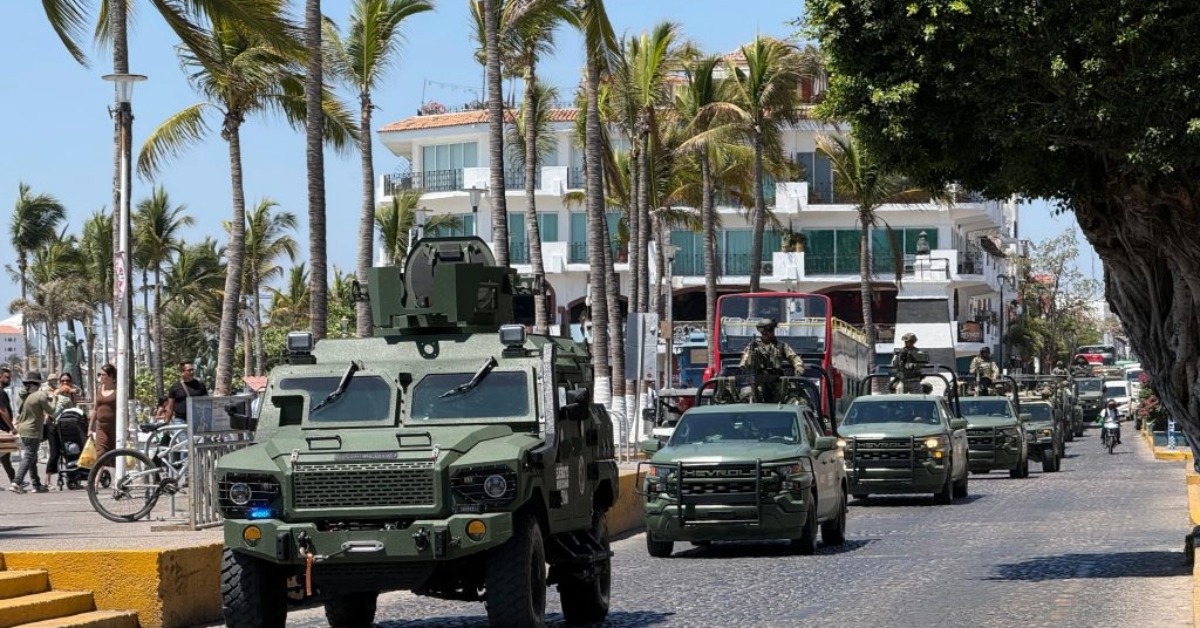
Puerto Vallarta has received 200 Army troops and 11 tactical units in a deployment officials say will be permanent. For residents, visitors, and expats, the question is not only whether the city is safe. It is how to read security news in a tourist economy where perception, patrols, crime reports, and travel advisories often point in different directions. The answer is more practical than alarming.
[adinserter block=”3″]
Is Puerto Vallarta Safe After New Army Patrols Arrive
Puerto Vallarta is entering a new stage in its public security strategy after the arrival of 200 Mexican Army personnel and 11 tactical units. Local authorities say the deployment is not a seasonal operation tied to a vacation period. They describe it as a permanent reinforcement meant to support patrols across the municipality.
For a tourist city, that kind of news can be read in two opposite ways. Some residents and visitors see more troops as a sign that authorities are taking public safety seriously. Others see the same convoy and wonder whether the situation is worse than officials are saying.
Both reactions are understandable. Neither one tells the full story.
A military deployment does not automatically mean a city is unsafe for daily life or tourism. It also does not prove that everything is under control. It means authorities believe the city needs more visible security, greater deterrence, and better coordination among municipal, state, and federal forces.
That distinction matters in Puerto Vallarta because the city depends heavily on confidence. Visitors want to know if they can walk the Malecón, take a taxi, eat out, go to the beach, and return to their hotel without feeling exposed. Residents and business owners want more than tourism messaging. They want to know whether robberies, vehicle theft, extortion, assaults, and violent incidents are being reduced where they live and work.
The practical question is not whether Puerto Vallarta is simply “safe” or “unsafe.” The better question is how to read the different pieces of security news without panic, denial, or rumor.
[adinserter block=”3″]
What the new deployment signals
The arrival of Army units sends a visible message. Authorities want residents, visitors, and businesses to see a stronger security presence. In a city where tourism is central to the local economy, visibility is part of the strategy.
That visibility can help in several ways. Patrols may deter some opportunistic crimes. They can reassure hotel zones, commercial corridors, beach areas, and transit points. They can also support local police when incidents move beyond routine municipal enforcement.
But visible patrols are not the same as long-term public safety. They are one tool.
The important detail in this case is the word permanent. Puerto Vallarta has seen reinforced security before, including during holiday periods and after high-profile incidents. A permanent deployment suggests that officials see a continuing need rather than just a short-term spike in demand.
That does not mean soldiers will be on every corner. It means federal forces are being folded into the security picture for an extended period. The real test will be where they are assigned, what they are asked to do, and whether the results are measured clearly.
If the deployment is concentrated only in tourist corridors, it may improve the visitor experience while leaving residential colonias with the same problems. If it is spread too thin, it may look impressive without changing much. If it is paired with investigations, arrest follow-through, better lighting, crime mapping, and stronger local policing, it could have more durable effects.
Safety in a tourist zone is not the same as citywide safety
Puerto Vallarta is often described as safe for tourists, and many visitors do experience the city that way. The hotel zone, Romantic Zone, Marina, airport corridor, Malecón, and main restaurant areas usually receive more patrols and faster attention because they are tied to the city’s public image.
That does not make those areas risk-free. It means the security posture is different.
Tourist areas tend to receive more visible policing. They also have more witnesses, cameras, private security, taxi activity, hotel staff, and business owners who report problems quickly. These factors can lower some risks and raise the chance that incidents are noticed.
Citywide safety is a broader issue. Residents move through colonias, rural areas, school zones, industrial corridors, local markets, late-night streets, and roads that tourists may never see. Their risks may include theft, break-ins, robberies, domestic violence, business extortion, vehicle theft, or violent incidents that do not touch the beach economy directly.
This is why a visitor can have a safe vacation while a resident still feels that security has worsened. Both things can be true at once.
A serious reading of Puerto Vallarta security news requires separating tourist-zone security from municipal security. The first asks whether visitors can move through common travel areas with reasonable precautions. The second asks whether the wider city is becoming safer for the people who live there year-round, particularly outside of the tourist zones.
[adinserter block=”3″]
How to read routine police stories
Local security coverage often includes reports of vehicle recoveries, robbery arrests, police chases, neighborhood patrols, and preventive operations. These stories are useful, but they need context.
A police story about a recovered vehicle can mean authorities are responding effectively. It can also point to a broader pattern of theft. A report on the arrest of robbery suspects may reassure some readers, but it also raises questions about where the robberies occurred, whether the suspects are linked to other cases, and whether the charges will hold.
Routine crime stories should not be dismissed as noise. They are often the first visible signs of pressure points in a city.
At the same time, they should not be read as proof of collapse. A tourist city with active reporting will always generate police news. The key is whether those reports show isolated cases, repeated patterns, or rising concentrations in specific areas.
Readers should pay attention to the details that repeat. Are incidents happening near ATMs, parking areas, nightlife corridors, bus stops, beaches, or short-term rentals? Are robberies occurring at similar times of day? Are businesses reporting more assaults? Are vehicle thefts connected to specific colonias or roads?
The pattern matters more than any single headline.
Travel advisories need careful reading
International travelers often turn to government travel advisories for guidance. These advisories are important, but they are often misunderstood.
A travel advisory is not a real-time neighborhood safety map. It is a government risk document written for citizens of that country. It often covers entire states, even when risk varies sharply between cities.
That matters in Jalisco. Puerto Vallarta may be discussed under a broader state-level advisory that also includes areas with different security conditions. Some advisories also include rules for government employees that differ from those for ordinary travelers.
This can create confusion. A traveler may see a strong warning for Jalisco and assume all parts of the state carry the same risk. That is not how security works on the ground.
Puerto Vallarta should still be viewed with caution, especially after recent violence and renewed deployments. But readers should look beyond the label. They should ask what the advisory says about Puerto Vallarta specifically, which areas are restricted, which travel behaviors are discouraged, and whether the guidance has changed recently.
A useful advisory reading includes three layers. The first is the national warning. The second is the state-level warning. The third is the city-specific detail, including whether major tourist areas are treated differently from other regions.
Travel advisories should inform decisions. They should not replace local awareness.
[adinserter block=”3″]
Perception is a real safety issue
Security is not only about crime statistics. It is also about how people feel as they move through the city.
Recent national survey data showed a sharp rise in the share of Puerto Vallarta residents who considered their city unsafe. That does not mean crime doubled. It does mean public confidence changed quickly.
Perception can shift after visible violence, heavy patrols, rumors, road disruptions, social media videos, business closures, or reports of shootings and robberies. In a tourist city, perception also spreads fast because visitors, residents, hotel workers, taxi drivers, restaurant staff, and expats all exchange information in real time.
Authorities sometimes treat perception as a public relations problem. That is too limited. Perception affects behavior.
If residents stop walking at night, avoid certain roads, change where they withdraw cash, or tell relatives not to visit, the city changes. If businesses close earlier or pay more for private security, the cost of insecurity is borne by others. If tourists decide not to book, the economic impact is immediate.
Perception can be wrong in specific details and still be important as a public signal. When a large number of people say they feel less safe, officials need to explain what they are measuring, what they are seeing, and what is being done.
Crime statistics are useful but incomplete
Official crime statistics are essential, but they have limits.
They usually count complaints or investigation files, not every crime that occurs. Many people do not report crimes because they think nothing will happen, they do not want to spend hours filing a complaint, they fear retaliation, or they are unsure where to go. Foreign visitors may leave before filing a formal report.
This means official figures can undercount common crimes, especially theft, fraud, attempted robbery, and some assaults.
Still, statistics matter. They help separate rumor from trend. They also help identify whether problems are concentrated in specific categories, such as robbery, vehicle theft, business assaults, domestic violence, or homicide.
For Puerto Vallarta, the most useful data would not be broad statements about whether the city is safe. The useful data would be crime by colonia, crime type, time period, and outcome. Residents need to know where incidents are increasing, what type of incidents are increasing, and whether arrests are leading to prosecution.
A citywide average can hide local reality. A tourist corridor may improve while another colonia worsens. A few high-profile incidents can dominate public perception, even when some crime categories remain stable. The only way to know is to publish clearer data.
[adinserter block=”3″]
What “reinforced security” means on the ground
The phrase reinforced security is often used after a deployment. It sounds clear, but it can mean several different things.
It may mean more patrols in visible areas. It may mean checkpoints, convoy patrols, airport or port security, surveillance near nightlife zones, or joint operations with municipal police. It may also mean intelligence work that the public does not see.
For residents, the most visible part is usually the convoy. That can create reassurance or anxiety, depending on the moment.
For the strategy to matter, it needs more than movement. It needs defined targets. Officials should be able to state whether the deployment focuses on robberies, vehicle theft, organized crime, violent incidents, extortion, or general deterrence. They should also explain whether soldiers are supporting local police or leading operations.
There is also a civil question. Military forces are not a substitute for strong local policing. Local officers know neighborhoods, repeat offenders, business corridors, and daily patterns. Federal support can help, but lasting safety usually depends on investigation, community trust, prosecution, prevention, and municipal services.
A street with poor lighting, abandoned lots, irregular trash collection, few witnesses, and low trust in police can remain vulnerable even with occasional patrols.
What residents and visitors should actually watch
Readers do not need to panic every time a security story appears. They also should not ignore repeated signs of stress.
The most useful approach is to watch for consistency. One robbery story is an incident. Several similar robberies in the same type of area may be a pattern. A single military convoy may be a response. A permanent deployment suggests a larger security decision.
Residents should watch how daily life changes. Are restaurants closing earlier? Are ride-share drivers avoiding certain routes? Are hotel workers changing advice to guests? Are parents adjusting to school transportation? Are small businesses adding locks, cameras, or guards?
Visitors should watch practical signals. Are hotels giving specific safety instructions? Are transport operators warning against certain late-night routes? Are authorities asking people to avoid specific roads? Are advisories updated or unchanged?
Expats should be careful with rumor networks. Community chats can be useful, but they can also amplify incomplete claims. A video without a date, location, or source can make an old incident feel new. A screenshot of a warning can circulate long after it has expired.
Good security reading requires patience. Check the date. Check the location. Check whether the authorities confirmed the incident. Check whether the story describes a tourist area, a residential colonia, a road outside the city, or another municipality entirely.
[adinserter block=”3″]
Common safety mistakes in Puerto Vallarta
Most visitors and residents are not making decisions about cartel violence every day. They are making ordinary safety decisions that can reduce exposure to common crime.
The basic risks in a tourist city are often practical. People withdraw large amounts of cash from exposed ATMs. They walk home alone after drinking. They leave phones on restaurant tables. They use isolated streets late at night. They leave valuables in cars. They trust unofficial taxis or informal rentals. They assume a familiar neighborhood is risk-free.
These habits matter because opportunistic crime depends on openings.
Reasonable caution does not mean living in fear. It means using indoor ATMs when possible, taking known transport late at night, avoiding deserted streets after bars close, locking balcony doors, and not flashing cash or expensive items. It also means filing a report when a crime occurs, even if the process is inconvenient.
For expats, there is another layer. Long-term residents can become too comfortable. Familiarity lowers awareness. People who would never take certain risks in a large U.S. or Canadian city may be willing to do so in Puerto Vallarta because the city feels friendly and walkable.
Puerto Vallarta can feel relaxed and still require normal urban caution.
The business side of safety
Security is also an economic issue.
Hotels, restaurants, transport operators, tour companies, real estate firms, and small shops all depend on trust. When safety concerns rise, the first effect may not be empty streets. It may be more questions from customers, more cancellations, more cautious spending, and more pressure on workers.
Business owners often become informal security reporters. They know when clients stop walking from one area to another. They hear when taxi drivers avoid certain routes. They notice when staff ask to leave earlier or arrive in groups. Their experience should be part of the public conversation.
Hotel associations and business chambers can provide useful details if they speak beyond general reassurance. The public needs to know whether incidents are affecting bookings, transportation, employee schedules, delivery routes, or closing times.
Small businesses deserve special attention. Large hotels can hire private security and absorb short-term disruptions. Smaller restaurants, shops, and service providers often cannot. For them, even a small rise in robberies or fear can change payroll, hours, and customer flow.
[adinserter block=”3″]
The questions officials still need to answer
The new deployment raises several practical questions.
Where exactly will the troops be deployed? Will they focus on the hotel zone, downtown, the Romantic Zone, the airport corridor, colonias with higher crime reports, rural areas, or access roads?
What metrics will authorities use to judge success? Will they track robberies, vehicle theft, emergency calls, response times, arrests, prosecution outcomes, or resident perception?
How will the Army coordinate with municipal police, state police, the National Guard, prosecutors, Civil Protection, and tourism officials? Who is responsible for what?
Will crime data be shared by colonia or only through general statements? Will business groups, transport operators, neighborhood leaders, and residents be asked what they are seeing?
These questions are not hostile. They are the basic standards for public accountability.
A permanent deployment should come with permanent reporting. Otherwise, residents are left to judge security by what they see on the street, what they hear in WhatsApp groups, and what they read after each incident.
So, is Puerto Vallarta safe?
The honest answer is that Puerto Vallarta remains a functioning tourist city where many people live, visit, work, dine out, use the beach, and go about their daily lives without incident. It is not a city that should be reduced to fear.
It is also not a city where security news should be brushed aside.
The arrival of 200 Army troops and 11 tactical units indicates that authorities believe Puerto Vallarta needs stronger, more sustained security support. The rise in safety concerns shows that perception has shifted. Routine police stories show that local crime remains part of daily life. Travel advisories show that international governments continue to view parts of Mexico, including Jalisco, through a risk lens.
None of those facts alone gives a complete answer. Together, they point to a city that requires informed caution, clearer data, and steady follow-up.
For tourists, the practical approach is to stay in known areas, use trusted transportation, monitor advisories, avoid risky late-night habits, and follow local instructions if an operation occurs.
For residents and expats, the practical approach is to look for patterns, ask for data, avoid rumors, and pay attention to how security changes by neighborhood.
For officials, the challenge is larger. More patrols may calm the moment. Lasting confidence will depend on results people can see and data they can trust.
Puerto Vallarta’s safety story is not a single headline. It is a continuing test of enforcement, transparency, public trust, and daily life in a city where the beach economy and the local reality are tied together.
[adinserter block=”3″]