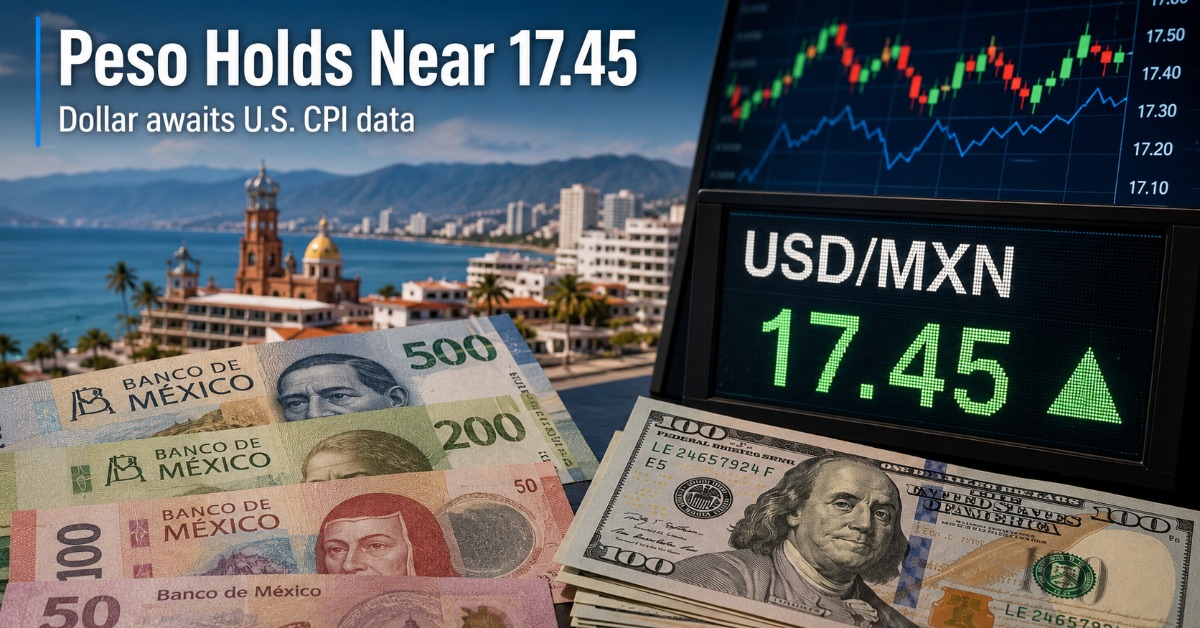
The Mexican peso opened Wednesday near 17.45 per U.S. dollar, holding a narrow range after Tuesday’s modest gain as traders waited for fresh inflation data from the United States.
Early market pricing put USD/MXN at roughly 17.42-17.49, with the dollar hovering near 17.45 shortly after Mexican markets opened. The official Banxico FIX rate determined on June 9 was 17.4312, while the DOF morning indicator page for June 10 listed the dollar at 17.4453.
That leaves the peso close to Tuesday’s close, when it gained after Mexico’s inflation report came in softer than expected and the dollar eased. A previous June 9 peso update noted that traders were already waiting for the U.S. CPI number, which can move the dollar quickly.
Mexico’s inflation data gives the peso some support
Mexico’s annual inflation slowed to 3.94% in May, down from 4.45% in April, according to INEGI. The figure brought headline inflation back within Banxico’s target range of 3%, plus or minus one percentage point.
That helps explain why the peso has held steady, though it does not eliminate rate risk in the trade. Core inflation was still 4.19%, and service prices have been harder to cool, so traders are not assuming Banxico can move aggressively.
Mexico’s rate advantage remains part of the peso story because investors can still earn more by holding peso assets than by holding dollar assets. That advantage can support the currency when global risk appetite is stable, but it can fade quickly when the dollar strengthens, or oil shocks make traders nervous.
Banxico says the FIX is determined from “wholesale foreign-exchange market quotes” and released after noon on bank business days. It is an official reference rate, not a guarantee of what a customer will receive at a bank branch, an ATM, a hotel-zone exchange booth, or an airport counter.
The dollar is waiting on U.S. CPI
The biggest market test today is the U.S. Consumer Price Index for May, scheduled by the U.S. Bureau of Labor Statistics for 8.30 a.m. Eastern time. A hotter reading could push Treasury yields higher and strengthen the dollar, which would usually put pressure on the peso.
A softer number would likely have the opposite effect, at least in the first reaction. Traders have been sensitive to every fresh signal on U.S. inflation because the next Federal Reserve meeting is set for June 16 and 17.
Oil is another piece of the morning trade, especially with global markets watching Middle East tensions and firmer crude prices. The peso often loses some ground during these risk-off moves, even when domestic economic data looks supportive.
What to watch at banks and exchange windows
The wholesale rate near 17.45 will not match the price on every board around town. Exchange counters, airport kiosks, bank branches, and ATMs build in spreads, and those spreads can appear wider when markets are moving ahead of a major data release.
A stronger peso makes dollar income buy fewer pesos after conversion, while a weaker peso can raise import costs and affect goods priced with a dollar component. Earlier coverage of how a strong peso changes spending power in Mexico laid out that squeeze for people paid in dollars.