A rail construction route in Yucatán has revealed another layer of the peninsula’s ancient past. Archaeologists working near Ucú identified a structure that may have served ritual purposes inside a Maya residential complex. The find includes an offering with a vessel and beads, raising questions about daily life, belief, trade, and how ancient communities in northwest Yucatán were connected to larger Maya centers.
Possible Maya Altar Found
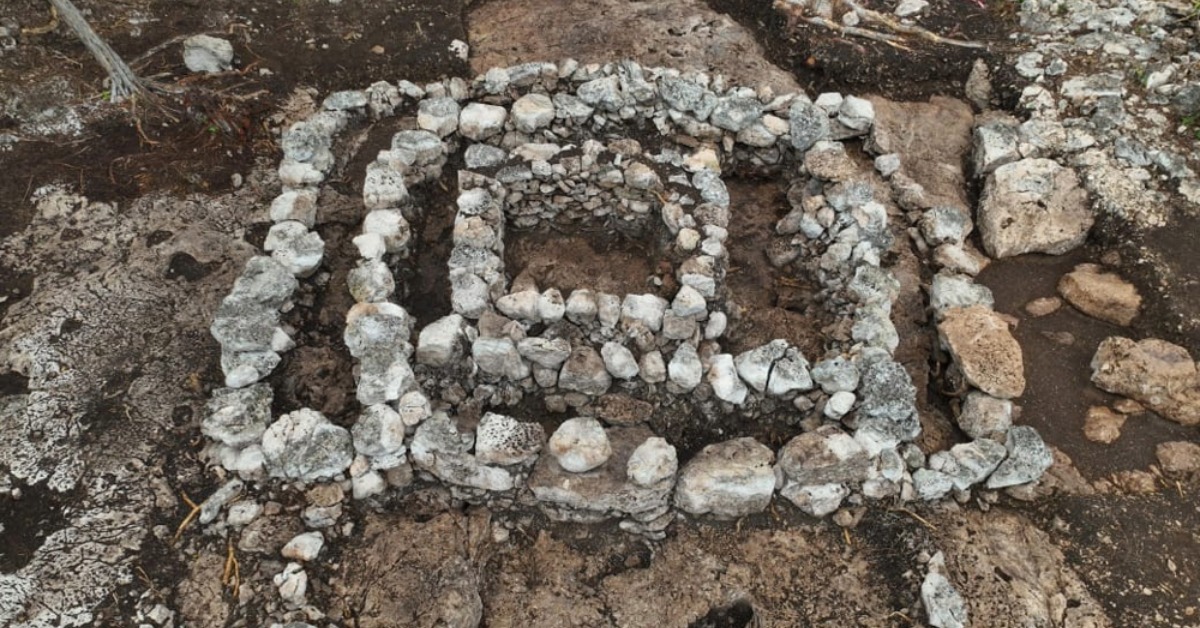
Archaeologists working on the Tren Maya cargo rail route in Yucatán have identified a structure that may have served as a Maya altar more than 1,500 years ago.
The discovery was made near the community of Yaxché de Peón, in the municipality of Ucú, west of Mérida. The site is part of a larger residential complex explored during archaeological monitoring tied to the rail project’s cargo service.
The structure is now under study and conservation by specialists from the National Institute of Anthropology and History (INAH). The agency is responsible for protecting Mexico’s archaeological heritage during public and private construction works.
Archaeologists found a residential complex with a possible ritual space
The discovery was not an isolated object. Archaeologists identified a domestic unit comprising several household groups arranged around patios.
The homes were built with roughly shaped limestone. Today, only parts of the walls, foundations, entrances, and openings remain visible.
The site appears to have been occupied during the Classic Maya period, roughly between 400 and 750 A.D. That estimate is based in part on an offering found in one of the domestic structures.
The offering included a vessel and a strand of beads made from shell and green stone. In Maya archaeology, offerings can help researchers understand how people marked important spaces, events, or beliefs.
The possible altar stood apart from the other residential structures because of its form and placement. It measured about six meters by six meters and had three superimposed levels. It also had a bench attached to its south side.
Specialists said its location within the residential unit suggests it may have been tied to the beliefs and religious practices of the people who lived there.
The site adds detail to everyday Maya life in Yucatán
Many visitors know the Maya world through large cities such as Chichén Itzá, Uxmal, Cobá, or Palenque. This finding points to a different part of the story.
The Ucú discovery appears to be connected to a smaller residential setting rather than a major ceremonial center. That makes it useful for understanding daily life in ancient Maya communities.
The site shows how homes, patios, work areas, and possible ritual spaces could exist together. It also suggests that religious practice was not limited to large temples or public plazas.
For archaeologists, domestic spaces can be especially important. They help show how families lived, worked, worshipped, and interacted with nearby communities.
The structure’s central position inside the unit is part of what makes it notable. It may have served a shared function for the household group or a small local community.
Why the northwest Yucatán corridor matters
The discovery is also important because of where it was found.
Archaeologists working on the project have been documenting settlements along a roughly 50-kilometer corridor in northwest Yucatán, west of Mérida. This part of the peninsula was connected to trade routes that linked inland communities to the Gulf coast.
Specialists have suggested that sites in this region may have been connected to Chunchucmil, an important Maya commercial center in western Yucatán.
Chunchucmil has long interested researchers because it appears to have played a strong role in trade. Its location helped connect inland settlements with coastal resources such as salt and fish.
The newly documented settlement near Ucú may have been part of that broader network. Researchers have also pointed to connections with Oxkintok, another important Maya site in western Yucatán.
This does not mean the Ucú site was a major city. Instead, it may help explain how smaller settlements supported larger regional systems.
What was found inside the structure
The structure itself contained several details that drew attention from archaeologists.
At the center, researchers recorded a small limestone disk known locally as a panucho. In this context, the term refers to a small stone disk used as a side cover for a jobón, a hollowed-out tree trunk used as a beehive.
Nearby, archaeologists also found an arrangement of three flat stones.
A cavity was detected in the bedrock at a depth of about 80 centimeters, but no materials were found inside it. Even so, the structure’s shape, size, and placement led researchers to propose that it may have had ritual or ideological functions.
The find remains preliminary. Archaeologists are using careful language because a structure is not confirmed as an altar simply because it looks unusual. Its use must be supported by context, associated materials, and comparison with similar finds.
How the structure will be preserved
The possible altar is expected to be preserved where it was found.
The proposed conservation measure is to cover it with geotextile, a protective material often used to separate and shield archaeological remains. This method can help preserve a structure when it cannot be fully exposed or displayed.
In this case, preservation appears to be tied to the service road area associated with the rail project. The goal is to protect the remains while allowing the infrastructure work to continue.
This kind of archaeological salvage is common in large construction projects in Mexico. Specialists document, study, and protect remains found along the route before work advances.
The process does not always mean a site becomes open to the public. Many finds are recorded, conserved, and left protected underground.
Tren Maya cargo works continue to reveal buried history
The find was made during work linked to the cargo service of the Tren Maya, separate from the passenger rail service that many residents and visitors already know.
The cargo expansion includes connections meant to move goods through the peninsula and toward the port area of Progreso. Federal project information has described cargo infrastructure for Yucatán, including planned rail branches and multimodal terminals.
The Ucú discovery is tied to the rail corridor between Poxilá and Paraíso, south of Progreso.
The Tren Maya has been one of Mexico’s most debated infrastructure projects. Supporters frame it as a development and connectivity project for the southeast. Critics have raised concerns about environmental damage, land impacts, and the handling of archaeological and cultural resources.
This latest find shows why archaeological monitoring remains central to the project. The Yucatán Peninsula has a dense and complex pre-Hispanic history, and construction work can expose remains that were not visible from the surface.
A small structure with a larger story
The possible altar near Ucú does not, on its own, change the broad history of the Maya world. But it adds a useful piece to the map.
It points to a residential community that lived more than 1,500 years ago in a corridor tied to trade, household life, and belief.
For readers living in Mexico, the find is also a reminder that archaeology here is not limited to major tourist sites. Much of the country’s past remains under present-day towns, roads, farms, and construction routes.
In Yucatán, each new find can help explain how ancient communities were organized beyond the famous ruins. This discovery may help researchers better understand how smaller Maya settlements lived within wider networks of commerce, religion, and daily life.