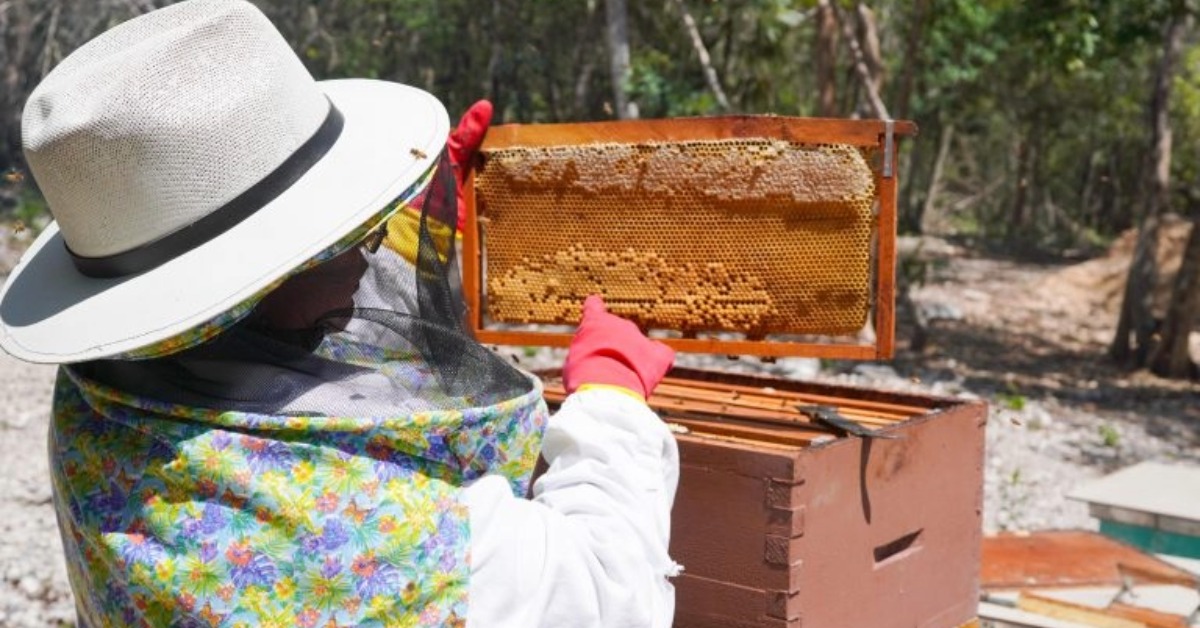
In Playa del Carmen, a city more often tied to tourism headlines, local officials say several Maya communities are strengthening projects built around melipona honey, a product with deep roots in the region’s Indigenous history. Authorities identified Pacto Obrero, Vida y Esperanza, and Campamento Hidalgo among the communities working with the native stingless bee. Officials said support has been directed to a 2026 project led by women in Pacto Obrero, while similar efforts are active in the other communities. Their message was direct. These are not being framed only as small social programs. They are being presented as a way to protect inherited knowledge, sustain a culturally important food and medicinal product, and create practical opportunities for families in rural and semi-rural areas of the municipality.
Why melipona honey matters
For many international readers, melipona honey needs context. It does not come from the European honeybee most people know. It comes from a native stingless bee, often linked to the Maya world under the name xunán kab. Its value in the Yucatán Peninsula has never been only commercial. For centuries, the bee and its honey have been tied to food, healing practices, ritual life, and local identity. That history is not only oral memory. Archaeologists working in Quintana Roo have recently described material evidence of ancient meliponiculture, reinforcing what codices and colonial-era accounts had already suggested. In other words, when officials describe the honey as sacred or ancestral, they are not using a loose slogan. They are referring to a practice with a long historical record across the peninsula.
A tradition that also faces pressure
That background helps explain why these community projects matter beyond their size. Meliponiculture has been under pressure for years. Researchers have warned that traditional keeping of Melipona beecheii has declined sharply in the peninsula, due to land-use change, habitat loss, weakened transmission of traditional knowledge, and the difficulty of quickly expanding colonies. One often-cited study based in Quintana Roo documented a severe long-term drop in hives in the Maya zone. That makes today’s community projects more than a cultural showcase. They are also part of a broader effort to keep a fragile practice alive before it becomes even harder to recover. The issue is not simply whether more honey can be produced. It is whether the knowledge, materials, vocabulary, and local relationships around the bee can remain part of daily life.
From cultural preservation to local development
Officials in Playa del Carmen are also placing these projects inside a wider economic strategy. In recent days, the municipal government has promoted broader support for apiculture, including visits to production units and training for beekeepers. The stated goal is to strengthen production, commercialization, and diversification in rural communities. That matters because it suggests the current melipona projects are not isolated efforts. They sit inside a policy conversation about employment, value-added products, and local supply chains. Honey can be sold, but so can wax-based goods and other derivatives. Training can also lower the barrier for new producers. For communities that are often discussed only through the lens of poverty or marginalization, that shift matters. It frames Maya knowledge not as a relic, but as a living asset that can still support present-day development.
The tourism angle is now part of the story
There is another layer here, and it is specific to Playa del Carmen. Municipal officials have also tied honey production and meliponiculture to a tourism narrative. Earlier this year, the city promoted a Ruta de la Miel y la Selva, presented as a community and agroecological experience that links visitors with meliponarios, apiaries, and Maya knowledge. One of the stops named by officials is Vida y Esperanza, the same community discussed this week. That overlap is important. It suggests local authorities see melipona honey as part of a broader identity strategy for a destination trying to show it offers more than beaches and hotels. There is an opportunity in that approach, but also a challenge. If tourism becomes part of the model, the communities involved will need to keep control over how their traditions are presented, used, and rewarded.
What readers should take from this
For readers outside Mexico, this is a useful reminder that development stories in tourist cities are often more complex than they appear from the coast. A project about melipona bees may sound small next to hotel expansion, airport growth, or real estate. In practice, it touches several bigger issues at once. It speaks to Indigenous continuity, women-led community work, biodiversity, rural income, and how local governments define growth. Playa del Carmen’s melipona projects will not reshape the local economy on their own. That is not the point. Their importance lies in something more durable. They show that a fast-growing city still contains older systems of knowledge, and that public policy can either ignore them or help them survive. Right now, local officials are signaling that these traditions still have a place in the municipality’s future.