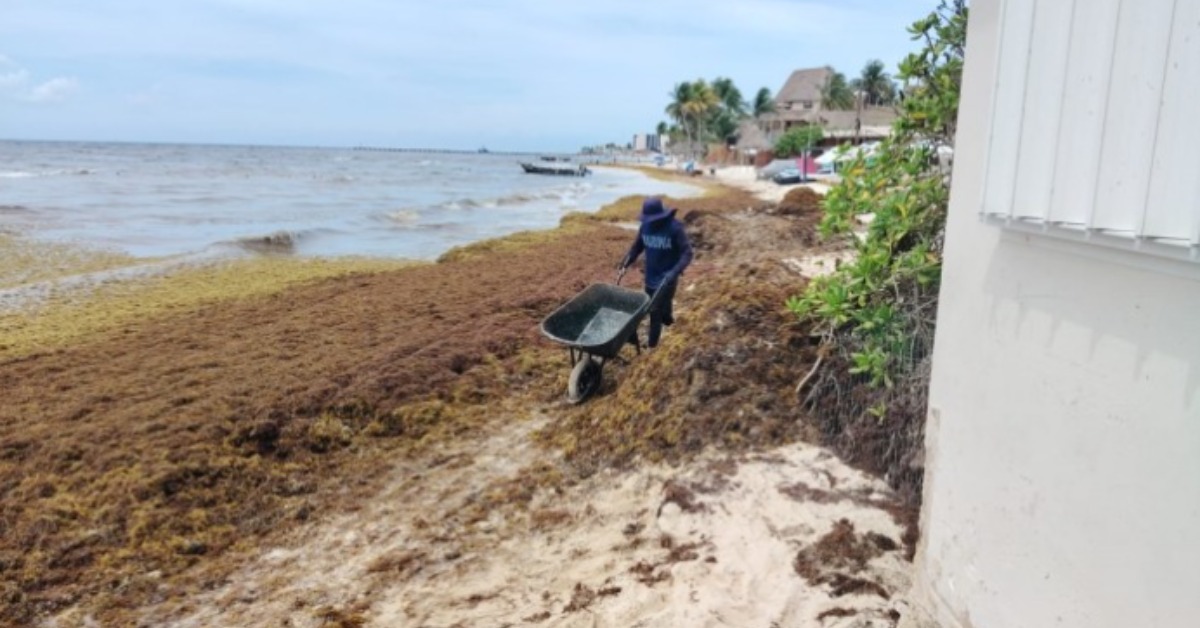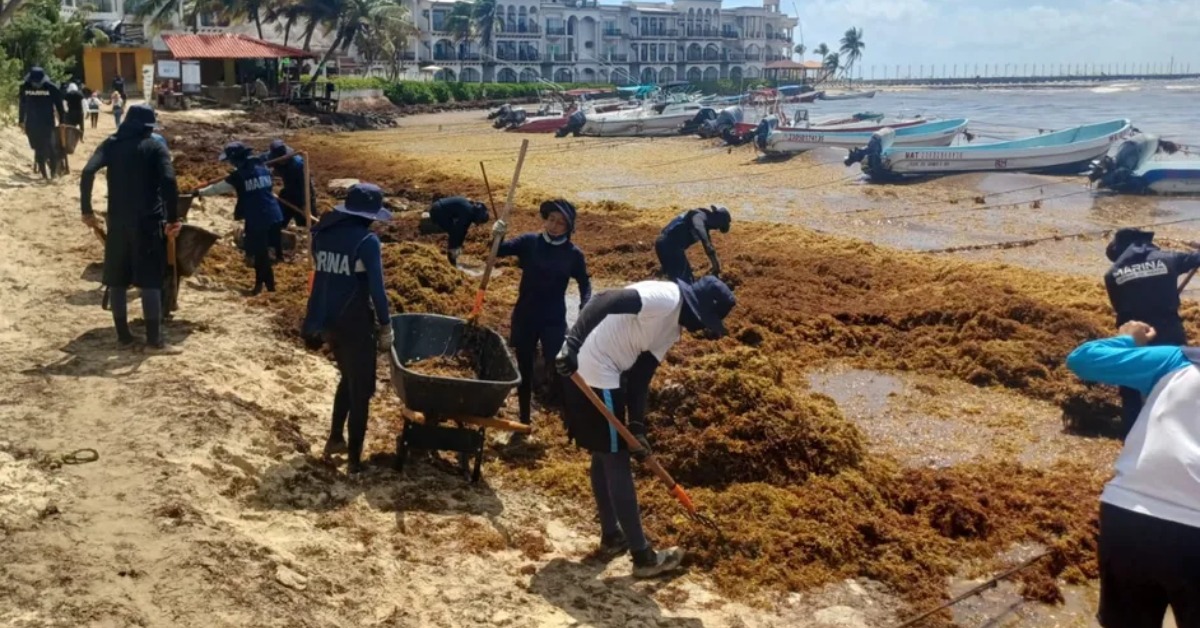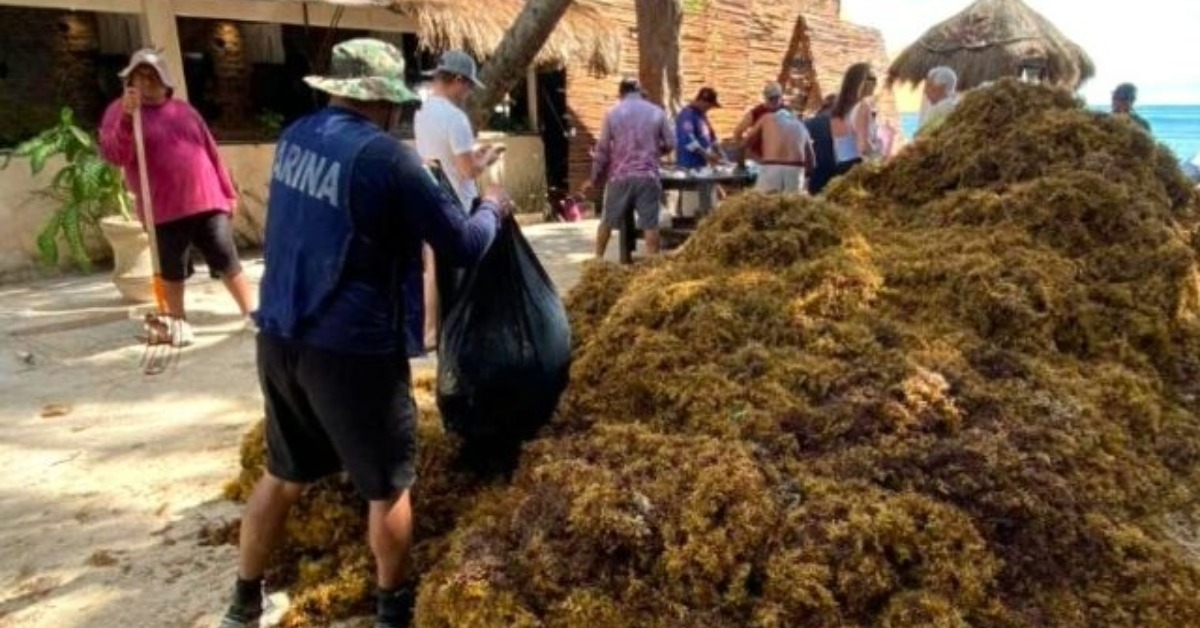
Playa del Carmen is getting the largest share of Mexico’s current sargassum response in Quintana Roo, as heavier seaweed arrivals begin shaping the 2026 season. More Navy personnel, containment barriers, and cleanup resources are being directed toward the city’s beaches, where tourism, ferry service, beach clubs, and daily life all depend on keeping the coastline usable. The work is part of a wider state response, but Playa del Carmen is becoming one of the clearest tests of whether the strategy can keep pace.
Sargassum cleanup crews concentrate on Playa del Carmen and Mahahual
Playa del Carmen is now one of the main points of Mexico’s sargassum response in Quintana Roo, as heavier arrivals push more cleanup crews and containment equipment toward the Riviera Maya.
The Secretary of the Navy, known as Semar, has assigned 110 naval personnel to Playa del Carmen. That is the largest reported deployment among the main coastal areas included in the current operation.
The focus reflects the city’s importance as a tourism hub, ferry connection, and residential center. When sargassum reaches Playa del Carmen’s beaches, the impact is visible fast. It affects beach access, hotel zones, restaurants, ferry areas, and small businesses that depend on the coast.
The response also includes floating containment barriers, vessels, and beach cleanup teams. These crews are working as the 2026 season shows signs of being heavier than last year.
Playa del Carmen gets the largest crew deployment
The current Navy deployment places Playa del Carmen ahead of other affected areas in staffing. Tulum has 18 naval personnel assigned, while Mahahual has 63.
That does not mean Playa del Carmen is the only place facing pressure. Tulum, Mahahual, Xcalak, and Puerto Morelos are also part of the response. But the larger crew presence in Playa del Carmen shows where authorities see an urgent need to keep beaches clear.
The city’s coastline has little room for delay. Heavy sargassum can quickly affect central beaches, public access points, and the ferry corridor to Cozumel.
For many residents and visitors, the issue is not just whether seaweed is present. It is whether beaches remain usable, whether odors develop, and whether cleanup crews can remove the algae before it decomposes.
A heavier 2026 season is taking shape
Quintana Roo officials and monitoring groups expect sargassum arrivals to rise this year. Projections point to a possible increase of around 25% to 30% compared with 2025.
If that forecast holds, the state could receive about 130,000 tons of sargassum this year. That would be well above the roughly 96,000 tons reported last year.
Through April, cleanup crews had already collected about 28,000 tons of sargassum across six municipalities in the Mexican Caribbean. That early number has raised concern about the months ahead.
The strongest landings are often tied to winds, currents, and offshore sargassum mats. This makes daily conditions hard to predict at the beach level.
A clear morning in Playa del Carmen can turn into a heavy cleanup day if winds shift. The reverse can also happen when currents move the algae away from shore.
How barriers are being used along the coast
Authorities have installed about 7,530 meters of containment barriers in several coastal areas, including Playa del Carmen, Puerto Morelos, Tulum, and Mahahual.
The purpose is to intercept sargassum before it reaches the sand. When the seaweed is held offshore, vessels can collect some of it before it piles up on beaches.
This approach is important because sargassum becomes harder to manage once it lands. Heavy piles can trap trash, affect water quality, and create odors as they break down.
Barriers can help, but they are not a complete solution. Rough seas, strong currents, and large mats can reduce their effectiveness. They also require maintenance, positioning, and support from boats.
For Playa del Carmen, the challenge is constant movement. The city’s beaches are active, public, and heavily used. Cleanup work must happen while daily coastal life continues around it.
What residents and visitors may notice
People in Playa del Carmen may see more cleanup activity along the beach during the heavier part of the season. That can include workers with rakes, trucks hauling seaweed, equipment near access points, and vessels operating offshore.
Visitors may also notice that beach conditions vary from one area to another. One stretch may have heavy sargassum while another nearby beach is clearer.
That variation is common during sargassum season. Local wind, wave action, and shoreline shape can all affect where the seaweed lands.
For hotels, beach clubs, and restaurants, fast removal matters. Sargassum that sits too long can produce a strong odor and discourage beach use.
For residents, the concern is more routine. It can affect daily walks, swimming, beach access, and the general condition of public areas near the water.
Health concerns come from decomposing sargassum
Fresh sargassum floating offshore is not the same as rotting sargassum on the sand. The health concern grows when large piles begin to decompose.
As sargassum breaks down, it can release gases such as hydrogen sulfide and ammonia. Hydrogen sulfide can smell like rotten eggs and may irritate the eyes, nose, and throat.
Some people may be more sensitive to those gases. This includes people with asthma, respiratory problems, heart conditions, older adults, and young children.
Most brief exposure near a beach is not a serious problem for healthy adults. Still, people should avoid sitting near thick piles that are breaking down.
Children and pets should also be kept away from heavy deposits. The piles can contain sharp debris, small marine animals, or other material mixed into the seaweed.
Sargassum is natural, but the scale is not
Sargassum is a brown seaweed that floats in the ocean. In normal amounts, it provides shelter for fish, turtles, crabs, and other marine life.
The problem is the scale of recent arrivals. Since 2011, the Caribbean has seen repeated large sargassum events that have affected beaches from the eastern Caribbean to Mexico.
Scientists track these blooms with satellite images, ocean models, and field reports. These tools can show large offshore mats and estimate where they may travel.
Still, forecasts are not perfect. They can show increased risk for Quintana Roo, but they cannot always predict the exact conditions for one beach in Playa del Carmen.
That is why local monitoring remains important. A regional forecast gives the broader picture, while daily beach reports show what residents and visitors can expect that day.
Playa del Carmen is a practical test case
Playa del Carmen is not the only place affected by sargassum, but it is one of the most visible. Its beaches are central to the city’s identity and economy.
The city also has a mix of pressures. It serves tourists, residents, ferry passengers, workers, and local businesses in the same coastal zone.
That makes the sargassum response more complicated. Crews need to act quickly without disrupting beach access more than necessary.
The current strategy clearly sets a goal. Authorities want to collect more sargassum before it reaches shore and remove the rest before it decomposes.
Whether that will be enough depends on the volume of seaweed in the coming months. If arrivals continue rising, Playa del Carmen may need sustained cleanup support throughout the season.
The bigger challenge ahead
The long-term question is not whether Playa del Carmen can clean its beaches after a landing. It is whether the region can manage sargassum as a recurring seasonal problem.
That means better offshore collection, faster cleanup, safe disposal, and more reliable monitoring. It also means finding practical uses for some of the collected seaweed.
There have been efforts to turn sargassum into fertilizer, construction materials, fuel, or other products. Those ideas still face cost, safety, and processing challenges.
For now, the priority is simpler. Keep sargassum away from the busiest beaches when possible. Remove it quickly when it lands. Reduce odor, health concerns, and beach disruption.
In Playa del Carmen, that work is already underway. The larger deployment shows that officials expect the city to remain one of the key pressure points of the 2026 season.