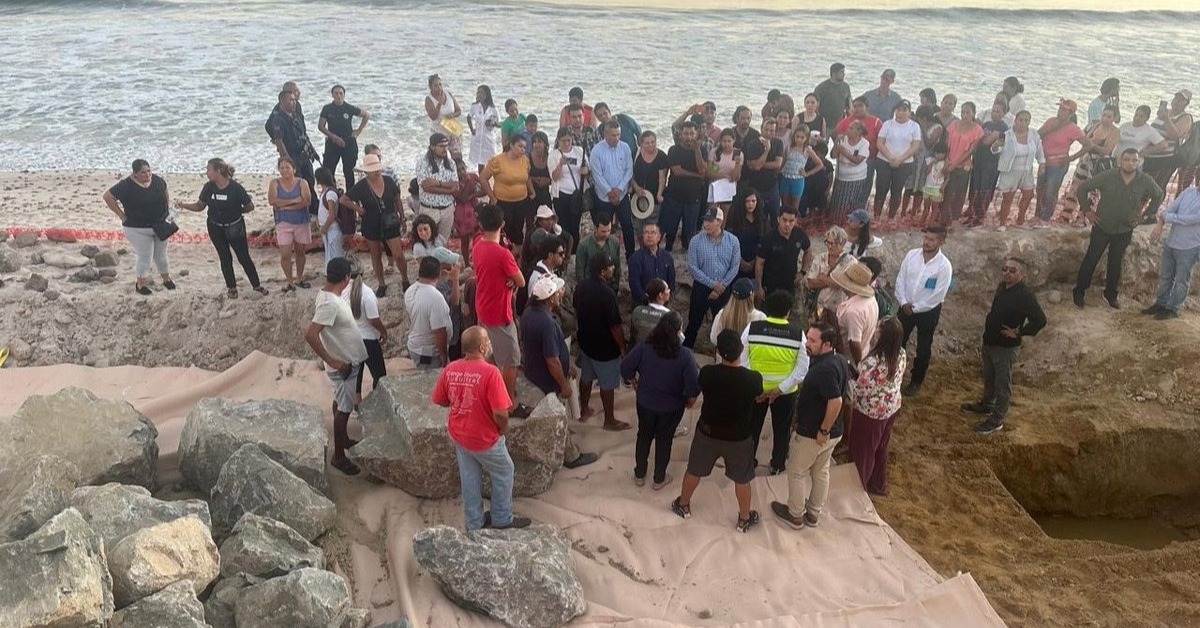
Bahía de Banderas collected more than 21.5 million pesos for a construction license tied to a Playa Cocinas development, but the payment is only one part of the story. The project sits inside a wider dispute over public beach access, federal coastal rules, environmental permits, and the future of one of Punta de Mita’s most contested shorelines. The license helps explain why local residents, federal agencies, and developers are now locked in a fight that extends beyond a single construction site.
Bahía de Banderas collected more than 21.5 million pesos for a construction license
The municipality of Bahía de Banderas collected more than 21.5 million pesos for a construction license tied to a development at Playa Las Cocinas, in Punta de Mita.
The license was issued on April 23, 2025, in favor of Proyecto H5 Nayarit, S.A. de C.V., a company linked to Grupo DINE. The authorization covers a project with homes, multifamily units, pools, hotel areas, and service areas on more than 58,000 square meters.
The municipal payment receipt lists 21,528,481.64 pesos in license fees. The license has a validity period of 1,080 days, which places the project on a long construction timeline.
The fee has drawn attention because Playa Las Cocinas is already at the center of a broader dispute. Residents and environmental defenders say the project raises unresolved questions about public beach access, federal coastal land, turtle nesting areas, and whether the work has the needed environmental approvals.
A municipal license does not settle the federal question
A construction license from a municipality is not the same as federal authorization to work on the beach.
That distinction is central to this case. Municipal governments can issue licenses for construction inside their local jurisdiction. But Mexico’s beaches and the adjacent Zona Federal Marítimo Terrestre, known as ZOFEMAT, fall under federal rules.
ZOFEMAT is generally the 20-meter strip of land next to the beach. It is considered federal public property. In simple terms, Mexico does not treat beaches as private property in the way many foreign residents may understand from other countries.
That does not mean every nearby project is illegal. It means any work that touches federal beach land, changes the shoreline, places rock, moves sediment, or affects vegetation may require separate federal review and approval.
This is where the Playa Cocinas dispute becomes more complicated. The municipality received a large payment for the construction license, while federal environmental and coastal rules still apply to anything inside the federal beach zone.
The older concession adds another layer
The dispute also involves a federal concession issued in 2004 to Cantiles de Mita, S.A. de C.V., another company tied to the project area.
That concession covered about 54,879 square meters in Punta de Mita. The reported authorized use was for protection, not permanent construction. That detail matters because a protective use can limit what a company may do on federal coastal land.
A project can have a municipal license and still face limits under federal rules. That is especially true in beach areas, where land ownership, concessions, environmental permits, and public access rights can overlap.
For readers in Puerto Vallarta and Riviera Nayarit, this is the key issue. The debate is not only about whether the municipality charged and collected a fee. It is whether the project’s different permits match the work being done near the shoreline.
Environmental approvals remain under scrutiny
Federal environmental agencies had already raised concerns before the latest disclosure about the municipal payment.
In 2025, federal authorities reviewed notices related to proposed work in the area. Those notices involved actions such as placing rock, handling sediment, and moving vegetation. The federal response said the work did not establish emergency conditions that would allow it to proceed without prior environmental authorization.
That point is important because developers sometimes argue that coastal work is needed to protect land from erosion. Federal authorities can still require proof, review, and permits before work begins.
The Playa Cocinas case includes concerns about the possible use of an older environmental authorization. Questions have been raised over whether a past study can support the current project without an updated review.
Residents have also pointed to the area’s role as a turtle habitat. Heavy machinery, rock barriers, artificial lighting, and changes to the sand can affect nesting areas. That concern has become one of the strongest arguments for a fuller environmental review.
Public access is now the center of the fight
The conflict has moved beyond paperwork.
Residents of Punta de Mita and nearby communities have protested the project for weeks. Their complaints include possible privatization of the beach, shoreline damage, and the loss of usable public space.
Federal authorities have said public access to Playa Las Cocinas must be guaranteed under Mexican law. State and municipal officials have also discussed mesas de diálogo with residents and the company.
Those talks have included possible access routes, adjustments to the project, and a formal demarcation of the federal maritime zone. But residents have continued to demand stronger guarantees before more work changes the coastline.
The issue is practical as much as legal. A beach can remain public on paper while walls, guards, construction, altered paths, or narrow access routes make it difficult to use.
That concern is common in Mexico’s beach towns. Legal access is one thing. Real, usable access is another.
The project sits inside a luxury development corridor
Playa Las Cocinas is not an isolated beach dispute. It sits inside one of Mexico’s most valuable coastal real estate corridors.
Punta de Mita has long been marketed as a destination for high-end resorts, private residences, and branded developments. Supporters of these projects point to investment, jobs, tourism, and infrastructure.
Those arguments carry weight in a region where many families depend on tourism. But they do not remove the need for clear permits, environmental safeguards, and open beach access.
That is why this case has become a test for Bahía de Banderas. The municipality collected a major fee from the license. Federal authorities are reviewing coastal access and environmental issues. Residents are asking whether public land is being protected.
The result could shape how future coastal projects are handled in Riviera Nayarit.
What happens next
The next phase will likely depend on what authorities make public.
Residents are asking for clear answers about the project boundaries, the status of the federal concession, environmental approvals, and the exact location of the ZOFEMAT line. They also want any public access route to be more than a token path.
The municipality will face pressure to clarify what the construction license covers and what it does not. Federal agencies will face pressure to show whether the project complies with environmental and coastal rules.
The company will also face pressure to demonstrate that its work complies with the law, protects the beach, and respects the community’s access.
For now, the 21.5 million peso license fee has added a new layer to the Playa Cocinas dispute. It shows that the project moved through municipal channels, but it does not answer the larger question.
The question is whether development at Playa Las Cocinas can proceed while protecting public beach access, federal coastal land, and the environmental rules that apply to one of Punta de Mita’s last contested shorelines.