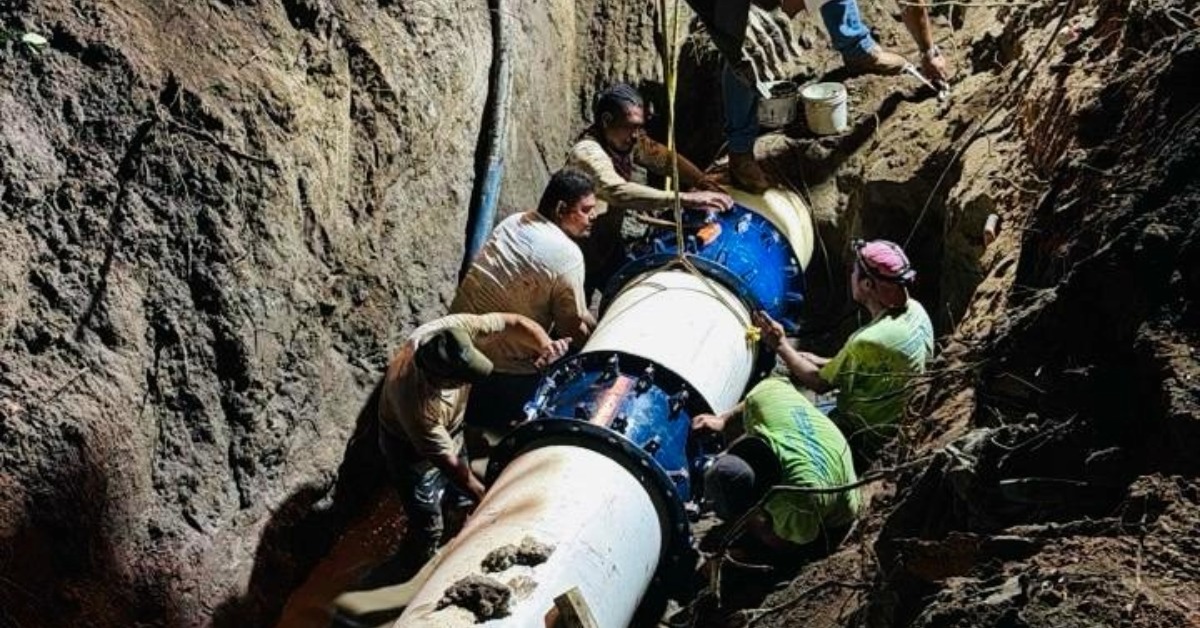
SEAPAL Vallarta says it has completed repairs to the 24-inch main that failed, causing a broad water outage across Puerto Vallarta. The damaged line is part of the system that carries water from the Pozo Radial to the Cerro del Machete water treatment plant, a key route for supplying the north side of the city.
The repair matters because this was not a minor neighborhood leak. It was a failure in one of the main lines that helps move water through a large section of the municipal system. Once that kind of pipe breaks, the problem spreads quickly. Water production drops, storage tanks begin to drain, and pressure falls across a wide area.
Officials said the line that failed had been in service for about 25 years. That detail helps explain why this outage drew so much attention. In cities that grow quickly, older water infrastructure often carries heavier demand than it was originally built to handle. When one of those lines fails, the effects can reach residential areas, hotels, businesses, and traffic-heavy districts all at once.
When water is expected to return
The repair may be finished, but service recovery will not be immediate. SEAPAL says water should return gradually between Thursday midday and Friday morning, with higher-elevation neighborhoods likely to be the last areas to see normal pressure restored.
That kind of delay is normal after a major break. Once the damaged section is repaired, operators still need to refill tanks, rebuild pressure, and stabilize flows across the system. In this case, officials said the failure interrupted the production of more than 24,000 cubic meters of water, meaning the recovery phase is not just about reopening the line. It also means replacing a large volume that was not produced while the system was down.
For residents, that distinction is important. A completed repair does not always mean the water comes back within hours. Some neighborhoods may see service first, others may get weak pressure, and some homes may have intermittent supply before conditions fully stabilize. That is especially true in upper sections of El Pitillal and other elevated zones, where pressure recovery usually takes longer.
Why so many neighborhoods were affected
SEAPAL and local reports said the outage affected more than 140 neighborhoods and developments, largely across the northern part of Puerto Vallarta. The impacted area included places such as Marina Vallarta, Versalles, Fluvial Vallarta, Aramara, Las Juntas, Ixtapa, and surrounding residential zones.
The reason the footprint was so large is tied to where the break happened. The failed pipe is on a main supply route connected to a strategic treatment system. When that line went down, the city did not just lose local distribution in one sector. It lost part of the network that feeds a much larger service area.
That scale also explains why the issue mattered beyond households. Hotels and businesses in the affected zone had to shift into contingency mode. In a city where tourism, rentals, and service businesses are tightly linked to reliable water access, even a short outage can create wider practical problems. Restaurants need water for operations. Buildings need pressure for storage systems and pumps. Hotels need it for guest rooms, kitchens, and laundry service.
What readers should understand about the recovery phase
For international readers, the most useful context is that Puerto Vallarta’s water system does not recover like flipping a switch. A citywide or district-wide outage can take time to unwind, even after crews leave the repair site.
Water systems depend on pressure, elevation, storage, and the sequence in which tanks refill. Homes with rooftop storage or private cisterns may feel less impact at first. Buildings without backup storage may experience the disruption more sharply. That difference often makes an outage feel uneven from one street to the next.
It also means residents should be careful about assuming the problem is over the moment they hear that repairs were completed. The more accurate reading is that the emergency phase has ended and the system recovery phase has started. In practice, that is the period when taps may return slowly, pressure may fluctuate, and some areas may lag behind the official timeline.
A reminder of how vulnerable the system can be
This outage also points to a larger issue that returns often in Puerto Vallarta and other fast-growing cities: aging infrastructure under seasonal pressure. SEAPAL had already said days earlier that it was taking steps to strengthen production and prepare for the dry season, including work tied to the Pozo Radial and other supply points.
That makes this break especially notable. It happened at a time when demand is high, temperatures rise, and any interruption can quickly affect large parts of the city. Even when the utility is taking preventive action, a rupture in an older main can still overwhelm those efforts in the short term.
For residents, the immediate concern is practical. They want to know when the water will be back. But the broader takeaway is that the city’s supply system remains exposed to failures that can quickly escalate into major disruptions. That is not unique to Puerto Vallarta, but it is a recurring issue that matters in a city with continued development, heavy seasonal use, and expanding demand in the north.
What happens next
For now, the next step is straightforward. SEAPAL must restore storage levels, stabilize distribution, and return pressure across the affected sectors. Residents in lower areas may notice improvement sooner. Those in high zones may need to wait longer.
Until recovery is complete, stored water should be used carefully. In outages like this, the final hours are often the most uneven. Some homes begin to recover while others remain dry. That gap does not always mean a new failure has occurred. It is often part of the normal return process after a major break in a primary line.
The immediate emergency appears to be over. The larger question is whether this incident becomes just another short disruption or another signal that the city’s water network needs more sustained upgrading before the next major break arrives.