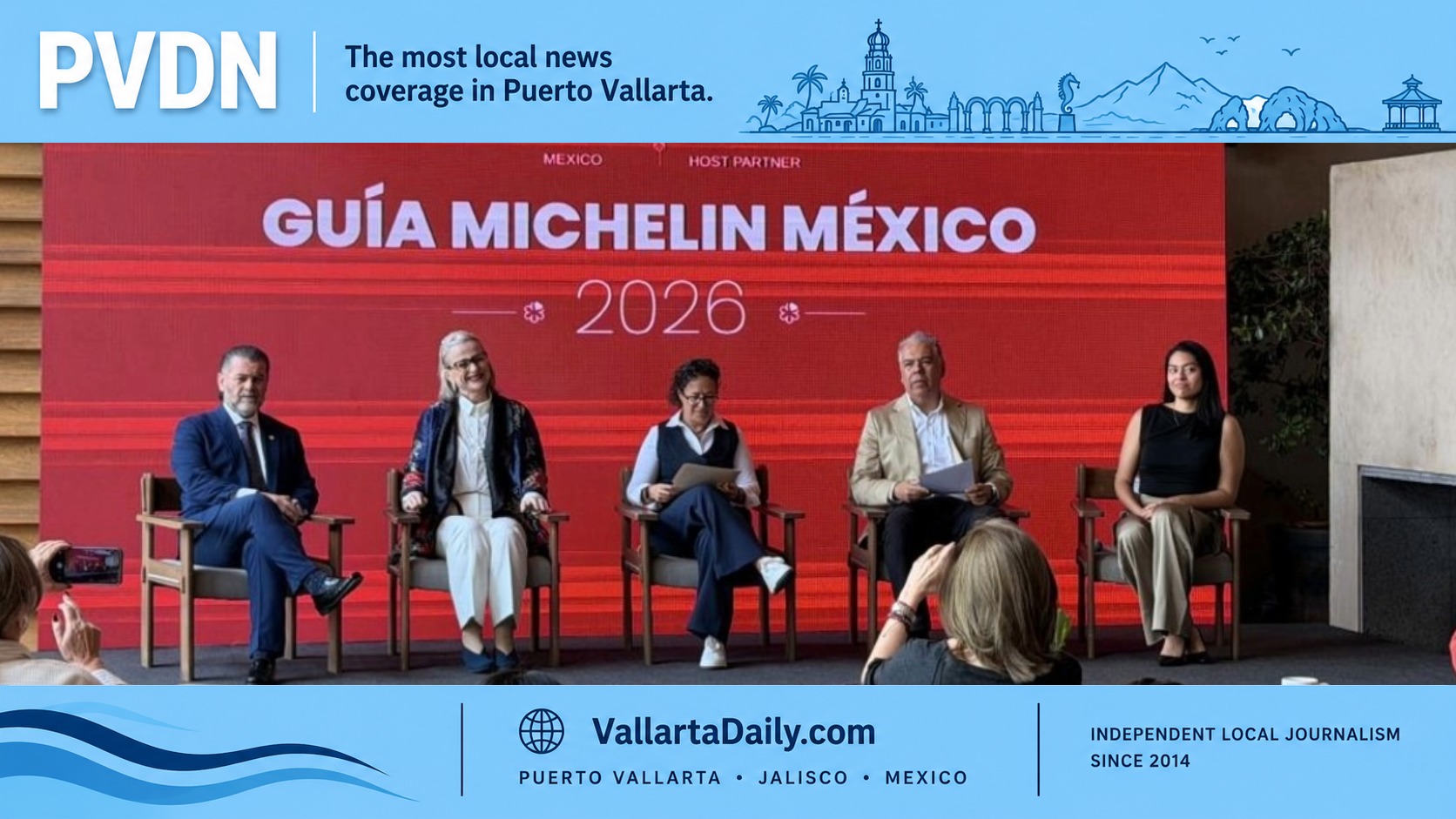
Puerto Vallarta, Jalisco, July 14, 2026 – Puerto Vallarta’s public tourism trust approved spending up to US$290,000, roughly 5.8 million pesos, to keep the city inside the Michelin Guide Mexico evaluation during 2026. The resulting guide listed two local restaurants, while the payment opened a harder question than whether those restaurants deserved recognition. How independent can a guide be when destinations must pay to appear on its map?
A FIDETUR committee record from March 6 shows that the committee approved the amount unanimously, with VAT included and the peso total capped at 5.8 million.
The expense was assigned to budget line 4332, identified as a state tourism promotion subsidy. The agreement was to be signed through the National Chamber of the Restaurant and Seasoned Food Industry, known as CANIRAC, and tied to Puerto Vallarta’s participation in the 2026 edition. Nine voting members representing state government, municipal tourism, hotels and tourism businesses supported the expenditure.
Michelin later awarded ICÚ, on Venustiano Carranza in Zona Romántica, a Bib Gourmand recognizing good cooking at good value. Pancho’s Takos on Basilio Badillo was added to the recommended list. No Puerto Vallarta restaurant received a Michelin star.
PVDN previously reported on the city’s first appearance in the guide and the later delivery of Michelin plaques to both restaurants.
The payment does not establish that either restaurant bought an award or received one through political influence. No public evidence reviewed by PVDN shows that Vallarta officials chose the winners, changed scores or knew the inspectors’ identities.
Dividing 5.8 million pesos between two restaurants may make for an eye-catching figure, but it misstates the transaction. FIDETUR paid to place the destination inside Michelin’s coverage and promotional system, not to purchase two guaranteed distinctions.
Michelin separates selection from destination funding
Michelin says its partnerships with tourism boards support marketing and promotion, while restaurant decisions remain under its inspection team’s purview. The company says inspectors are Michelin employees, reserve anonymously, pay every bill and judge food through five common criteria. Star decisions involve multiple visits and collective agreement.
Michelin has repeated the same independence claim when announcing destination partnerships. Its statement tied to Poland’s 2026 expansion said that tourism board cooperation covered marketing and promotion, while anonymous inspectors retained full control over the selection.
That structure offers a credible firewall between the sponsor and the final rating. It also leaves much of the process beyond outside verification. Michelin protects inspectors’ identities, while the public materials reviewed by PVDN do not state how many Puerto Vallarta restaurants were visited, how many inspection meals were conducted, or how establishments entered the initial candidate pool.
The local transparency gap is wider. The FIDETUR vote identifies the maximum payment, budget line, and intermediary, but the complete executed agreement with CANIRAC was not included in the public materials located by PVDN.
Without that document, taxpayers cannot see the geographic boundaries, promotional deliverables, renewal terms, performance measures, or any clauses preventing local officials and restaurant groups from influencing which establishments Michelin considers.
Independence stops at the edge of the map
The strongest criticism of Michelin’s funding model is not necessarily that sponsors buy stars. It is that sponsors help determine where Michelin looks.
Recent deals elsewhere show that restaurant quality alone does not place a city inside the guide. Tourism agencies across several United States markets have paid six- and seven-figure sums tied to multi-year coverage. Atlanta and Boston reportedly committed at least US$1 million each, while state and city agencies contributed a combined US$2.7 million toward three years of Texas editions.
Minneapolis agreed to a US$750,000, three-year arrangement, while neighboring Saint Paul was left out of the Great Lakes guide. The two cities share a single metropolitan dining market, yet the paid boundary determined which restaurants were eligible.
That distinction changes how Michelin should be read. Its awards may represent independent judgments within an inspected territory, but the guide is not a neutral survey of every strong restaurant in Mexico. A restaurant in a city that does not fund participation may never be included in the comparison.
The guide can still identify excellent cooking, yet it cannot prove that its selected regions contain the nation’s only or best examples.
Mexico’s restaurant chamber has openly described Michelin’s arrival as the result of CANIRAC negotiations and has worked with the federal Tourism Secretariat to place the guide inside national gastronomic tourism policy.
That relationship treats Michelin as both an editorial authority and a destination marketing product. The dual role does not prove corruption, but it does create a perception conflict that Michelin and public agencies must address with stronger disclosure.
Vallarta still needs to show the return
A tourism trust can reasonably spend money on international promotion. The relevant public question is whether this particular agreement delivered more value than another 5.8 million peso campaign might have produced.
Two listings alone do not answer that question. ICÚ and Pancho’s Takos may gain reservations, publicity and prestige. The city may gain culinary visibility. None of those outcomes yet demonstrates increased hotel stays, visitor spending, restaurant traffic across the wider city or tax revenue linked to the Michelin agreement.
Most tourists choose their vacation destination before planning their meals. There is no evidence that the 5.8 million pesos in taxpayer money will yield any measurable gains for the city. That is real money for a city that consistently runs in the red and has failing infrastructure being felt every day.
A serious evaluation would publish the final amount paid, the contract term, the exact promotional package, website and media reach, referral traffic, earned media, restaurant booking changes, culinary travel indicators and any measurable lift against comparable periods.
The analysis should also separate Michelin exposure from World Cup travel, broader Jalisco promotion and Puerto Vallarta’s existing culinary campaigns.
Michelin remains useful as an expert opinion on restaurants its inspectors actually visit. The destination funding model does not, by itself, prove that ICÚ or Pancho’s Takos received undeserved recognition. As a local, I can testify to the quality of both restaurants.
Michelin should be trusted more narrowly. Its ratings can be read as Michelin’s judgment within a purchased coverage area, not as a complete census of Puerto Vallarta dining, nor as proof that the public expenditure was wise.
Before any renewal, FIDETUR should publish the executed agreement, the actual payment, the editorial independence clauses, and measurable tourism results. Otherwise, Puerto Vallarta is being asked to accept two untested claims at once: Michelin’s independence and the government’s return on 5.8 million pesos.