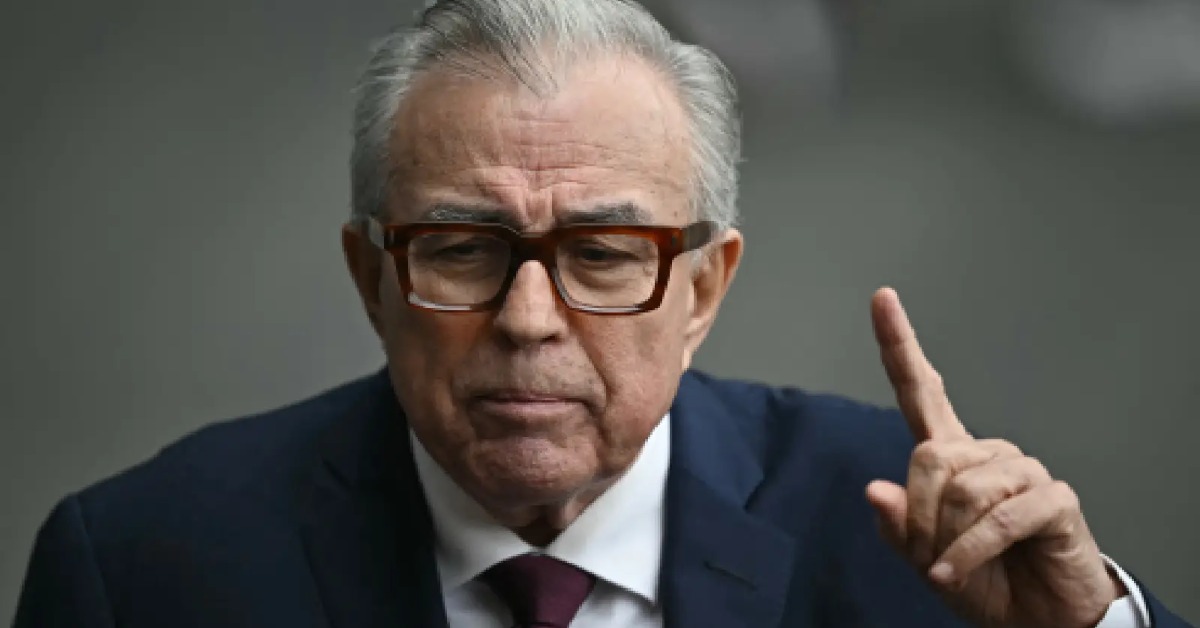
Rubén Rocha Moya’s leave of office has put Sinaloa in a legal and political storm. Federal officials say the former governor no longer has constitutional immunity, yet he has been assigned federal protection after U.S. prosecutors accused him of links to the Sinaloa Cartel. The case now sits between Mexican sovereignty, U.S. extradition pressure, Morena politics, and the question of what evidence is needed before Mexico acts against one of its own powerful officials.
Rocha Moya loses immunity but receives federal protection amid U.S. cartel accusations
Rubén Rocha Moya’s request for leave as governor of Sinaloa has changed the legal ground under one of Mexico’s most serious political-criminal cases in years.
Federal officials say Rocha Moya no longer has fuero, the constitutional immunity that protects certain public officials from immediate prosecution while they hold office. At the same time, the federal government assigned him a security detail after a risk review, even as U.S. prosecutors accuse him of helping the Sinaloa Cartel.
The case has placed Mexico in a difficult position. The United States wants action tied to a federal indictment in New York. Mexico says any arrest or extradition process must meet Mexican legal standards, not just U.S. demands.
Rocha Moya has denied the accusations. The charges remain allegations and have not been proven in court.
What changed after Rocha Moya left office
Rocha Moya asked the Sinaloa Congress for leave after U.S. authorities made public criminal charges against him and other current and former Sinaloa officials. State lawmakers approved the leave and named Yeraldine Bonilla Valverde as interim governor.
That move matters because of fuero. In simple terms, fuero is a legal shield tied to certain public offices. It does not mean an official can never be investigated. It means prosecutors may face extra steps before moving against that person.
Federal officials argue that Rocha Moya lost that protection when he stopped exercising the duties of governor. Arturo Zaldívar, a former Supreme Court minister now serving in the federal government, said the protection belongs to the office, not the individual.
That interpretation is not free of debate. Some legal voices argue that immunity may not disappear automatically unless there is a formal resignation or a congressional removal process known as desafuero. That dispute could become important if prosecutors try to move quickly.
For now, the federal government’s position is that Rocha Moya can be summoned by the Attorney General’s Office.
Why he received federal protection
The assignment of federal protection has drawn attention because it came just after Rocha Moya lost the shield of office.
Security Secretary Omar García Harfuch said the measure followed a risk evaluation by the federal protection service. He said Rocha Moya did not personally request the security detail and that officials had no confirmed threat against him.
The protection was described as limited. Federal officials did not give operational details, including the number of agents assigned.
Harfuch also said the federal security cabinet had not detected signs that Rocha Moya obstructed federal operations in Sinaloa. He said there were no internal suspicions against him within Mexico’s security strategy.
That statement is politically sensitive. The U.S. indictment accuses Rocha Moya and others of working with cartel figures. Mexico’s security chief, at least publicly, says Mexican officials have not seen evidence of that in their own operations.
What the United States alleges
The U.S. case was filed in the Southern District of New York. Prosecutors accuse Rocha Moya and nine other current or former Sinaloa officials of drug trafficking and weapons-related offenses.
The indictment alleges they conspired with leaders of the Sinaloa Cartel to move narcotics into the United States. It also alleges the arrangement involved political support, protection, and bribes.
The U.S. case focuses on Los Chapitos, the faction tied to the sons of Joaquín “El Chapo” Guzmán. Prosecutors allege that cartel leaders helped Rocha Moya win the 2021 election through intimidation and other pressure against rivals.
In return, U.S. prosecutors claim Rocha Moya promised protection once in office. The indictment alleges cartel leaders were allowed to operate with impunity in Sinaloa.
Those are serious claims. There are also claims that must still be tested in court.
The Justice Department itself states that the indictment contains allegations only. The defendants are presumed innocent unless proven guilty.
Mexico’s response to the extradition pressure
Mexico has not treated the U.S. case as an automatic order to arrest Rocha Moya.
Federal officials say the United States submitted requests for provisional detention for extradition purposes. Mexican authorities say that it is different from a completed extradition process.
The distinction is important. A provisional detention request can be used to hold someone pending a formal extradition case. But Mexico says the United States still must justify the urgency and provide enough support for the request.
The federal government says the Attorney General’s Office reviewed the material and found that the U.S. submission did not prove urgency at this stage. Mexico has requested more information through diplomatic channels.
President Claudia Sheinbaum has tried to draw a narrow line. She says Mexico will not protect anyone who commits a crime. She also says Mexico will not allow a foreign government to decide what happens inside Mexico without proof that meets Mexican law.
That position reflects a long-running tension in U.S.-Mexico security cases. Washington often pushes for fast arrests and extraditions. Mexico often raises concerns about sovereignty, due process, and the quality of the evidence provided.
The Sinaloa political fallout
The case is not only legal. It is also political.
Rocha Moya belongs to Morena, the party of President Sheinbaum and former President Andrés Manuel López Obrador. That makes the case harder for the federal government to manage.
If Mexico moves against Rocha Moya, Morena faces damage in one of its important state governments. If Mexico refuses to move, critics can accuse the government of protecting an ally.
Sinaloa’s interim governor, Yeraldine Bonilla Valverde, now inherits a state facing cartel violence, institutional pressure, and national attention. Federal officials have promised to keep reinforcing security operations in the state.
The case also reaches beyond Rocha Moya. Other accused figures include people tied to Sinaloa’s state government, law enforcement, the Culiacán municipal government, and the Senate. One sitting senator, Enrique Inzunza Cázarez, still raises a separate immunity question because he holds federal office.
For residents watching from outside Sinaloa, the case does not create an immediate nationwide travel rule or a change in daily life. But it touches issues that shape Mexico’s stability: public security, political accountability, U.S. pressure, and trust in institutions.
What comes next
The next step is Mexico’s legal review.
The Attorney General’s Office can investigate the allegations under Mexican law. If prosecutors find sufficient evidence, they could seek legal action in Mexico or initiate an extradition process.
If they do not find enough evidence, Mexico could delay the case, reject parts of the request, or ask the United States for more proof.
The key question is no longer whether the allegations are politically explosive. They are. The question is whether the U.S. can provide evidence that Mexico accepts as strong enough to act.
Until then, Rocha Moya sits in a rare position. He is no longer exercising power as governor, according to Sinaloa’s Congress. Federal officials say he no longer has immunity. Yet he remains protected by the Mexican government while facing one of the most consequential U.S. cartel cases involving a Mexican political figure.