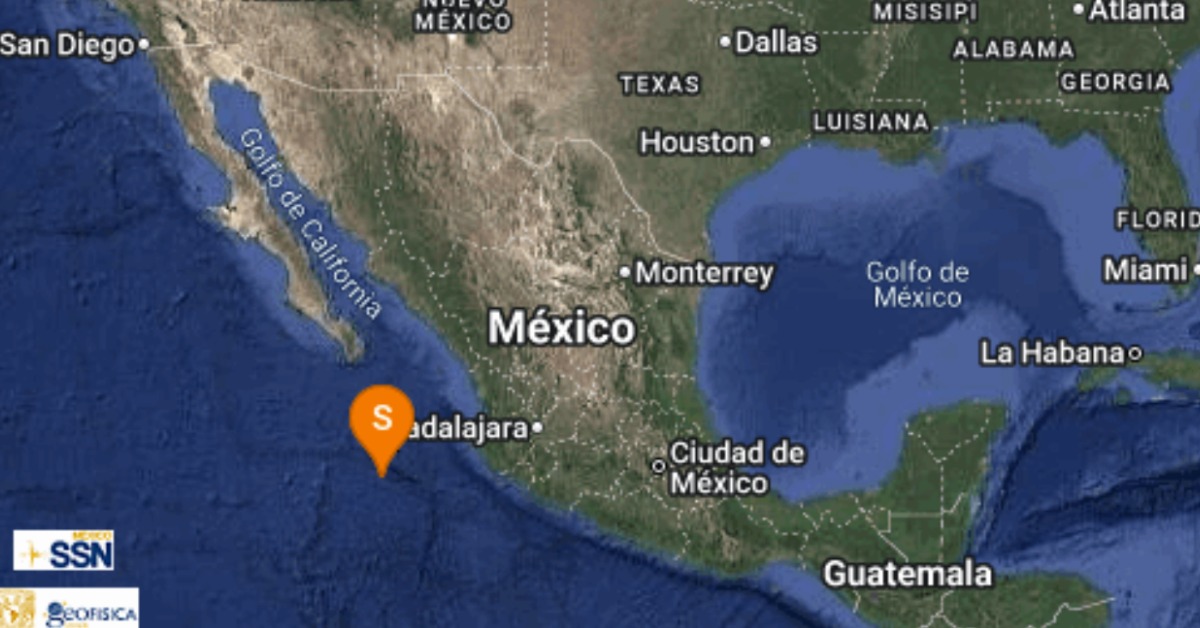
A magnitude 4.7 earthquake registered far southwest of Puerto Vallarta on Thursday morning, drawing attention along Jalisco’s coast even as early reports showed no damage or injuries. The event was centered hundreds of kilometers offshore, but its timing aligns with other recent seismic activity tracked in the region. Authorities were monitoring for any later effects, while the official seismic record placed the quake in the Pacific with a shallow depth.
4.7 quake registered southwest of Puerto Vallarta
A magnitude 4.7 earthquake was recorded Thursday morning in the Pacific Ocean, far southwest of Puerto Vallarta, according to the Servicio Sismológico Nacional. The quake was listed at 10:18:14 a.m. Central Mexico time, with its epicenter 412 kilometers southwest of Puerto Vallarta, Jalisco.
The official SSN post gave the location as “412 km al suroeste de Puerto Vallarta” and placed the quake at latitude 19.07, longitude -108.81, with a depth of 10 kilometers. The distance from shore is the central detail in the report. It explains why the event drew attention despite there being no immediate reports of damage in the city.
Early same-day reports said no injuries, structural damage, or material losses had been reported. Authorities were described as monitoring the region for possible aftershocks or effects from the offshore movement.
Offshore location limited the early impact
The quake was recorded in open water, not under the city or nearby neighborhoods. That makes this event different from closer coastal tremors, where even a moderate magnitude can be felt more sharply.
A shallow depth of 10 kilometers can be notable in seismic reporting, but distance changes the public impact. In this case, the epicenter was hundreds of kilometers from Puerto Vallarta’s urban area.
The latest report follows another magnitude 4.0 quake southwest of Puerto Vallarta recorded earlier this month. Puerto Vallarta also recently participated in a Jalisco earthquake and tsunami drill, part of broader emergency planning in a coastal state exposed to seismic activity.
What authorities were watching
The early concern after an offshore quake is not only shaking. Coastal authorities also monitor later effects, including aftershocks and unusual sea-level behavior.
Mexico’s Centro de Alerta de Tsunamis, operated by the Navy, says its role is to monitor seismic and sea-level information and issue tsunami alert bulletins when thresholds require them. No tsunami warning tied to this Puerto Vallarta event was found in the reviewed public reports at the time of writing.
The SSN report did not describe damage. It recorded the event and its location. That is an important distinction, since the seismic agency reports earthquakes while civil protection agencies handle impact checks, emergency response, and public safety actions.
Recent seismic activity remains part of coastal life
Puerto Vallarta sits on Mexico’s Pacific side, where seismic activity is common. Most quakes recorded offshore do not cause damage, and many are not felt widely. Still, repeated moderate events can draw public concern because they involve the same coastline where emergency planning includes both earthquake and tsunami protocols.
The reported magnitude 4.7 quake did not produce immediate reports of harm. Officials continued monitoring after the morning event, according to early reports. Any later update from SSN or civil protection authorities could adjust the technical record or add field information from the coast.